Risk off mood

A ‘risk off’ tone is quickly permeating its way through the market psyche as tensions surrounding the eurozone periphery reach fever pitch. This is reflected in the sharp jump in equity volatility as indicated by the VIX ‘fear’ gauge. Equity markets and risk trades in general look set to remain under pressure in the current climate.

Moreover, the EUR which is finally succumbing to bad news about the periphery will continue to face pressure over the short-term. Against this background economic data will likely be relegated to the background this week but it worth noting that what data there is on tap, is likely to send a weaker message, with data such as durable goods orders in the US as well as various purchasing managers indices (PMI) data in the eurozone today likely to show some slippage.

The Greek saga remains at the forefront of market attention, with restructuring speculation remaining high despite various denials over the weekend by Greek and European Central Bank (ECB) officials. News that Norway has frozen payments to Greece, whilst Fitch ratings agency’s downgrades of Greece’s ratings by 3 notches and S&P’s downgrade of Italy’s ratings outlook to negative, have all contributed to the malaise afflicting the periphery.

This weekend’s local election in Spain in which Prime Minister Zapatero and his Socialist Party suffered its worst defeat in more than 30 years leading to a transfer of power in the Spanish regions, will lead to concerns about the ability of the government to carry out much needed legislative changes.

It is difficult to see any improvement in sentiment towards the peripheral Europe and consequently the EUR over the short-term. In Greece, Prime Minister Papandreou will attempt to push through further unpopular austerity measures through parliament this week in advance of a 5th bailout tranche of EUR 12 billion scheduled for next month. This comes at a time when opinion polls show the government losing more support and 80% of those surveyed saying they would not accept more austerity measures.

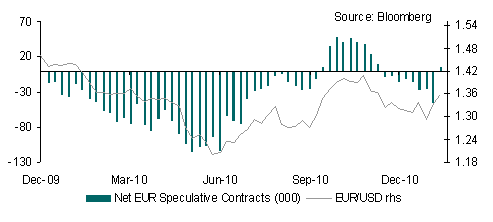
The deterioration in sentiment for the EUR has been rapid as reflected in the CFTC IMM data, with net long speculative positions now at their lowest since 15 February and heading further downhill. Conversely, USD short covering has been significant though there is still a hefty USD short overhang, which points to more USD short covering as EUR sentiment sours.

Nonetheless, the USD still has plenty of risks hanging over it including the fact that it still suffers from an adverse yield differential (note that 2-year Treasury yields have fallen to the lowest since 6 December 2010). Safe haven currencies in particular CHF are the key beneficiaries and notably EUR/CHF touched a record low around 1.2354 and is showing little sign of any rebound.
Euro resilient but for how long?

The resilience of the EUR to bad news has been impressive but is unlikely to persist. The recent negatives include 1) the rejection of the Portuguese government’s austerity plan and the increased likelihood of a bailout, 2) a likely delay in the decision on increasing the size and scope of the EFSF EU bailout fund, 3) a drop in Eurozone purchasing managers indices in March, 4) downgrades to Portugal’ sovereign credit ratings by Fitch last night and S&P and 5) Moodys downgrades of 30 Spanish banks. Despite all of this, and after hitting a low of around EUR/USD 1.4054, EUR has bounced back close to the 1.4200 level.

Further direction will come from the outcome of the EU leaders’ summit today and the March German IFO business confidence survey. For the former there is unlikely to be a decisive result, with the optimism following the informal March 11 leaders’ summit likely to give way to delay due to wrangling over details. For the latter, a slight moderation in the IFO is expected following February’s upside surprise. However, there is a bigger risk of a downside surprise following the softer than forecast March German manufacturing PMI released. Against this background, EUR/USD is likely to struggle to break resistance around 1.249.

In general FX markets look somewhat more stable and even the pressure on the USD appears to have abated slightly despite a much weaker than expected outcome for US February durable goods orders yesterday, which revealed a drop in both headline and ex-transportation orders. My composite FX volatility measure has dropped sharply over recent days, led by short term implied JPY volatility which has dropped close to pre-crisis levels. Lower volatility has also likely reduced the prospects of further FX intervention although USD/JPY 80 will continue to be well defended.

Lower volatility as also reflected in the sharp drop in the VIX index has corresponded with a general easing in risk aversion as both Middle East and Japan tensions have eased slightly. US data today are unlikely to offer much direction, with a slight upward revision to US Q4 GDP and an unchanged outcome for the final reading of Michigan consumer confidence expected.

Euro Sentiment Jumps, USD Sentiment Dives

The bounce in the EUR against a broad range of currencies as well as a shift in speculative positioning highlights a sharp improvement in eurozone sentiment. Indeed, the CFTC IMM data reveals that net speculative positioning has turned positive for the first time since mid-November. A rise in the German IFO business confidence survey last week, reasonable success in peripheral bond auctions (albeit at unsustainable yields), hawkish ECB comments and talk of more German support for eurozone peripheral countries, have helped.

A big driver for EUR at present appears to be interest rate differentials. In the wake of recent commentary from Eurozone Central Bank (ECB) President Trichet following the last ECB meeting there has been a sharp move in interest rate differentials between the US and eurozone. This week’s European data releases are unlikely to reverse this move, with firm readings from the flash eurozone country purchasing managers indices (PMI) today and January eurozone economic sentiment gauges expected.

Two big events will dictate US market activity alongside more Q4 earnings reports. President Obama’s State of The Union address is likely to pay particular attention on the US budget outlook. Although the recent fiscal agreement to extend the Bush era tax cuts is positive for the path of the economy this year the lack of a medium to long term solution to an expanding budget deficit could come back to haunt the USD and US bonds.

The Fed FOMC meeting on Wednesday will likely keep markets treading water over the early part of the week. The Fed will maintain its commitment to its $600 billion asset purchase program. Although there is plenty of debate about the effectiveness of QE2 the program is set to be fully implemented by the end of Q2 2011. The FOMC statement will likely note some improvement in the economy whilst retaining a cautious tone. Markets will also be able to gauge the effects of the rotation of FOMC members, with new member Plosser possibly another dissenter.

These events will likely overshadow US data releases including Q4 real GDP, Jan consumer confidence, new home sales, and durable goods orders. GDP is likely to have accelerated in Q4, confidence is set to have improved, but at a low level, housing market activity will remain burdened by high inventories and durable goods orders will be boosted by transport orders. Overall, the encouraging tone of US data will likely continue but markets will also keep one eye on earnings. Unfortunately for the USD, firm US data are being overshadowed by rising inflation concerns elsewhere.

Against the background of intensifying inflation tensions several rate decisions this week will be of interest including the RBNZ in New Zealand, Norges Bank in Norway and the Bank of Japan. All three are likely to keep policy rates on hold. There will also be plenty of attention on the Bank of England (BoE) MPC minutes to determine their reaction to rising inflation pressures, with a slightly more hawkish voting pattern likely as MPC member Posen could have dropped his call for more quantitative easing (QE). There will also be more clues to RBA policy, with the release of Q4 inflation data tomorrow.

Both the EUR and GBP have benefitted from a widening in interest rate futures differentials. In contrast USD sentiment has clearly deteriorated over recent weeks as highlighted in the shift in IMM positioning, with net short positions increasing sharply. It is difficult to see this trend reversing over the short-term, especially as the Fed will likely maintain its dovish stance at its FOMC meeting this week. This suggests that the USD will remain on the back foot.

The Week Ahead

As markets make the last strides towards year end it appears that currencies at least are becoming increasingly resigned to trading in ranges. Even the beleaguered EUR has not traded far from the 1.3200 level despite significant bond market gyrations. Even news that inflation in China came in well above expectations in November (5.1% YoY) and increased prospects of a rate hike is likely to prompt a limited reaction from a lethargic market.

At the tail end of last week US data provided further support to the growing pool of evidence indicating strengthening US economic conditions, with the trade deficit surprisingly narrowing in October, a fact that will add to Q4 GDP growth, whilst the Michigan measure of consumer confidence registered a bigger than expected increase in November to its highest level since June.

The jump in consumer confidence bodes well for retail spending and highlights the prospects that US November retail sales tomorrow are set to reveal solid gains both headline and ex-autos sales driven by sales and promotions over the holiday season. Other data too, will paint an encouraging picture, with November industrial production (Wed) set to reveal a healthy gain helped by a bounce in utility output. Manufacturing surveys will be mixed with a rebound in the Empire manufacturing survey in December likely but in contrast a drop in the Philly Fed expected.

The main event this week is the FOMC decision tomorrow the Fed is expected to deliver few surprises. The Fed funds rate is expected to remain “exceptionally low for an extended period”. Despite some recent encouraging data recovery remains slow and the fact that core inflation continues to decelerate (CPI inflation data on Wednesday is set to reveal a benign outcome with core CPI at 0.6%) whilst the unemployment rate has moved higher means that the Fed is no rush to alter policy including its commitment to buy $600 billion in Treasuries including $105 billion between now and January 11.

In Europe there are also some key releases that will garner plenty of attention including the December German ZEW and IFO investor and manufacturing confidence surveys and flash purchasing managers indices (PMI) readings. The data are set to remain reasonably healthy and may keep market attention from straying to ongoing problems in the eurozone periphery but this will prove temporary at least until the markets are convinced that European Union leaders are shifting away from “piecemeal” solutions to ending the crisis. The EU leaders’ summit at the end of the week will be important in this respect. A Spanish debt auction on Thursday will also be in focus.

Assuming the forecasts for US data prove correct it is likely that US bond markets will remain under pressure unless the Fed says something that fuels a further decline in yield such as highlighting prospects for more quantitative easing (QE). However, following the tax compromise agreement last week this seems unlikely. Higher relative US bond yields will keep the USD supported, and as I have previously noted, the most sensitive currencies will be the AUD, EUR and JPY, all of which are likely to remain under varying degrees of downward pressure in the short term. The AUD will also be particularly sensitive to prospects of further Chinese monetary tightening.

Double-dip fears pressure USD

Markets have found it hard to decide whether to sell the USD due to weaker economic data or buy it on higher risk aversion, but the moves overnight were clear; the USD sold off sharply in the wake of a run of soft data releases. Four separate US releases came in below consensus yesterday, with the June ISM, jobless claims, pending home sales and domestic vehicle sales, all disappointed to varying degrees, especially pending home sales, which dropped an astonishing 30% in June.

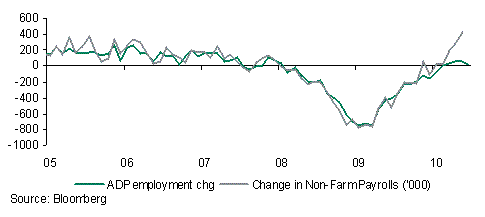
The news could have been much worse today, with the release of the US June jobs report. Following the 13k increase in the June ADP employment count the consensus forecast for nonfarm payrolls looked way too optimistic; consensus expectations were for a 130k drop in payrolls according to Bloomberg, with estimates ranging from 0 to -250k. In the event payrolls dropped by 125k and the unemployment dropped to 9.5%, an outcome that was not as bad as feared.

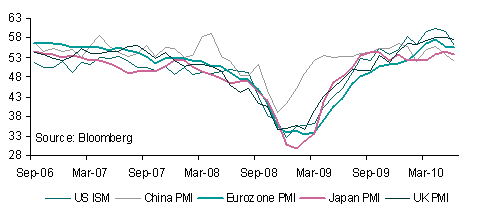
It was not just the US ISM that slipped, but a host of global purchasing managers indices (PMIs) weakened in June including China and India, supporting the view that economic activity will lose momentum in H2 2010. Before we all get too carried away it is worth noting that most manufacturing surveys are coming off a high level.

Nonetheless, for once it wasn’t European concerns that sparked an increase in risk aversion as eurozone banks borrowed less than feared from the ECB, and the Spanish bond tender passed off relatively well, factors that helped EUR/USD jump above 1.25000. Although I remain bearish on the prospects for the EUR over coming months, there may be some further near term upside, with EUR/USD 1.2675, the next resistance level in focus.

As a consequence of US double-dip fears, risk aversion remains at a high level, with US bond yields and commodity prices dropping sharply, leaving commodity currencies sharply lower. In the current environment the USD is likely to be sold on rallies.

On the commodity currency front, AUD/USD may find some relief from the news of a compromise on a proposed mining tax, but the weight of risk aversion will limit any rebound, with my preference to play AUD upside versus NZD. The main concession from Australian Prime Minister Gillard reduce was to reduce the tax to 30% for iron and coal, whilst retaining the 40% tax for oil and gas projects. The agreement likely increases the chance of an election in Australia in the next couple of months as Gillard capitalises on a popularity bounce. Fresh elections could be another factor that limits AUD upside over coming weeks.