Euro vulnerable to event risk

The USD is benefitting in the current environment of elevated risk aversion reflected in a jump in USD speculative positioning over recent weeks, with current IMM positioning currently at its highest since June 2010.

Admittedly there is still plenty of scope for risk aversion to intensify but what does this mean for the USD? The USD index is currently trading just over 78 but during the height of the financial crisis it rose to around 89, a further gain from current levels of around of around 14%.

The main obstacle to further USD strength in the event of the current crisis intensifying is if the Fed implements QE3 but as the Fed has indicated this is unlikely to happen anytime soon, as “Operation Twist” gets underway.

Now that the Fed FOMC meeting is out of the way markets will also be less wary of buying USDs as the prospect of more QE has diminished for now. Data this week will likely be USD supportive too, with increases in consumer confidence, durable goods orders, an upward revision to Q2 GDP expected.

The EUR remains highly vulnerable to event risk this week. Various votes in eurozone countries to approve changes to the EFSF bailout fund will garner most attention in FX markets, with the German vote of particular interest although this should pass at the cost of opposition from within Chancellor Merkel’s own party.

The EUR may garner some support if there is some traction on reports of a three pronged approach to help solve the crisis which includes ‘leveraging’ the EFSF fund, large scale European bank recapitalisation and a managed default in Greece, but there has been no confirmation of such measures.

Meanwhile, the potential for negotiations between the Troika (EC, IMF, ECB) and the Greek government to deliver an agreement on the next loan tranche for the country has increased, which could also offer the EUR a boost this week, albeit a short lived one.

Speculation of a potential European Central Bank (ECB) rate cut has increased a factor that could undermine the EUR depending on whether markets see it as growth positive and thus EUR positive or as a factor that reduced the EUR’s yield attraction. There is also more speculation that the ECB will offer more liquidity in the form of a 1-year operation but once again there has been no confirmation.

A likely sharp drop in the German IFO survey today and weakness in business and economic confidence surveys on Thursday will support the case for a rate cut, while helping to maintain the downward pressure on the EUR.

Given the potential for rumours and events to result in sharp shifts in sentiment look for EUR/USD to remain volatile, with support seen around 1.3384 and resistance around 1.3605.
All Eyes On Jackson Hole

It’s all about Jackson Hole and ahead of the Fed symposium the USD index is likely to maintain its place in towards the middle end of its recent 73.47 – 75.12 range helped by weaker equity markets. Expectations or hopes that Fed Chairman Bernanke will announce or at least hint at a fresh round of quantitative easing have receded allowing the USD to escape further pressure. Bernanke will likely keep all options open but there are still some in the FOMC who do not want to embark on QE3.

Although the USD may be saved from a further drubbing the commitment to maintain exceptionally accommodative monetary policy through Q2 2013 has contributed to a relative reduction in US bond yields and in turn is acting to restrain the US currency. A likely revision lower to US Q2 GDP will not help the USD in this respect.

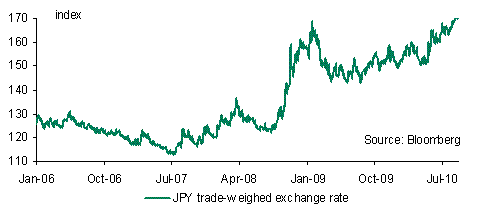
One currency in particular that is reactive to yield differentials is USD/JPY, which registers an impressively high correlation with US – Japan yield differentials. Attempts this week by the Japanese authorities to encourage capital outflows and a downgrade of Japan’s credit ratings by Moody’s have done little to weaken the JPY.

Even the usually bearish JPY Japanese margin traders have been scaling back their long USD/JPY positions over recent weeks while speculative investors remain overly long (well above the three-month average) JPY according to IMM data. The risk of a shake out of long JPY positions is high but unless yield differentials reverse renewed JPY weakening looks unlikely in the short-term.

Eurozone peripheral issues will be put on the backburner ahead of the Jackson Hole meeting but that doesn’t mean they have gone away. As the continued pressure on Greek bonds shows markets continue to be fixated on the country’s problems and there may be growing nervousness ahead of the decision to distribute the next IMF loan tranche at the end of September. Nervousness also extended to Germany, with ratings agencies having to confirm the country’s AAA rating.

So far this week EUR has shown impressive resilience despite weak data in the form the German August IFO business and ZEW investor confidence surveys. However, there is a risk of EUR weakness should Bernanke not hint at QE3, with the currency already trading around the bottom of its multi-day range.

AUD has failed to recoup its end July losses and is still some 5% below its high above 1.10 versus USD. There is scope for some AUD appreciation especially as AUD speculative positioning has dropped sharply over recent weeks reducing sharply the net long overhang in the currency.

Moreover, markets have become overly aggressive in pricing in interest rate cuts in Australia and as evidenced from the AUD bounce following RBA Governor Stevens comments this morning (in which he referred to inflation data as still being concerning) there is an asymmetric risk to the AUD on the upside.

Nonetheless, AUD has experienced an increase in sensitivity to risk over recent weeks and will continue to be driven by gyrations in risk appetite. In this respect it is too early to assume the worst is over, suggesting that any further gains in AUD will be limited.

CHF and JPY remain on top

It’s been a tumultuous few week for global markets. First a debt deal in Europe and then a debt ceiling agreement in the US. In both cases any boost to sentiment has and will be limited. Europe’s debt deal, while comprehensive, left quite a few questions in terms of implementation, scope and mutual country agreements.

In the US the deal to raise the US debt ceiling by $1.2 trillion hammered out between Republican and Democrat party leaders helps to stave off a debt default but is far smaller and less comprehensive in terms of deficit reduction measures than had been hoped for and may still be insufficient to prevent a credit ratings downgrade by S&P and/or more ratings agencies. The deal will prove a disappointment to USD bulls.

Markets in the US have failed to find much to rally them despite the debt deal. Indeed, all that has happened is that attention has shifted back towards economic growth worries in the wake of a disappointing ISM manufacturing index in the US (50.9 in July, a reading which is just about in expansion territory) which follows on from a run of soft data in the US including the Q2 GDP report. Unfortunately data elsewhere is no better as a series of weak manufacturing surveys have highlighted this week.

Weak data and the US debt deal have pushed Treasury yields lower but despite this the USD has rallied, especially against the EUR, which is not only suffering from renewed peripheral debt concerns and weaker growth, but also from a run of disappointing earnings releases in contrast to the US where earnings have on the whole beaten forecasts. The USD may have benefited from a renewed increase in risk aversion and in this respect further US equity weakness may provide the USD with further support.

Whether EUR/USD will extend its recent losses is doubtful, however. Much will depend on Friday’s US July jobs report and if there is another weak outcome as looks likely, speculation of another round of Fed asset purchases could dent USD sentiment. The currencies that remain on top in this environment are the CHF and to a lesser extent the JPY much to the chagrin of the Swiss and Japanese authorities

US Dollar Tensions

There was considerable relief, most acutely in the US administration, that the US August jobs report revealed a better than expected outcome. To recap, private sector payrolls increased by 67k vs. an upwardly revised 107k in July whilst total non farm payrolls dropped 54k. The data sets the market up for a positive start to the week in terms of risk appetite despite Friday’s drop in the August US non-manufacturing ISM index, deflating some of the market’s upbeat mood.

Once again I wonder how long positive sentiment can be sustained with so many doubts about recovery prospects and limited ammunition on the fiscal front as well as some reluctance on the monetary front, to provide further stimulus should a double dip become a reality.

Markets will be treated to several major central bank decisions including from the Bank of Japan, Bank of England, Bank of Canada and Reserve Bank of Australia this week. These meetings are set to prove uneventful, with unchanged decisions across the board expected although the Bank of Canada decision is a tough call.

The main US release this week is the Fed’s Beige Book on Wednesday, a report which will help the Fed to prepare for the FOMC meeting on September 21. The evidence contained within it is unlikely to be positive reading, with consumer spending set to be relatively soft and evidence of recovery likely to remain patchy.

On Thursday the US July trade deficit is set to reveal some narrowing and as usual the deficit with China will be of interest given the renewed tensions over FX policy. FX tension seems to be intensifying once again due to the relatively slow pace of CNY appreciation since the June de-pegging as well as political posturing ahead of November US mid-term elections. A deterioration in US trade data, a factor that largely contributed to the soft Q2 GDP outcome in contrast to a strengthening in China’s trade surplus will have added fuel to the fire.

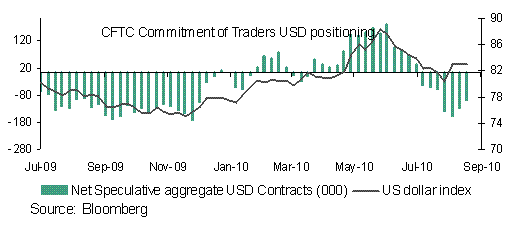
The firmer risk backdrop has put the USD on the back foot, with the USD index dropping sharply overnight. Nonetheless, speculative USD positioning as reflected in the CFTC IMM data reveals further short covering up to the end of August, implying USD speculative sentiment is actually turning less negative.

Another country which has a different sort of tension regarding the USD is Japan. Improving risk appetite will likely prevent the JPY from visiting previous highs against the USD but will do little to reduce FX intervention speculation. Indeed, there was more jawboning over the weekend on the subject, with Japan’s finance minister Noda reiterating that Japan would take decisive action to stem the JPY’s appreciation but adding that coordinated FX intervention was a difficult option. Clearly Japan us unlikely to succeed with unilateral FX intervention.

Political events have added to the debate on FX policy as focus turns to the election for leader of the ruling DPJ party next week, with a battle looming between current Prime Minister Kan and challenger Ozawa. Although Ozawa is unpopular with the electorate he yields plenty of political power, and appea rs to be more inclined towards FX intervention. Having failed to sustain a move above 85.00 the pull back in USD/JPY suggests little appetite to extend gains, likely leaving USD/JPY in a relatively tight range, with strong support around 83.55 and resistance around 85.23.

Bernanke Boost

Last week ended with a downward revision to US Q2 GDP. The data clarified that growth momentum going into Q3 was indeed quite weak though it probably didn’t take the GDP revision to tell us this nugget of information, something that has been evident from the run of weak data over recent months.

Softer growth in Q2 placed particular attention on the Jackson Hole speech by Fed Chairman Bernanke in which he acknowledged the slowing in the pace of growth, but also forecast a moderate economic recovery in H2 2010. Importantly if the Fed is proven wrong he noted the FOMC would undertake unconventional (quantitative easing) QE II measures if needed.

The net impact on Bernanke’s speech and the smaller than expected downward revision to US Q2 GDP was to provide a boost to risk appetite. Sentiment will at least begin this week on a positive note in the knowledge that the Fed stands ready to act although double dip fears are far from over.

One trigger for Fed action will be a further deterioration in job market conditions and markets will pay close attention to the August US jobs report at the end of the week. Bloomberg consensus estimates forecast a 100 drop in payrolls, with private payrolls up 47k and the unemployment rate edging higher to 9.6%. Such an outcome would do little to boost confidence in a jobs market recovery.

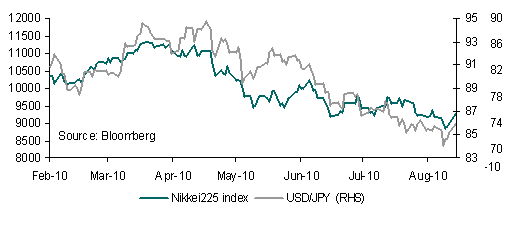
The week begins with all eyes on Japan however, with an emergency Bank of Japan (BoJ) meeting in focus. USD/JPY has already jumped higher on the belief that concrete action will emerge to weaken the JPY. The risk of disappointment is high and at most the BoJ will announce measures to extend loans to banks. A lack of other action especially in the form of FX intervention alongside a likely increase in risk aversion once the Bernanke bounce wares off, will result in a renewed USD/JPY move lower, with a breach of 85.00 likely. As seen in the chart below a decisive turn in the Japanese stocks will be a key factor in helping to eventually drive USD/JPY higher.

Two other central bank meetings of note this week are the European Central Bank (ECB) and Sweden’s Riksbank meetings on Thursday. No change in policy by the ECB will be of little surprise but the release of new staff projections, with growth likely to be revised up in 2010 but left unchanged for 2011, will be of interest. Developments regarding open market operations will also be of attention. In contrast, the Riksbank is widely expected to hike rates by 25bps on the back of a firming economy and house price inflation.

A UK holiday today will likely keep liquidity thin and as noted above risk currencies including AUD, NZD and CAD as well as Asian currencies will start the week firmer but will struggle to hold gains as the week progresses. EUR/USD has benefited little from improved risk appetite and will have a hard time this week making much any headway although potential EUR/CHF buying from the SNB may give some, albeit limited support.

A renewed downside move to support around EUR/USD 1.2455 remains on the cards in the short term. Overall USD sentiment has become less negative as reflected in the CFTC IMM positioning data in contrast to a renewed deterioration in EUR speculative sentiment. We look for more of the same.