Awaiting US jobs data

The USD continues to languish as market hopes/expectations of further US Federal Reserve stimulus including possibly more quantitative easing or QE3 weigh on the currency. There may also be some hesitation to buy USDs ahead of tomorrow’s August jobs report. The omens from the US ADP jobs data yesterday were not particularly positive, with a below consensus 91k private jobs reported.

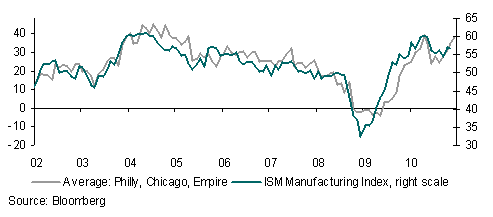
As the Fed FOMC minutes earlier this week highlighted there are a few in the FOMC who are prepared to take more aggressive action which would equate to an even weaker USD. Ahead of the jobs data today’s August ISM manufacturing survey will offer some direction for markets but if our forecast of a sub 50 outcome proves correct it will only play into expectations of more Fed stimulus leaving the USD on the back foot.

EUR/USD struggled to sustain any move above 1.45 this week but has continued to withstand various peripheral bond concerns without too much difficulty, an ability it has managed to maintain for the past several months. Although it has pulled back EUR/USD may struggle to sustain a drop below its 100-day moving average at 1.4362.

Although there have been various fresh worries over recent days such as the collateral issues between Greece and Finland as well as well as questions about German demands for Greece’s bailout, the EUR is likely to remain unperturbed. Whether the EUR will be able to withstand growing evidence of slowing growth in the eurozone is another question altogether, especially as it is leading to a reassessment of European Central Bank (ECB) policy expectations, something that will likely be confirmed at next week’s ECB meeting.

GBP has had problems of its own to deal with and has failed to capitalise on any USD tone while losing ground against the EUR. Data yesterday did not help, with consumer sentiment falling for a third straight month according to the GfK confidence index. It appears that speculation of further Fed monetary stimulus may also be rubbing off on GBP, with potential for more UK QE likely to act as a weight on the currency.

Bank of England MPC member Posen added fuel to the fire in comments that he made supporting the need for central banks to undertake more QE. GBP looks destined for more weakness in the short term, with support around GBP/USD likely 1.6111 likely to be tested. A below 50 reading for the August manufacturing PMI today, will only add to downside pressure.
USD weaker, EUR resilient, JPY supported, CHF pressure

Why has the USD come under pressure even after Fed Chairman Bernanke failed to signal more QE? The answer is that Bernanke offered hope of more stimulus and gave a shot in the arm to risk trades even if QE3 was not on the cards. Consequently the USD has looked vulnerable at the turn of this week but we suspect that a likely batch of soft US data releases over coming days including the August jobs report at the end of the week, ISM manufacturing survey on Thursday and consumer confidence today, will erase some of the market’s optimism and leave the USD in better position. The FOMC minutes today may also give some further guidance to the USD as more details emerge on the potential tools the Fed has up its sleeve.

The EUR’s ability to retain a firm tone despite the intensification of bad news in the eurozone has been impressive. Uncertainty on various fronts in Germany including but not limited to concerns about the outcome of the German Bundestag vote on the revamped EFSF on September 30, German commitment to Greece’s bailout plan and German opposition party proposals for changes to bailout terms including the possibility of exiting the eurozone, have so far gone unnoticed by EUR/USD as it easily broke above 1.4500. EUR was given some support from news of a merger between Greece’s second and third largest banks. Likely weak economic data today in the form of August eurozone sentiment surveys may bring a dose of reality back to FX markets, however.

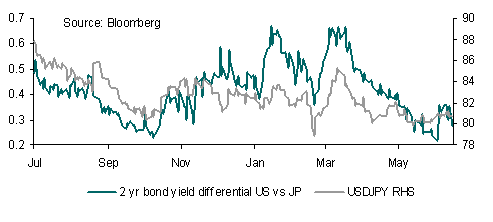
The lack of reaction of the JPY to the news that Japan’s former Finance Minister Noda won the DPJ leadership and will become the country’s new Prime Minister came as no surprise. The JPY has become somewhat used to Japan’s many political gyrations over recent years and while Noda is seen as somewhat of a fiscal hawk his victory is unlikely to have any implications for JPY policy. Instead the JPY‘s direction against both the USD and EUR continues to be driven by relative yield and in this respect the JPY is likely to remain firmly supported. Both US and European 2-year differentials versus Japan are at historic lows, with the US yield advantage close to disappearing completely. Until this picture changes USD/JPY is set to languish around current levels below 77.00.

EUR/CHF has rebounded smartly over recent weeks, the latest bounce following speculation of a fee on CHF cash balances, with the currency pair reaching a high of 1.1972 overnight. The pressure to weaken the CHF has become all the more acute following the much bigger than anticipated drop in the August KOF Swiss leading indicator last week and its implications for weaker Swiss growth ahead. The ‘risk on’ tone to markets following Bernanke’s speech has provided a helping hand to the Swiss authorities as safe haven demand for CHF lessens but given the likely weak slate of economic releases this week his speech may be soon forgotten. Nonetheless, the momentum remains for more EUR/CHF upside in the short term, at least until risk aversion rears its head again.

Which is the ugliest currency?

The contest of the uglies has once again been set in motion in FX markets as last Friday’s weak US jobs report, which revealed a paltry 18k increase in June payrolls, downward revisions to past months and a rise in the unemployment rate, actually left the USD unperturbed. Europe’s problems outweighed the negative impact of more signs of a weak US economy, leaving the EUR as a bigger loser.

The USD’s resilience was even more impressive considering the drop in US bond yields in the wake of the data. However, news over the weekend that talks over the US budget deficit and debt ceiling broke down as Republicans pulled out of discussions, will leave USD bulls with a sour taste in their mouth.

Should weak jobs recovery dent enthusiasm for the USD? To the extent that it may raise expectations of the need for more Fed asset purchases, it may prove to be an obstacle for the USD. However, there is sufficient reason to look for a rebound in growth in H2 2011 while in any case the Fed has set the hurdle at a high level for more quantitative easing (QE).

Fed Chairman Bernanke’s reaction and outlook will be gleaned from his semi-annual testimony before the House (Wed) although he will likely stick to the script in terms of US recovery hopes for H2. This ought to leave the USD with little to worry about. There will be plenty of other data releases this week to chew on including trade data, retail sales, CPI and PPI inflation and consumer confidence as well as the kick off to the Q2 earnings season.

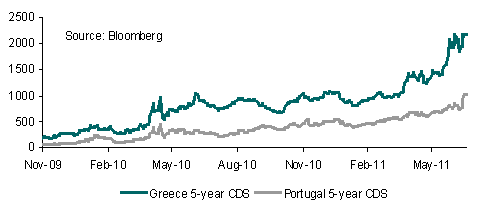
Fresh concerns in Europe, this time with contagion spreading to Italy left the EUR in bad shape and unable to capitalise on the soft US jobs report. In Italy high debt levels, weak growth, political friction and banking concerns are acting in unison. The fact that there is unlikely to be a final agreement on second Greek bailout package at today’s Eurogroup meeting will act as a further weight on the EUR.

Discussions over debt roll over plans, the role of the private sector and the stance of ratings agencies will likely drag on, suggesting that the EUR will not find any support over coming days and will more likely lose more ground as the week progresses. If these issues were not sufficiently worrisome, the release of EU wide bank stress tests on Friday will fuel more nervousness. Against this background EUR/USD looks vulnerable to a drop to technical support around 1.4102.

The Bank of Japan is the only major central bank to decide on interest rates this week but an expected unchanged policy decision tomorrow is unlikely to lead to any JPY reaction. In fact there appears to be little to move the JPY out of its current tight range at present. USD/JPY continues to be the most correlated currency pair with 2-year bond yield differentials and the fact that the US yield advantage has dropped relative to Japan has led to USD/JPY once again losing the 81.0 handle.

However, as reflected in the CFTC IMM data the speculative market is still holding a sizeable long position in JPY, which could result in a sharp drop in the currency should US yields shift relatively higher, as we expect over coming months. In the short-term USD/JPY is likely to be well supported around 80.01.

All Eyes On US Jobs Data

Happy New Year!

2010 ended on a sour note especially for eurozone equity markets (and the Australian cricket team) where there has yet to be a resolution to ongoing growth/fiscal/debt tensions.  The EUR strengthened into year end but this looked more like position adjustment than a shift in sentiment and EUR/USD is likely to face stiff resistance around the 1.3500 level this week, with a drop back towards 1.3000 more likely.  In the US there was some disappointment in the form of a surprise drop in December consumer confidence data but pending home sales and the Chicago PMI beat expectations, with the overall tone of US data remaining positive.

There will be plenty to chew on this week in terms of data and events which will provide some much needed direction at the beginning of the year.  The main event is the December US jobs report at the end of the week.   Ahead of this there will be clues from various other job market indicators including the Challenger jobs survey, ADP employment report, and the ISM manufacturing and non-manufacturing surveys.  The data will reflect a modest improvement in job market conditions and the preliminary forecast for December payrolls is for a 135k increase, with private payrolls set to rise by 145k and the unemployment rate likely to fall slightly to 9.7%.

The minutes of the 14 December Fed FOMC meeting (Tue) will also come under scrutiny against the background of rising US bond yields.  In addition, Fed Chairman Bernanke will speak on the monetary and fiscal outlook as well as the US economy to the Senate Budget Panel.   Bernanke will once again defend the use of quantitative easing whilst keeping his options open to extend it if needed.  However, the changing composition of the FOMC with four new members added in 2011 suggests a more hawkish tinge, which will likely make it more difficult to agree on further QE.   In any case, the tax/payroll holiday package agreed by the US administration means that more QE will not be necessary. 

It’s probably not the most auspicious time for new member Estonia to be joining the eurozone especially as much of the speculation last year focussed on a potential break up.  The beginning of the year will likely see ongoing attention on the tribulations of Ireland after its bailout, with looming elections in the country.  Portugal and Spain will also remain in focus as the “two-speed” recovery in 2011 takes shape.  Data releases this week include monetary data in the form of the eurozone December CPI estimate and M3 money supply.  Inflation will tick up to 2% but this ought to be of little concern for the ECB.  Final PMI data and confidence indices will likely paint a picture of slight moderation.   

The USD ended the year on a soft note, with year lows against the CHF and multi year lows vs. AUD registered, but its weakness is unlikely to extend much further.  The key driver will remain relative bond yields and on this front given the prospects for relative US yields to move higher, the USD will likely gain support.  There maybe a soft spot for the USD in Q1 2011 but for most of the rest of the year the USD is set to strengthen especially against the EUR which will increasingly comer under pressure as peripheral tensions and growth divergence weigh on the currency.

The Week Ahead

As markets make the last strides towards year end it appears that currencies at least are becoming increasingly resigned to trading in ranges. Even the beleaguered EUR has not traded far from the 1.3200 level despite significant bond market gyrations. Even news that inflation in China came in well above expectations in November (5.1% YoY) and increased prospects of a rate hike is likely to prompt a limited reaction from a lethargic market.

At the tail end of last week US data provided further support to the growing pool of evidence indicating strengthening US economic conditions, with the trade deficit surprisingly narrowing in October, a fact that will add to Q4 GDP growth, whilst the Michigan measure of consumer confidence registered a bigger than expected increase in November to its highest level since June.

The jump in consumer confidence bodes well for retail spending and highlights the prospects that US November retail sales tomorrow are set to reveal solid gains both headline and ex-autos sales driven by sales and promotions over the holiday season. Other data too, will paint an encouraging picture, with November industrial production (Wed) set to reveal a healthy gain helped by a bounce in utility output. Manufacturing surveys will be mixed with a rebound in the Empire manufacturing survey in December likely but in contrast a drop in the Philly Fed expected.

The main event this week is the FOMC decision tomorrow the Fed is expected to deliver few surprises. The Fed funds rate is expected to remain “exceptionally low for an extended period”. Despite some recent encouraging data recovery remains slow and the fact that core inflation continues to decelerate (CPI inflation data on Wednesday is set to reveal a benign outcome with core CPI at 0.6%) whilst the unemployment rate has moved higher means that the Fed is no rush to alter policy including its commitment to buy $600 billion in Treasuries including $105 billion between now and January 11.

In Europe there are also some key releases that will garner plenty of attention including the December German ZEW and IFO investor and manufacturing confidence surveys and flash purchasing managers indices (PMI) readings. The data are set to remain reasonably healthy and may keep market attention from straying to ongoing problems in the eurozone periphery but this will prove temporary at least until the markets are convinced that European Union leaders are shifting away from “piecemeal” solutions to ending the crisis. The EU leaders’ summit at the end of the week will be important in this respect. A Spanish debt auction on Thursday will also be in focus.

Assuming the forecasts for US data prove correct it is likely that US bond markets will remain under pressure unless the Fed says something that fuels a further decline in yield such as highlighting prospects for more quantitative easing (QE). However, following the tax compromise agreement last week this seems unlikely. Higher relative US bond yields will keep the USD supported, and as I have previously noted, the most sensitive currencies will be the AUD, EUR and JPY, all of which are likely to remain under varying degrees of downward pressure in the short term. The AUD will also be particularly sensitive to prospects of further Chinese monetary tightening.