US payrolls clues

Most investors will be glad to see the back of August, a month that marked the biggest monthly decline in US stocks in nine years. The main imponderable is whether September will be any better. A series of manufacturing surveys globally today will do little to restore confidence although there was some good news in a slight increase in China’s official August purchasing managers index (PMI) as well a stronger than forecast increase in Australian Q2 GDP, which will likely provide some short-term relief for risk trades.

There was also some slight solace for markets in terms of US data at least from the point of view that the data was not as disappointing as many recent releases. Although the August Chicago PMI slipped (to 56.7) consumer confidence increased (to 53.5) though admittedly confidence remains at a relatively low level. The job market situation detailed within the consumer confidence report was more pessimistic in August than the previous month, however, with those reporting jobs hard to get moving higher. This sends a negative signal for Friday’s payrolls data.

There will be more clues to Friday’s US jobs report today which will enable any fine tuning of forecasts to take place in the wake of the August ADP employment report and ISM manufacturing survey. Consensus forecasts centre on a 15k increase in private jobs. Despite the slight increase in the Empire manufacturing survey in August, the falls in other manufacturing surveys point to some downside risks to the ISM today, with a simple average of the three pointing to the ISM closer to the 50 mark, which will highlight a loss in US manufacturing momentum.
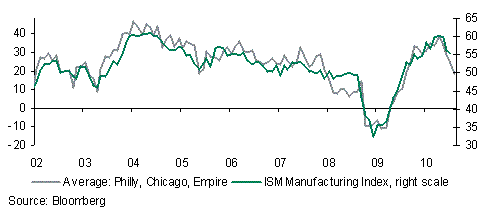
Manufacturing surveys elsewhere will also be in focus, with the final PMI readings scheduled to be released for the eurozone and UK. There is likely to be confirmation of the slight drop in the eurozone PMI to 55.0 in August while the UK PMI is likely to drop to around 57.0 over the month. Both surveys remain at a relatively high level but it is clear that activity is moderating in H2 2010 from a healthy level in H2. The data will give little support to the EUR but the currency has found a degree of stability over the last couple of days. Nonetheless, a further downward move is in prospect.

The Fed FOMC minutes provided little for markets to get excited about. The minutes noted concerns about large scale asset purchases from some Fed officials, indicating resilience to increasing quantitative easing despite acknowledging increased downside risks to the growth and inflation outlook. It is unclear exactly what will be the trigger for further QE as acknowledged by Fed Chairman Bernanke last week.

The minutes will do little to help market confidence given the hesitancy to pursue further QE and provide further stimulus to the economy but the USD is likely to benefit from the fact that the Fed may not be as eager to expand its balance sheet further. Other currencies that remain beneficiaries in the current risk averse environment are the JPY and CHF. The JPY may find further upside more difficult given ongoing intervention fears but the trend remains for a lower USD/JPY in the coming weeks.

EUR strength is overdone

The latest in a long line of disappointing US data was released on Friday. University of Michigan consumer confidence sent an alarming signal about the propensity of the US consumer to contribute to economic recovery. Confidence dropped much more than expected, to its lowest level since August 2009, fuelling yet more angst about a double-dip in growth.

The Fed’s relatively dovish FOMC minutes last week contributed to the malaise and undermined the USD in the process as attention switched from the timing of exit strategies to whether the Fed will expand quantitative easing. Friday’s benign June CPI report left no doubt that the Fed has plenty of room on its hands, with core inflation remaining below 1% and likely to decelerate further over the coming months. Against this background Fed Chairman Bernanke’s semi-annual testimony to the US Congress (Wed/Thu) will be a particular focus, especially if he hints at potential for further QE, a possibility that appears remote, but could harm the USD.

Arguably the biggest event of the week is the European bank stress test results on Friday. Although several European governments have suggested that the banks in their countries will pass the tests there is still a considerable event risk surrounding the announcement. 91 banks are being tested and much will depend on how rigorous the tests are perceived to be. Should they be seen not to be sufficiently thorough, for instance in determining a realistic haircut on sovereign debt holdings, the potential for pressure on the EUR to increase once again will be high. Similarly debt auctions across Europe this week will also garner interest but similar success to last week’s Spanish auction cannot be guaranteed.

The big question in FX markets is whether the EUR can hold onto its recent gains and whether the USD will be punished further amidst growing double-dip worries. Interestingly the USD’s reaction on Friday to the soft consumer confidence data was not as negative as has been the case recently, with higher risk aversion once again outweighing negative cyclical influences. Various risk currencies actually came under pressure against the USD and this is likely to extend into this week. Despite a threat to the USD from any QE hints by Bernanke, speculative positioning has turned net short USD once again suggesting potential for less USD selling.

The bigger risk this week is to the EUR, which could face pressure on any disappointment from the bank stress test results. The EUR was strong against most major currencies last week, suggesting that the strengthening in EUR/USD is less to do with USD weakness, but more related to EUR strength. This strength in the EUR is hard to tally with the worsening economic outlook in the eurozone and the fact that a stronger EUR from an already overvalued level will crimp eurozone growth further. The latest CFTC IMM data has revealed a further covering of short positions, but this is likely to be close to running its course. Technically EUR/USD has broken above its ‘thick’ Ichimoku cloud, and the weekly MACD is turning above its signal line from oversold levels suggesting a period of further strength but its gains are set to be short-lived.

AUD and NZD outperformance

Just as the euro looked as though it was showing some signs of rebounding following the battering it received in the wake of the downgrade of Greece’s credit ratings, S&P placed Spain on credit watch negative from neutral, which helped drag EUR/USD all the way down again. Expect more to come as sovereign risk concerns / fiscal deficit remain in focus. EUR/USD was helped by the usual sovereign demand, preventing a test of technical support around 1.4625 but another push lower is likely over the short term.

Despite a tough budget from Ireland yesterday, it alongside the likes of Latvia, Ireland, Hungary and Portugal will remain on the ratings agencies’ hit lists. Eurozone periphery bond spreads have widened sharply against bunds but even larger countries in Europe such as Italy have seen an increase in funding costs. Added to these concerns are the lingering uncertainties about Dubai as reflected in the continued rise in CDS.

In contrast, growth worries are receding quickly in Australia where another robust jobs report was released. Employment rose 31.2k in November, with an upward revision to the previous month, to 27.2k from 24.5k initially. The details looked good too, with much of the jobs increase coming from full time hires (30.8k). The jobless rate fell to 5.7% compared to 5.8% in October. Taken together with the hawkish slant to the RBNZ statement, the data will help keep the AUD and NZD resilient to any sell off in risk trades.

The decision by the RBNZ to leave interest rates unchanged at 2.5% came as no surprise. However, Governor Bollard did shift away from the earlier pledge not to hike interest rates until H2 10 and stated that a hike could come around the middle of 2010. The RBNZ also upgraded its growth forecasts. A rate hike could come even earlier in my view, a factor likely to keep the NZD well supported.

Markets will digest more interest rate decisions today, in the UK and Switzerland. No change is likely from both the BoE and SNB but the issue of QE will remain at the forefront, especially given the split decision by the BoE MPC at the last meeting. As for the SNB the usual concerns about CHF strength are likely to be expressed but the tone of the SNB’s comments are likely to remain dovish, expressing little urgency to begin implementing an exit strategy.

The US data slate is light but does include weekly jobless claims and October trade data. There will be more interest than usual on the claims data given the surprise in last week’s payrolls report. Claims have been on an improving trend declining at a more rapid pace than previous recessions and markets will eye the numbers to determine whether they point to further improvement in payrolls or whether they suggest the November data was merely an aberration.

US rates “low for long”

Risk appetite is failing to show much improvement this week and sharply weaker than forecast US housing data dampened sentiment further following other soft data over recent days including the Empire manufacturing survey, industrial production and retail sales less autos. The data will add to concerns about the pace and magnitude of growth in the months ahead.

A sub-par recovery and benign inflation outlook are the two main reasons why the Fed will not hike rates for a long while yet. This was echoed by St. Louis Fed President Bullard – a voting member of the FOMC – who gave a little more colour on the Fed’s “extended period” statement. He highlighted the probability that US interest rates will not be raised until the first half of 2012.

Bullard noted that following the past two recessions the Fed did not raise rates until two and half to three years after recession ended. This is accurate given that in 2001 the Fed did not begin to hike rates until around 2 ½ years after the end of the recession whilst in 1990-91 rates did not go up until close to 3 years after recession ended. This recession just passed was arguably worse than both of the past two, so why should rates rise any earlier?

One factor that could trigger an earlier rate hike is the risks from the massive global liquidity fuelled carry trade fuelled by Fed policy. Bullard highlighted that the risks of creating an asset bubble from keeping rates “too low for too long” may prompt an earlier tightening. What will be important is that the Fed gets the exit strategy right and the risk that delaying any reduction in the Fed’s balance sheet and asset purchases could turn out to be inflationary which in turn would be negative for the USD and hit confidence in US assets.

The Fed is very likely to adjust the level of quantitative easing well before contemplating raising interest rates. The market is pricing in around 50bps of rate hikes in the next 12 months but even this looks to aggressive and as has been the case of recent months the market is likely to push back the timing of expected rate hikes. The consequences for the USD are negative at least until the market becomes more aggressive in pricing in US interest rate hikes or believes the Fed is serious about its exit strategy.