Risk Aversion Back With A Vengeance

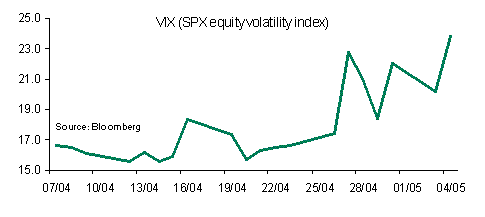
Risk aversion is back with a vengeance as reflected in the rise in equity volatility (VIX), drop in equity markets and rally in US Treasuries.  European peripheral debt markets sold off despite the EU/IMF aid package for Greece, whilst EUR/USD slid below 1.3000.  Various rumours dealt a blow to markets including talk of a sovereign ratings downgrade and a EUR 280 billion bailout for Spain.   The message is clear.  This situation is becoming increasingly dire by the day.  Europe is in big trouble and the whole euro project is under threat of unravelling.  
Concerns about parliamentary approvals, implementation/execution risk, prospects for relatively weaker growth in Europe, as well as contagion to Spain and Portugal, has tempered any enthusiasm towards the EU/IMF bailout package.  In addition, despite the large size of the EUR 110 billion loan package there are growing worries that it will be insufficient to cover Greece’s funding requirements over the next three years.  All of this implies that the EUR will remain under pressure for some time yet.  I have previously spoken about a drop to around EUR/USD 1.25 but the risk is for a much sharper decline is growing.

The USD is the clear winner, spiking to its highest level since May 2009 and is looking well set to consolidate its gains over the short-term despite the fact that net aggregate USD speculative positioning has already reached its highest level since September 2008 (according to the CFTC Commitment of Traders IMM data) in contrast to EUR positioning, which is at a record low.  This is unlikely to stand in the way of further downside for EUR/USD, with the next technical support level seen at 1.2885, which would match the previous lows see in April 2009.

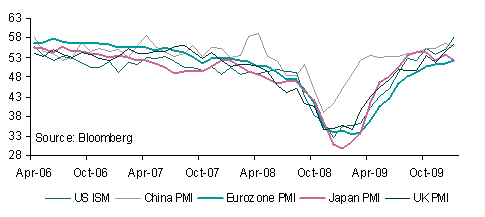
A combination of worries including contagion to Spain and Portugal, policy tightening in China, debt concerns in the UK and Japan, all threaten to undo the positive message from recent positive economic data including further strengthening in Purchasing Managers Indices globally.   The immediate attention remains on Greece and growing scepticism about the ability of Greece to carry out austerity measures in the face of rising domestic opposition, including a nationwide strike today. 
The rout in US and European markets will spill over to Asia, putting equity markets and Asian currencies under pressure.  Another risk currency to suffer is the AUD, which has dropped sharply following the Reserve Bank of Australia (RBA) meeting, in which the Bank indicated that rates were close to peaking.  Speculative positioning has dropped for the past two weeks as longs are taken off but AUD/USD weakness is set to be temporary, with buyers likely to emerge around near term support seen around 0.9001.
The Good, The Bad And The Ugly

GOOD: Positive earnings. The biggest earnings news of the day was from Goldman Sachs reporting that profits almost doubled in Q1. Apple also beat estimates and its shares surged. 82% of US earnings have beaten expectation so far. There is still a long way to go in the earnings season but the growth/earnings story is helping to maintain the positive bias to risk trades. There will be plenty of attention on earnings, including AT&T, eBay, Morgan Stanley, Starbucks, Boeing and Wells Fargo.

Data releases remain upbeat, with the April German ZEW investor confidence survey beating consensus, whilst central banks delivered hawkish messages across the board including the Reserve Bank of Australia policy meeting minutes, which pointed to another interest rate hike in May. However, the biggest impact came from the Bank of Canada which unsurprisingly left rates at 0.25%, but removed the conditional commitment to keep policy on hold until the end of Q2, leaving a rate hike on June 1 very likely.

The CAD jumped on the back of the outcome, with USD/CAD dropping below parity. I continue to like CAD alongside the AUD and NZD and believe they will be the star performers over the coming months despite lofty valuations.    Near term targets for CAD, AUD and NZD vs USD are 0.9953, 0.9407, and 0.7195, respectively. 

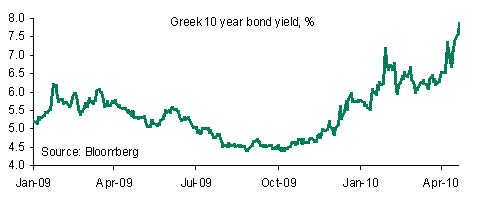
BAD: Talks between Greek officials and the IMF, ECB and EU on the conditions for a EUR 45 billion bailout loan will also be of interest although completion of talks could take weeks and in the meantime the situation is unlikely to improve, with Greece needing around EUR 10 billion to cover obligations by end May. Greek bond yields jumped to fresh record highs around 7.84% yesterday whilst the spread over German bunds also widened. Moreover, although Greece’s sale of EUR 1.95 billion in 13-week paper yesterday was heavily oversubscribed the, the yield was high at 3.65% which was far higher than the 1.67% yield at a similar sale in January.

In contrast to the likes of the CAD, AUD and NZD, the EUR is set to continue to suffer and as reflected in the widening in Greek bond spreads and high funding costs, Greek woes will keep plenty of pressure on the currency, with EUR/USD set to fall to support around 1.3300 in the short-term.

UGLY: UK regulator FSA will conduct a formal investigation of Goldman Sachs. The FSA will work closely with the US Securities and Exchange Commission SEC, which has accused the bank of Fraud though this has vehemently denied by Goldman Sachs. Although the negative market impact of the fraud case has been outweighed by good earnings and data the fallout is spreading. Some European politicians have even called for governments to stop working with the bank.

What to watch

US February non-farm payrolls released at the end of last week put the finishing touches to a week that saw risk appetite continue to improve each day. There were no big surprises from the various central bank decisions including the RBA, BoE and ECB last week though Malaysia’s central bank did surprise by hiking 25bps. The RBA’s 25bps hike was a close call but in the event the Bank delivered a 25bps hike too.

Sentiment towards Greece has improved in the wake of the announcement of fresh austerity measures by the Greek government, which provoked a short covering EUR/USD rally from around 1.3435 lows though the EUR never really showed signs of embarking on the sort of rebound the massive short EUR speculative position had suggested.

US jobs report revealed that non-farm payrolls dropped by 36k and was all the more remarkable given the potentially very negative impact of severe weather distortions to the data. The data provides the setting for a firm start to the week in terms of risk appetite which will likely put the USD under a bit of pressure into the week.

This week’s events include central bank decisions in New Zealand and Switzerland. The RBNZ has already indicated that it sees no reason to raise interest rates in H1 and an unchanged decision will come as no surprise to the market. The NZD offers better potential for appreciation than the AUD in the short term and I suspect that a “risk on” tone at least early in the week will keep the Kiwi supported.

The SNB in Switzerland is also unlikely to offer any surprises in its rate decision with an unchanged outcome likely. It appears that the Bank has take a somewhat more relaxed tone to the strength of the CHF and any comments on the currency will be scrtunised for hints of intervention.

It probably isn’t much of a shock to expect Greece to remain in the spotlight this week as markets continue to deliberate whether Greece needs financial aid and if so, whether it will be provided by EU countries such as Germany and/or France, at least in terms of some form of debt guarantee.

Further tensions within Greece, with more strikes in the pipeline will test the resolve of the government to carry through austerity measures while likely acting as a cap on any EUR upside over coming days. I still think EUR/USD 1.3789 is a tough nut to crack.

Meanwhile, GBP/USD looks like it will find it tough going to gain much traction above 1.50 with political uncertainties in the form of a likely hung parliament as well as what looks like various efforts by the BoE officials to talk GBP down, likely to prevent an real recovery.

Euro Still Vulnerable

Markets have become rather skittish, with attention gyrating between sovereign deficit/debt concerns on the one hand and better news on the corporate and economic front on the other.  This week the latter appears to be gaining the upper hand helped by an easing of concerns about Greece. Although the Greek saga is by no means close to an end, especially given the new deadlines set by the EU Commission on adherence to budget cuts, the chances of the worst case scenario of default or pull out from the EU looks to have diminished. 

Renewed attention on other EU members, especially in light of the derivatives transactions carried out by Greece and potentially by other European countries to disguise the extent of their budget problems suggests that there is still more pain ahead. Nonetheless, it is increasingly clear that investors are differentiating between Europe and the rest of the world much to the chagrin of the EUR.  

Differentiation between the eurozone and the US was particularly apparent in the wake of stronger than forecast earnings and data in the US. Two more companies joined the three-quarters of S&P 500 companies beating earnings forecasts whilst economic reports including US January industrial production and housing starts came in ahead of forecasts.  This pattern is set to continue today, with the US Philly Fed manufacturing index set to increase to around 17 in February from 15.2 in January. 

In contrast, data in Europe has been much less impressive, with for example, the February ZEW survey of investor confidence recording its 5th consecutive decline in February.  The eurozone economic news may look a little better in the form of likely increases in manufacturing Purchasing Managers Indices (PMIs) but unless the data reveals particularly strong readings the growing perception that Europe is falling behind in the recovery process will remain in place.

Despite the improvement in risk appetite the USD has taken a firmer tone, appearing to react more to positive data and implications for a reduction in policy accommodation by the Fed.  In particular, the USD was spurred by the FOMC minutes of the January 26-27 meeting, in which the Fed debated its exit strategy from quantitative easing.  Some officials even went as far as pushing for asset sales in the “near future” to reduce the size of the Fed’s balance sheet.

Even though the USD has taken a firmer tone it will continue to be buffeted by the conflicting forces of improved risk appetite and shifting interest rate expectations.  Correlations reveal that risk is still the dominant FX factor suggesting that there may still be some further downside left for the USD as risk appetite improves. 

Although commodity currencies have also come under pressure due to the generally firmer USD tone overnight, the downside in these currencies is likely to prove limited especially given strong data releases.  For example, data overnight revealed that business confidence rose to its highest level in 15 years in Australia.  Added to upbeat comments from RBA deputy governor Lowe and strong labour market data, it highlights the growing probability of a March rate hike by the RBA.

The EUR remains the weak link and although it may benefit from easing Greek concerns the growing evidence of a relatively slower economic recovery in the eurozone suggests any upside in the EUR will be limited.  Having dropped below technical support around 1.3580, EUR/USD looks vulnerable to a further push lower in the short-term.

Calming the Tiger

As markets enter the year of the Tiger a somewhat calmer tone appears to be ensuing, with risk appetite edging higher helping equities and the beleaguered EUR to recover some lost ground.  US stocks were helped by a firmer than expected reading for the Empire manufacturing survey (to 24.91 in Feb) and a slight uptick in the US NAHB (National Association of Home Builders) index (to 17 in Feb) but consumer confidence remained weak as indicated by the decline in the weekly reading of ABC Consumer Confidence (-49).  

On the other side of the pond the better than expected February ZEW survey (a survey of investor confidence) in Germany (45.1) helped sentiment although it still recorded a decline from the previous month as Greek fiscal/debt concerns weighed on financial market participants’ confidence.  The bigger impetus came from comments by Greek Finance Minister Papaconstantinou who said there would be no need to for a bailout of the country.

Tensions over Greece eased further following news that tax collectors in the country called off a planned strike, helping to allay some concerns that unions will block planned spending cuts.   On the policy front, the EU Council ratified Greece’s plans but with strings attached, giving the country one month to present a report on the timetable for implementing budget cuts for 2010 and three months to outline policy measures required to cut the deficit below 3% by 2012.

Meanwhile, commodity prices have pushed higher helping currencies such as the AUD and NZD to strengthen.  Moreover, the AUD was boosted by more hawkish interest rate expectations following the release of the minutes of the latest RBA policy meeting which indicated that the Reserve Bank was merely pausing in its rate cycle.  Expectations of a rate hike in March increased as a result.

Overall, the recent rally in the USD is looking increasingly overdone and some reversal is likely over coming weeks.  The fact that market positioning has reached extreme levels in particular in the case of the EUR highlights scope for some recovery in the currency, especially now that the worst case scenario of a Greek default has passed.  The outlook for commodity currencies is even more bullish as risk appetite improves further.     

If anything, data today is likely to give further support to the recovery story, with US industrial production and housing starts expected to post healthy gains.  The Fed FOMC minutes may offer some additional insight into the debate over the implementation of exit strategies but there is unlikely to be much elaboration from the recent comments by Fed Chairman Bernanke in his speech to the US Senate in which he hinted that a rise in the discount rate is not far off.  

Risk currencies including many Asian currencies are likely to benefit from the improvement in risk appetite over the short term.  EUR/USD will likely strengthen as more short positions are covered but will face strong technical resistance around 1.3839.   Asian currencies have been resilient to the recent rise in risk aversion and this is likely to continue over the coming weeks.  As risk appetite recovers currency plays including long AUD/JPY , and even some further upside in EUR/USD look favourable.