AUD hit by weak jobs data

AUD has been one of the best performing major currencies so far in February. Better than expected Chinese trade data released yesterday was a boon for the AUD given Australia’s strong trade links with China. Moreover, as markets have backed away from RBA policy easing expectations AUD has gained a sound footing.

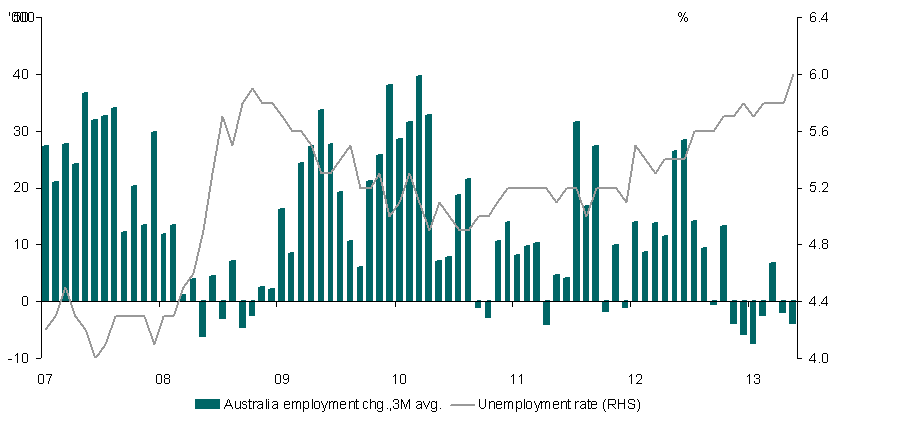
Positive sentiment for the AUD was dashed today however, following the release of January jobs data which came in worse than expected at -3.7k versus +15k consensus. The details were weak too, with the unemployment rate rising to a 10 year high of 6% and participation rate dropping to 64.5%.

The data will clearly restrain AUD in the short term, but is unlikely to spark renewed risks of further policy easing given a rise in inflation pressures. In this respect, AUD is set to continue to show some resilience over coming weeks. Near term AUD/USD support is seen around 0.8915.

AUDjobs

Posted in Australia. Tags: , , . Leave a Comment »

RBA statement bullish for AUD

AUDIMM

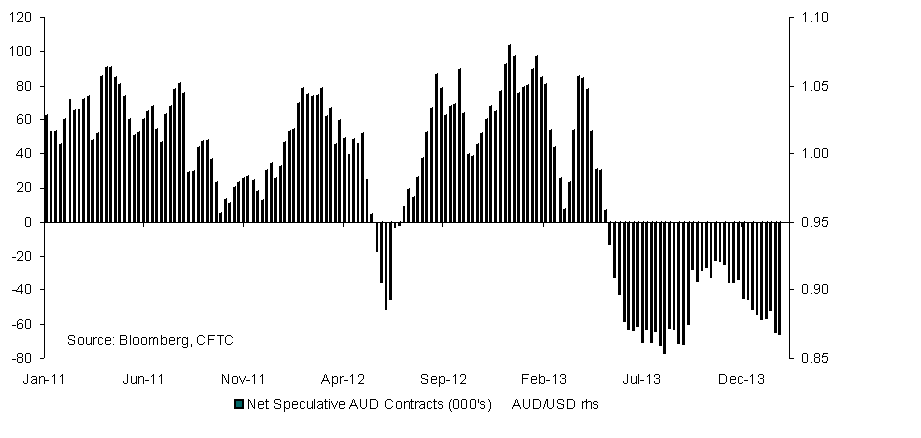
AUD has held up relatively well considering the pressure on risk currencies in general. The fact that speculative positioning in AUD has already fallen to extreme levels suggests 1) scope for further downside is limited and 2) AUD could bounce strongly in the event of good news.

In the event, the RBA unsurprisingly left policy rates unchanged but focussed attention on the recent rise in inflation. The RBA highlighted in its accompanying statement that inflation has been higher than forecast. Moreover, the RBA does not appear to be actively talking the AUD down but highlighting the benefits of past AUD weakness if sustained.

Overall, the statement is bullish for the AUD especially as it appears to confirm that the policy easing cycle is over. Consequently the bounce in AUD following the rate decision is likely to be strong.

AUD/USD technical support is seen around 0.8660, with resistance at 0.8889.

Posted in Australia. Tags: , . Leave a Comment »

A further blow to risk appetite

Amid a market that is already very nervous the much weaker than expected US ISM manufacturing confidence index (51.3 versus 56.0 consensus) taken together with the weaker Chinese non manufacturing purchasing managers index (53.4 versus 54.6 prior) dealt another blow to risk appetite.

Consequently the VIX fear gauge has spiked to its highest level since the end of 2012 and our risk barometer has moved swiftly into risk hating territory. US Treasury yields have continued to drop, with the 10 year yield having slid by around 45 basis points so far this year.

Suffice to say investors should steer clear of risk assets over the short term as the turmoil does not look like it will be over anytime soon. A combination of tapering, a confluence of country specific emerging market country concerns and weaker growth in China provide the backdrop for a volatile few weeks if not longer, ahead.

The main event today is the Reserve Bank of Australia meeting where we look for no change in policy. However, the key events of the week are yet to come, with the European Central Bank and Bank of England policy decisions and US January jobs report all on tap over coming days. In brief, no change in policy is expected from either central bank and payrolls are expected to come in around 200k.

EUR to drift lower, AUD supported, JPY flatlines

EUR/USD has failed to retake the 1.2400 handle and as noted yesterday looks set to gradually make its way lower again. News that the German government lent its support to the European Central Bank (ECB) bond buying plan helped to limit losses overnight, but there is likely to be little news on the policy front over coming weeks as Europe moves into full blown summer holiday mode.

No news is perhaps good news, but market patience continues to run thin and the EUR will eventually be punished should policy makers fail to deliver which has been so often the case. With only German factory orders in terms of data releases of note today, EUR/USD is set to settle into a range, but with a downside bias.

The RBA meeting today is likely to prove relatively uneventful. Almost all analysts polled expect a no change outcome from the Reserve Bank. As this is the largely priced in, the main influence on AUD will be the accompanying statement. The market is overly aggressive in pricing in 75 basis points of policy rate cuts over the coming months and in this respect it will require a particularly dovish statement to validate these expectations.

More likely, the RBA will sound neutral reflecting on relatively firm data (except the June jobs report) releases since the last meeting and a better global environment. Combined with strong attraction to ‘carry’ trades and a firmer tone to risk appetite, AUD looks well supported, with technical support seen around 1.0437.

USD/JPY continues to flat line just above the 78.00 level ahead of this week’s Bank of Japan meeting. There is unlikely to be much excitement from the BoJ meeting but the pressure to take more aggressive steps to reach their 1% inflation goal as well as to weaken the JPY remains strong. The 78.00 level appears to be an uncomfortable equilibrium for markets and Japanese policymakers.

Although low implied FX volatility suggests that there is little expectation of a move in either direction Japanese officials continue to remain concerned about the strength of the JPY. Similarly, the US Treasury bond versus Japanese JGB yield differential (2 year) remains relatively steady, suggesting little directional impetus in the short term. Given hopes / expectations of more Fed quantitative easing it seems unlikely that USD/JPY will make much traction on the upside over coming weeks.

EUR rallies, AUD and CAD eye rate meetings

Some consolidation and even slightly more upbeat tone have helped risks assets to settle and the outlook today is for more of the same. The respite looks temporary unless followed by concrete measures out of the Eurozone to stem the crisis, however. Attention will focus on today’s emergency teleconference between G7 leaders in which they are expected to put more pressure on European leaders to act.

However, continuing stalemate in Europe, with Spain’s push for an injection of funds from the Eurozone bailout fund into its banks facing resistance from Germany who believe that any funding should come as part of a formal bailout package. Despite the lack of traction in Europe, the EUR has managed to eek out further gains, with the rebound from the lows around 1.2287 versus USD gaining traction. Near term resistance is seen around 1.2625.

There has been a change of heart by many ahead of today’s Reserve Bank of Australia (RBA) meeting. Weaker global data in particular in China, with both the manufacturing and non manufacturing purchasing managers indices (PMI) coming in weaker than expected, have added to worries about the path of the Australian economy.

Taken together with some deterioration in Australian money market conditions, weaker commodity prices and growing European contagion risks, the RBA will probably want to shield the domestic economy, with another 25bps rate cut. Talk of a 50bps easing today has done the rounds but this seems excessive given that it would fall hot on the heels of 50bps rate cut at the beginning of May.

The AUD has priced in some easing and a likely 25bps rate cut is unlikely to put much pressure on the currency but much will depend on the accompanying statement. In any case, downside risks remain in the current environment.

The Bank of Canada also meets today to decide on its policy rate settings. Unlike in Australia there has been no change of heart ahead of the meeting, with the BoC set to keep its policy rate on hold at 1%. The central bank has sounded more upbeat than most and the drop in the CAD over recent weeks has in any case acted to loosen monetary conditions.

Although somewhat resilient compared to its commodity counterparts such as AUD and NZD, the CAD is playing catch up, having been the worst performing currency so far this month. Speculative positioning has drifted lower too, although it is still close its three month average. This implies room for a further reduction in long positions as the CAD fails to outperform.

Recent weakness in US economic data highlights the risks ahead for Canada and the CAD, suggesting that investors will continue to take a cautious tone towards the currency over coming weeks. A more neutral statement from the BoC will likely keep CAD sentiment subdued.