USD finding support, AUD slipping

US bond yields look relatively well supported and in turn this is providing a degree of support for the USD. In this respect the firmer than consensus reading in a gauge of service sector activity, the February US ISM non-manufacturing survey (57.3 versus 56.8 in January) which contrasted with relatively weak service sector purchasing managers’ indices (PMI) in Europe, helped to maintain the healthy yield differential between the US and German bunds.

Combined with the generally ‘risk off’ sentiment pervading markets, in part due to the weaker PMI data, the USD looks to be in good form early in the week. The next market mover will be Wednesday’s ADP jobs report (a measure of jobs growth in the services sector), which will provide clues to Friday’s February non-farm payrolls outcome. In the meantime the fact that the speculative market (IMM) is positioned short USD (for the first time since September 2011) suggests that the room for further USD selling looks limited, with the USD index looking well supported above 79.00.

AUD and other high beta currencies lost more ground in the wake of the drop in the Chinese non-manufacturing PMI in February. AUD remains highly reactive to Chinese data releases given the high and growing exposure of Australia’s economy to China. Given the likelihood of a soft landing in China this year, the medium term damage to the AUD will be limited and I stil look for AUD/USD to reach 1.10 by year-end.

Over the near term however, there is scope for more AUD downside but much will depend on the outcome of the Reserve Bank of Australia (RBA) policy meeting. Expectations of rate cuts have diminished following recently better data and a less dovish statement at the last RBA meeting. A relatively benign statement will offer the AUD little support, leaving AUD exposed to a drop to technical support to just under 1.06 versus the USD.
Posted in Australia, FX, US. Tags: , , , , , . Leave a Comment »

Greek tensions hit EUR, Aussie jobs boost AUD

Eurozone tensions continue to act as a weight on global market sentiment and the EUR. Talk of a delay of part or all of the second Greek bailout until after elections in April has intensified speculation of a disorderly Greek default. Chinese support for Europe expressed yesterday has done little to alleviate the strain. Attention will now turn to the meeting of the Eurogroup in Brussels on Monday.

Relatively positive US economic data including a jump in the NAHB homebuilders survey to its highest level since May 2007 and hints by Federal Reserve officials of support for more quantitative easing in the minutes of the Jan 24-25 FOMC meeting have failed to outweigh negative developments in Europe.

A ‘risk off’ tone will filter through markets today. Data wise, US Philly Fed and housing starts will continue the positive tone of US releases, while in Europe bond auctions in France and Spain will be watched closely.

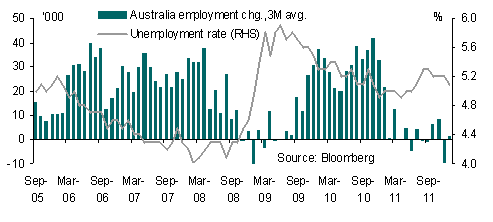
Australian jobs data for January came in stronger than forecast, rising by 46.3k compared to consensus of 10k. The unemployment rate surprisingly dropped to 5.1%. The increase in jobs more than made up for last month’s disappointment and highlights some signs of stability in job market conditions. Moreover, the data supports last week’s decision by the Reserve Bank of Australia (RBA) to keep rates on hold.


AUD jumped on the data but I expect the follow through to be limited especially given the fact that the AUD remains one of the most sensitive currencies to risk aversion. Upside will be restrained to resistance around 1.0788 versus USD today.

Why is the Swiss franc so strong?

All eyes remain focussed on Greek developments today as the country vacillates towards acceptance of further austerity measures in order to gain the Troika’s (EU, IMF, ECB) approval for a second bailout for the country. The stakes are high with a potential disorderly default and Eurozone exit on the cards should no agreement be reached.

Against this background market nervousness is intensifying as reflected in the slippage in global equity markets and drop in risk assets in general overnight. The data and events slate today includes an RBA policy meeting and German industrial production, but neither of these will be significant enough to deflect attention and calm fraying nerves as markets await further Greek developments.

Contrary to many commentaries, the fall in EUR/CHF cannot be attributed to higher risk aversion (it has had a low correlation with my Risk Aversion Barometer over recent weeks). Instead, EUR/CHF is another currency pair that is highly correlated with interest rate differentials. Indeed, its high sensitivity provides a strong explanation for the drop in EUR/CHF since mid December 2011. This move has occurred despite an improvement in risk appetite over this period, a factor that would normally be associated with CHF weakness.

The implied interest rate futures yield advantage of the Eurozone over Switzerland has narrowed by around 47 basis points since mid December 2011. This is a problem for the Swiss National Bank, who will increasingly be forced to defend its 1.20 line in the sand for EUR/CHF. However, given that the drop in EUR/CHF has closely tracked yield differentials, any intervention is likely to have a limited impact unless there is renewed widening in the yield gap.

EUR falls, JPY retraces after intervention

Risk aversion has come back in full force, with various concerns weighing on markets. Once again attention is firmly fixed on the eurozone and worryingly last week’s European Union (EU) rescue agreement has failed to prevent a further widening in eurozone peripheral bond spreads. This will come as a blow to eurozone officials as the agreement was aimed to prevent exactly this.

A lack of detail in the plans announced last week has come back to haunt markets. Moreover, given the event risk of the RBA, ECB and Fed central bank meetings this week plus the US October jobs report at the end of the week, nerves will likely remain frayed over coming days. Overall, the tone will likely be on of selling risk assets on rallies over the short term.

The EUR has unwound a significant part of its gains from last week as various doubts about the eurozone rescue package have surfaced. The measures announced by EU officials have failed to prevent a jump in Italian and Spanish bond yields. News that MF Global has filed for bankruptcy while the Greek Prime Minister has called for a referendum on the EU’s debt deal dealt markets a blow overnight.

As it was doubts had been creeping in due to the lack of detail in the rescue package including but not limited to the lack of specifics on the leveraging of the EFSF bailout fund. The pattern appears to have followed the reaction to previous EU announcements to stem the crisis, namely short lived euphoria followed by a sell off in risk assets. The EUR is likely to struggle further over the near term, with the current pull back likely to extend to around the 21 October low of 1.3705.

Japanese officials had blamed the strength of the JPY on speculative flows and have threatened more FX intervention following yesterday’s Judging by the price action this morning the threat has been followed up by action. In order for USD/JPY to sustain a move higher it will require both a widening in yield differentials and easing risk aversion. Neither are guaranteed to happen any time soon as was evident overnight with risk aversion rising. US data has improved but it is insufficient to provoke a sharp back up in US bond yields.

Consequently in the coming weeks USD/JPY topside momentum will be limited. A break above USD/JPY’s 200 day moving average level of 79.89 could prove decisive in terms of JPY long capitulation and once above this level USD/JPY will target the 11 July high of 80.83. However, this will require further intervention otherwise the underlying trend in JPY will continue to remain positive.

Euphoria fades, risk currencies weaker

The euphoria emanating from last week’s eurozone agreement will likely fade into this week as renewed doubts creep in. Details of how the EFSF bailout fund will be leveraged or how the special purpose vehicle will be utilised have yet to emerge while the firewall to protect countries such as Italy and Spain may still be insufficient given that the use of the European Central Bank (ECB) to provide unlimited support has been ruled out.

With more questions than answers markets will be hungry for further details over coming weeks and until then it is difficult to see risk appetite stretching too far. One indication of such concern was the fact that Italy’s borrowing costs climbed to euro-era highs the day after the European Union (EU) plan was agreed. The G20 meeting on 3-4 November will be eyed for further developments as well as further reaction to the EU agreement.

There are plenty of events to digest this week that could add to any market nervousness. In terms of central banks we do not expect to see any change in policy stance from the ECB, Federal Reserve or Reserve Bank of Australia (RBA) this week but the decisions may be close calls. The ECB under the helm of new President Draghi will be under pressure to ease policy as growth momentum has clearly weakened but the Bank will likely hold off for the December meeting when new growth and inflation forecasts will be released.

The RBA may also take some solace from a better global economic and market climate but the market disagrees having priced in a cut this week. The Fed will look to see how ‘Operation Twist” is faring before moving again but recent indications from some Fed officials suggest growing support for purchases of mortgage backed securities.

On the data front eurozone inflation today will be the key number in Europe while the US jobs report at the end of the week will be the main release in the US. Ahead of the payrolls data, clues will be garnered from the ISM manufacturing data and ADP jobs report. The consensus is for a 95k increase in non-farm payrolls and the unemployment to remain at 9.1% maintaining the trend of only gradual improvement in the US jobs market.

Recent data releases have turned less negative, however, and at the least have helped to alleviate renewed recessionary concerns. Overall, I suspect that markets will come back down to the reality of slow growth and unanswered questions this week, with risk assets likely to lose steam over coming days.