In the eye of the storm

The rout in global markets continues as the bad news mounts up. Failure to achieve concrete results from the meeting of eurozone finance ministers yesterday together with intensifying banking sector concerns and weaker global manufacturing surveys left a sour taste for investors. Aside from the selloff in global stocks the EUR fell to an eight month low and looks on track to test psychological support around 1.30 versus USD.

Attention continues to be focussed on the Greece. Greece’s failure to meet its deficit targets did not appear to derail the prospects of the country receiving it’s next loan tranche but discussions between the Troika and Greek officials are ongoing and payment to Greece may not now be made until November. European officials have indicated that they will reassess Greece’s deficit targets combining 2011 and 2012 targets, suggesting some leeway for Greece to be able to qualify for the next loan tranche.

One reason that markets are reacting negatively is the hints from Eurozone officials that the agreement reached in July on a second bailout for Greece may need “technical” revisions which has been perceived to imply bigger write downs for Greek bond holders compared to the haircuts of 21 percent agreed back in July.

There seems to be no end to the problems for the EUR and markets are clearly running out of patience. Over the near tem there appears to be little to prevent sentiment from deteriorating further. What is needed is a clear plan and this is clearly not forthcoming. Greece remains in the eye of the storm but as yet there is no plan to ring fence the country and avoid a deeper fallout globally.

Elsewhere risk currencies in general continue to be hit, with the AUD in particular facing pressure as the RBA hinted at prospects of interest rate cuts in the weeks ahead. The outright winner is the USD and further gains are likely as risk aversion continues to intensify despite the fact that the US has it’s own problems to deal with. As we move further into October the potential for more volatility remains high.
Euro still looks uglier than the dollar

Currency markets continue to vacillate between US debt ceiling concerns and eurozone peripheral debt worries. Despite a lack of agreement to raise the debt ceiling, with House Republicans failing to back a proposal by House speak Boehner, the USD actually strengthened towards the end of the week as eurozone peripheral issues shifted back into focus.

The resilience of the USD to the lack of progress in raising the debt ceiling is impressive and reveals that the EUR looks even uglier than the USD, in many investors’ eyes.

Much in terms of direction for the week ahead will depend on the magnitude of any increase in the debt ceiling and accompanying budget deficit reduction measures. Assuming that a deal is reached ahead of the August 2 deadline it is not obvious that the USD and risk currencies will enjoy a rally unless the debt ceiling deal is a solid and significant one.

Given the limited market follow through following the recent deal to provide Greece with a second bailout, the EUR remains wholly unable to capitalise on the USD’s woes.

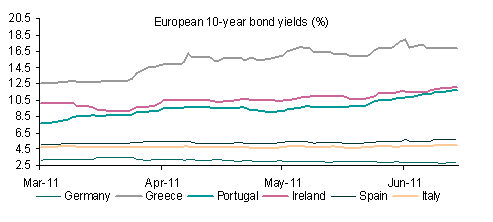
A reminder that all is not rosy was the fact that Moody’s ratings agency placed Spain’s credit ratings on review for possible downgrade while reports that the Spanish parliament will be dissolved on September 26 for early elections on November 20 will hardly help sentiment for the EUR. Compounding the Spanish news doubts that the EFSF bailout fund will be ready to lend to Greece by the next tranche deadline in mid-September and whether Spain and Italy will participate, have grown.

Some key data releases and events will also likely to garner FX market attention, with attention likely to revert to central bank decisions including the Bank of Japan, European Central Bank, Bank of England, Reserve Bank of Australia and US July jobs report. None of the central banks are likely to shift policy rates, however.

The risk for the USD this week is not only that there is disappointing result to the debt ceiling discussions, but also that there is a weak outcome to the US July jobs report. An increase of around 100k in payrolls, with the unemployment rate remaining at 9.2%, will fixate market attention on weak growth and if this increases expectations for a fresh round of Fed asset purchases the USD could be left rather vulnerable.

The RBA is highly unlikely to raise interest rates but the tone of the accompanying statement is unlikely to be dovish. The RBA noted the strong emphasis on the Q2 CPI inflation data and in the event it came in higher than expected, a fact that supports my expectation that the Bank will hike policy rates at least once more by the end of this year.

Markets have largely priced out expectations of a rate cut but there is still scope for a more hawkish shift in Australian interest rate markets, which will give the AUD a boost. However, AUD remains vulnerable to developments in the US and Europe as well as overall risk aversion, and a preferable way to play a positive AUD view in the current environment is via the NZD.

EUR higher but resistance looms

EUR and risk currencies in general were buoyed by the passage of the austerity bill in the Greek parliament. The implementation bill is also likely to be passed later today opening the door for the disbursement of EUR 12 billion from the European Union / IMF from the EUR 110 bailout agreed for the country. Combined with news that German banks are progressing towards agreeing on a mechanism to roll over Greek debt alongside French banks as well as likelihood of an European Central Bank (ECB) rate hike next week, the EUR is set to remain supported over the short term.

Nonetheless, it once again looks as though a lot of good news is priced in and it would be surprising if EUR/USD could extend to above strong resistance around 1.4557 given the many uncertainties ahead, not the least of which includes the stance of ratings agencies on any Greek debt rollover.

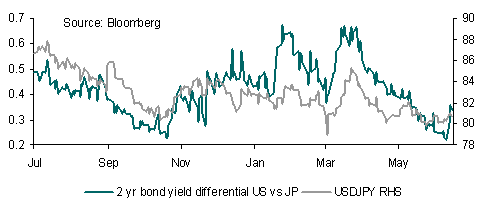
USD/JPY is the only major currency pair that is correlated with bond yield differentials at present (2-year yields) and therefore it should not come as a surprise that USD/JPY has moved higher as the yield differential between the US and Japan has widened by around 10bps over the past week. Indeed, yesterday’s move above 81.00 was spurred by the move in yield differentials although once again the currency pair failed to build sufficient momentum to close above this level.

Further gains will require US bond yields to move even higher relative to Japan but perhaps the end of QE2 today may mark a turning point for US bond markets and currencies. The end of QE2 taken together with a jump in bond supply over coming months, will see US Treasury yields will move sharply higher, implying much more upside for USD/JPY.

AUD has bounced back smartly over recent days, with the currency eyeing resistance around 1.0775 versus USD. A general improvement in risk appetite has given the currency some support but markets will be unwilling to push the currency much higher ahead of the Reserve Bank of Australia (RBA) meeting next week. On the plus side, there are no rate hikes priced in for Australia over the remainder of the year, suggesting an asymmetric risk to next week’s meeting.

In other words, unless the RBA openly discusses rate cuts in the statement, the AUD will likely remain supported. Conversely any indication that a rate hike may be in prospect will be AUD supportive. In any case we continue to believe the AUD offers better value especially relative to NZD and maintain our trade idea to buy AUD/NZD.

EUR Supported, AUD dives, NZD jumps

Today is probably not the best day to sell EUR given that the ECB policy decision looms on the horizon. Whilst there is a risk of a ‘buy on rumour, sell on fact’ impact on the EUR following the European Central Bank (ECB) decision later today the relatively high probability that the ECB flags a rate hike in July will likely give further support to the EUR especially as it is not fully priced in by the market.

Of course should ECB President Trichet fail to mention “strong vigilance” in his press conference the EUR could suffer but this is likely to be a lower probability event. Some justification for higher rates will come from an upward revision in the ECB’s inflation forecasts. Consequently EUR/USD looks well supported around 1.4450.

The Bank of England is unlikely to deliver any surprises today, with an unchanged policy rate outcome and asset purchases target likely. The outcome will keep GBP restrained versus USD but given the likely contrast with the ECB, EUR/GBP could head higher as the currency pair continues to set its sights on the 0.90 level.

Even against the USD, GBP is unlikely to extend its gains, with 1.6474 likely providing a near term technical cap. The dichotomy of weaker activity and higher inflation is clearly causing a problem for policy makers but we still believe a rate hike is likely later in the year. In the meantime GBP remains vulnerable to further data disappointments over coming weeks.

There was more bad news for the AUD today in the form of a weak than forecast May employment report. The data will reinforce expectations that the RBA will not hike interest rates over coming months, with July and August effectively ruled out, though a hike in September remains probable.

The data had major impact on AUD which dropped sharply below the 1.0600 handle versus USD. Clearly the combination of the RBA statement and weak jobs data has resulted in a major headwind against further near term AUD appreciation. AUD will remain under downward pressure in the short-term, with technical support seen at 1.0440.

Unlike the RBA the Reserve Bank of New Zealand (RBNZ) opened the door for higher interest rates following its unchanged policy decision today, with the Bank stating that “a gradual increase in the overnight cash rate over the next two years will be required”. Despite noting some caution about the strength of the NZD and its impact on the economy the Kiwi strengthened versus the USD

Australian dollar hit by weak jobs data

The USD’s bounce since the beginning of the month appears to be gaining more traction, with the USD index up over 3% from its recent lows. I’m still cautious about whether this move can extend much further in the absence of a back up in US bond yields especially given ongoing asset purchases / global USD liquidity injections by the US Federal Reserve at least until the end of June.

Nonetheless, given the magnitude of USD short positioning, which had moved ever close to revisiting record levels, the potential for short-covering was significant. US data today could provide some influence, with attention on April retail sales data, PPI inflation and jobless claims. A relatively positive outcome for retail sales could give the USD further support.

The day has started badly for the AUD, with the currency hit by an awful jobs report, with employment dropping by 22.1k in April compared to consensus expectations of +17k. The details were even more negative than the headline reading, with full time employment dropping by 49.1k and only partially mitigated by a 26.9k rise in part time employment.

The Reserve Bank of Australia will likely pay close attention to the data and it will likely result in any residual expectation of a rate hike by the RBA next month being taken off the table. Already today there has been a sharp rally in bank bill futures as markets pare back interest rate expectations and markets are not even pricing in a further full 25bps rate hike by year end.

The data weighed heavily on the AUD, with AUD/USD hitting a low below 1.06. AUD is likely to trade with a heavy tone over coming sessions, with the currency already under pressure from a generally firmer USD. Moreover, the rally in Australian bank bill futures will add further pressure to the currency as Australia’s favourable rate differential narrows further with the US.

Taken together with the fact that AUD positioning is close to its all time highs and that even compared to interest rate differentials its gains look overdone, it suggests more downside risks over the short-term, with AUD/USD 1.0537 seen as a near term technical support level.

In contrast GBP benefitted from a back up in UK bond yields in reaction to the Bank of England’s Quarterly Inflation Report. Inflation forecasts were revised higher but growth forecasts were revised lower as expected. The In truth, the reaction looked overdone but GBP has gained some momentum versus EUR and looks set to extend its gains, with focus on the 200 day moving average level of 0.8558.