RBA on hold, RBI hikes rates

News of the death of Osama Bin Laden gave the USD a lift and its gains have extended for a second day. Extreme short market positioning as well as increasing risk aversion (perhaps due to worries about retaliation following Bin Laden’s death) have helped the USD.

However, the boost to the USD could be short-lived in the current environment in which it remains the preferred global funding currency. Indeed, the fact that US bond yields have dropped sharply over recent weeks continues to undermine the USD against various currencies.

The USD firmed despite the US ISM manufacturing index dropping slightly, albeit from a high level. The survey provided some useful clues to Friday’s US jobs report, with the slight decline in the employment component of the ISM survey to 62.7 consistent with a 200k forecast for April payrolls.

Ahead of the European Central Bank (ECB) meeting on Thursday hawkish rhetoric from new Council member and Bundesbank chief Weidmann (replacing Weber) and more reassurances from Greek and EU officials that there will be no debt restructuring or haircut on the country’s debt has helped the EUR although it is notable that it could not sustain a foot hold above 1.49. Eurozone bond yields have risen by around 20bps compared to US yields over the past month, a fact that suggests that the EUR may not fall far in the short-term.

USD/JPY is trading dangerously close to levels that may provoke FX intervention by the Japanese authorities. General USD weakness fuelled a drop in USD/JPY which has been exacerbated by a rise in risk aversion over recent days (higher risk aversion usually plays in favour of a stronger JPY). The biggest determinant of the drop in USD/JPY appears to a narrowing in bond yields (2-year bond yields have narrowed by around 20bps over the past month) largely due to a rally in US bonds.

Unsurprisingly the Reserve Bank of Australia (RBA) left its cash rate on hold at 4.75%. The accompanying statement showed little inclination to hike rates anytime soon, with credit growth noted as modest, pressure from a stronger exchange rate on the traded sector and temporary prices shocks which are expected to dissipate. The only indication that rates will eventually increase is the view that longer term inflation is expected to move higher.
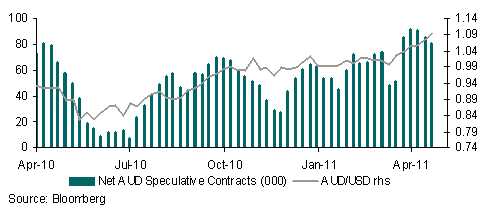
I look for further rate hikes over coming months even with the AUD at such a high level. AUD has lost a bit of ground after hitting a high just above 1.10 against the USD and on the margin the statement is slightly negative for AUD. A slightly firmer USD overall and stretched speculative positioning, with IMM AUD positions close to their all time high, points to some downside risks in the short-term.

In contrast India’s central bank the RBI hiked interest rates by more than many expected. Both the repo and reverse repo rates were raised by 50bps, with the central bank governor highlighting renewed inflation risks in his statement. The decision reveals a shift in RBI rhetoric to an even more hawkish bias in the wake of rising inflation pressures, which should be beneficial to the rupee.
Central bank decisions and US payrolls in focus

The USD’s troubles are far from over. Data and events this week will do little to stop the rot. As US Federal Reserve Chairman Bernanke made clear last week the Fed is committed to completing its asset purchase programme by the end of June though there is plenty of debate about what comes after. Reduced growth forecasts and the Fed’s view that price pressures are “transitory” have been sufficient to keep the USD on its knees.

The weaker than expected reading for Q1 US GDP growth at 1.8% QoQ clearly did nothing to alleviate pressure on the USD even though it is widely believed that the soft growth outcome will prove fleeting, with recovery set to pick up pace over the coming months. In truth much will depend on the trajectory for oil prices, especially as petrol prices in the US verge on the psychologically important $4 per gallon mark. Even higher energy prices could dent growth further but lower or stable prices will keep the recovery on track.

The highlight in this holiday shortened week for many countries this week is the US April jobs report at the tail end of the week. Estimates centre on around a 200k gain in payrolls but forecasts will be refined with the release of the ADP private sector jobs report and ISM manufacturing survey earlier in the week. The unemployment rate may prove sticky and will likely remain at 8.8%, a disappointment to those looking for a quicker recovery. The elevated unemployment rate will only reinforce expectations that the Fed will not be quick to reverse policy, with the USD continuing to suffer as a result.

Central bank meetings will be plentiful this week, with the European Central Bank (ECB) and Bank of England (BoE) likely to garner most attention. Recent data in the Eurozone has provided further evidence of growth divergence between North and South, but the EUR has remained resilient to this as well as to increased concerns about the periphery. This make the ECB’s job even tougher than usual when it meets this week and it is unlikely that the Bank will hike rates again so soon, especially given the strength of the EUR. Nonetheless, Trichet will continue to sound hawkish, limiting any damage to the EUR (if any) of no move in policy rates.

Similarly the Bank of England will also remain on the sidelines though this should come as little surprise in the wake of disappointing data recently and a surprise drop in inflation, albeit to still well above the BoE’s target. GBP has made up ground against a generally weak USD but judged against other currencies it has been an underperformer as expectations of monetary tightening have been pared back. Finally, the Reserve Bank of Australia (RBA) is set to remain on hold, but a hike over coming months remains likely even with the AUD at such a high level. Quite frankly although the USD is looking increasingly oversold there is nothing this week that would suggest it will recover quickly.

Risk aversion spikes

Increased risk aversion overnight in the wake of escalating Middle East tensions gave the USD some support but overall the USD index is gradually drifting towards its early November low around 75.631. The antithesis of USD weakness is strength in most other major currencies.

The USD is being undermined by relatively dovish expectations for US interest rates relative to elsewhere and last night’s semi annual testimony by Fed Chairman Bernanke to the US Senate did nothing to alter this tone, with Bernanke maintaining the emphasis on subdued inflation and elevated unemployment.

The USD index itself has a high (0.82) 3-month correlation with US interest rate futures and over recent weeks as the implied yield has dropped, the USD has lost ground. The prospects of higher US bond yields may eventually provide the USD with support, especially given the prospect of substantial short-covering but in the near term the USD is likely to remain under pressure.

The upbeat run of US data highlights another source of USD support over the medium term, given the likely outperformance of the US economy over coming months. Yesterday’s ISM manufacturing survey and vehicle sales data lend support to this view. Moreover, the rise in employment component of the ISM supports the view of at least a 195k increase in February payrolls.

The Fed’s Beige Book tonight and February ADP jobs report will not alter the USD’s trajectory. The Beige Book is unlikely to reveal anything to worry the Fed in terms of inflation risks although will probably reveal further signs of improved activity. The ADP report will give important clues for Friday’s February non-farm payrolls data although it’s worth noting that last month’s report was way off the mark. In any case neither release is likely to prevent a further drop in the USD.

EUR is a clear beneficiary of expectations of tighter monetary policy by the ECB and the widening interest rate (futures implied yield) differential between the US and eurozone has given the EUR plenty of support recently as reflected in the high correlation with EUR/USD. Further support to the hawkish market stance was given by the upward revision to eurozone 2011 growth and inflation forecasts by the EU. The fact that eurozone inflation increased to 2.4% YoY in February also reinforced expectations of ECB tightening sooner than later.

The ECB press conference following the council meeting tomorrow will likely shape such expectations further, the EUR has already priced in a hawkish ECB stance, limiting the prospects of further appreciation. Notably EUR/USD has failed to break resistance at its year high around 1.3861, which will prove to be a formidable cap in the short-term.

In contrast, the RBA has poured cold water over expectations of further policy rate hikes in Australia. The policy statement following yesterday’s decision to keep the cash rate on hold pointed to an extended pause in the months ahead. Despite this and perhaps because markets have already pared back Australian interest rate expectations AUD rebounded quite smartly from its post meeting low and despite some overnight weakness due to increased risk aversion it will soon verge on a break of resistance at 1.0257.

AUD/NZD has continued to charge ahead having hit a multi-year high above 1.3600. NZD underperformance has been exacerbated by the impact of the recent earthquake, with growth expectations for this year having been sharply revised lower and growing speculation of an interest rate cut. Indeed, such speculation was given further fuel by comments by NZ Prime Minister Key who noted he would welcome a policy rate cut. Nonetheless, my quantitative AUD/NZD model suggests that the cross looks over-extended at current levels, whilst relative speculative positioning supports this view.

Beyond Expectations

Egypt worries continue to reverberate across markets, yet there appears to be growing resilience or at least some perspective being placed on problems there. Encouraging economic data, particularly in the US has helped to shield markets to some extent, with equity market rallying and US bond yields rising last week. The main impact of Egypt and worries about Middle East contagion continues to be felt on oil prices.

Even the mixed US January jobs report has failed to dent market sentiment; the smaller than expected 36k increase in payrolls was largely attributed to severe weather. A further surprising drop in the unemployment rate to 9.0% due mainly to a significant drop in the labor force was also well received by the market.

There will be less market moving releases on tap this week and the data are unlikely to dent recovery hopes. Michigan confidence is set to record an improvement in February whilst the December trade deficit is set to widen to around $41.0 billion. There are also plenty of Federal Reserve speakers this week including a testimony by Chairman Bernanke.

One central bank that has softened its hawkish rhetoric is the European Central Bank (ECB), with President Trichet dampening speculation of an early rate hike last week and alleviating some of the pressure on eurozone interest rate markets. Consequently the EUR fell as the interest rate differential with the USD became somewhat less attractive. The EUR was also undermined by the opposition from some member states to French and German ideas for greater fiscal policy coordination, an aim apparently not shared across euro members.

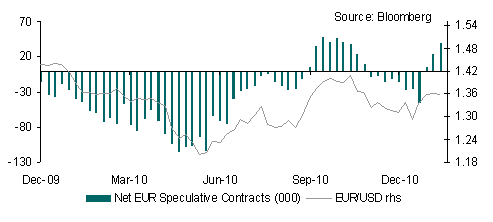
Data in Europe will be largely second tier. The EUR will look increasingly vulnerable to a further drop this week especially given the increase in net positioning over the past week to (1st February) according to the CFTC IMM data. The potential for position squaring looms large as positioning is now well above the three-month average. Stops are seen just below EUR/USD 1.3540.

In the UK the Bank of England policy meeting will take centre stage but there is unlikely to be any change in policy settings. Clues to policy thinking will be available in the monetary policy committee meeting minutes in two weeks times but it seems unlikely that any more members have joined the two voting for a hike at the last meeting.

Recent data have been a little more encouraging helping to wash off the disappointment of the surprise drop in Q4 GDP. The UK industrial production report is likely to be similarly firm on Thursday, with the annual pace accelerating. GBP/USD may however, struggle to make much headway against the background of a firmer USD and the weigh of long positioning, with GBP/USD 1.6279 seen as strong resistance.

There are plenty of releases in Australia this week to focus including the January employment data, consumer confidence, and a testimony by RBA governor Stevens in front of the House of Representatives on Friday. The data slate started off somewhat poorly this week, with December retail sales coming in softer than expected, up 0.2% MoM. AUD/USD is likely to be another currency that may struggle to sustain gains this week but much will depend on data over coming days. Resistance is seen around 1.0255.

On a final note, the weekend’s sporting events highlight how it’s not just economic data or moves in currencies that don’t always go as expected. After a solid run in the Ashes cricket England slumped to a 6-1 series loss to Australia in the one-day series, putting the Ashes win into distant memory. A similarly solid performance by Man United was dented with their unbeaten record broken by bottom of the table Wolves.

Econometer.org has been nominated in FXstreet.com’s Forex Best Awards 2011 in the “Best Fundamental Analysis” category. The survey is available at http://www.surveymonkey.com/s/fx_awards_2011

Your support in the survey is highly appreciated

Temporary Euro Relief

Eurozone peripheral country travails continue to garner most market attention. There was at least a semblance of improvement on this front as peripheral bond spreads with German bunds narrowed on Tuesday but this was largely due to European Central Bank (ECB) bond buying than any improvement in sentiment. The fact that German bund yields also rose helped to narrow bund-peripheral spreads further.

A clearer test of sentiment will be today’s debt sales by Portugal followed by actions by Spain and Italy tomorrow. ECB buying of Portuguese bonds has given some relief to other debt, with Spanish and Italian debt spreads narrowing too. Even Greece managed to sell short term debt (EUR 1.95 bn of 26 week T-bills) but at a higher cost than the previous sale.

Perhaps a stronger boost to sentiment will come from the news that European Union (EU) governments are discussing an increase in the EUR 440 billion bailout fund in recognition of the fact that the fund may prove too small to cope if the crisis spreads to Spain. However, don’t expect a decision anytime soon, with next week’s meeting of EU finance ministers unlikely to agree to such a move. Support (or lack) of from Germany may prove to be a sticking point against the background of domestic political pressure.

Other options being considered include the possibility of the EFSF (European Financial Stability Facility) purchasing bonds in the secondary market and lowering interest rates on EFSF bailout loans. News that Japan will buy 20% of EFSF bonds this month as well as recent supportive comments from China suggest that an increase in the size of the EFSF may be easily funded by such investors. The EUR will gain some support against the background of such speculation but its upside may be restrained around its 200-day moving average at EUR/USD 1.3071.

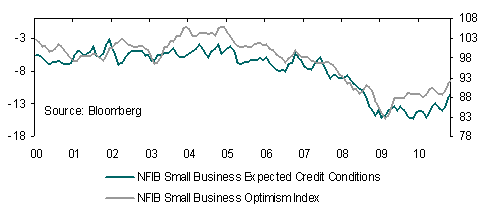
In the US the economic news was not so positive for a change as the National Federation of Independent Business (NFIB) small business optimism survey came in weaker than expected in December, an outcome that will come as a blow given that it suggests some stuttering in the recovery process as well as hiring.

There is only secondary data scheduled today, with most attention on the Fed’s Beige Book later tonight. The survey of Federal Reserve districts will likely reveal a broad based but moderate improvement in economic conditions with the exception of housing activity. A speech by the Fed’s Fisher on Monetary policy will also be in focus. Like the Fed’s Plosser overnight he may highlight some caution about the impact of Fed quantitative easing (QE).

The AUD is increasingly feeling the impact of the flooding in Queensland Australia as the extent of economic damage is revealed. Reserve Bank of Australia (RBA) board member McKibbin estimated that it could knock off at least 1% from economic growth. This may prove too negative and although the flooding will result in a significantly negative impact on growth in Q1 rebuilding and reconstruction will mean that overall growth for 2011 will not be as significantly impacted. Nonetheless, a paring back in RBA policy tightening expectations will see the AUD come under further pressure, with a move down to around AUD/USD 0.9634 on the cards over the short-term.