Indian Rupee – How low can it go?

Sentiment for the Indian rupee (INR) has gone from bad to worse. A number of concerns have hit the currency including weak economic data, deteriorating confidence in government policies, and intensifying risk aversion. The latest blow to the rupee came from data showing that economic growth in Q1 2012 slowed to 5.3% the slowest pace of growth in nine years. Worryingly high interest rates in the wake of persistent inflation pressures have damaged investment spending, a major weak point in the Q1 data. High inflation at over 7% means that the Reserve Bank of India has limited room to ease policy but the central bank has hinted at lower rates in the wake of lower oil prices.

These economic pressures have come at a time when the global environment has worsened. India was already more vulnerable compared to its Asian neighbours due it’s twin current account and fiscal deficits. Strong growth had put concerns about these deficits on the backburner but with growth slowing it only exposes India’s fragility. While less exposed to a global trade slowdown compared to other countries in the region India nonetheless is highly exposed to financial contagion. The INR is a high beta currency, sensitive to the vagaries of risk. The rise in risk aversion over recent weeks left the currency highly vulnerable as its sharp decline attests to.

Despite a host of regulation changes from the authorities the INR has continued to fall, with no let up in sight. While the RBI has suggested that it could sell USDs to oil companies to stem the decline in the rupee it may only result in slowing INR declines in the current environment. It’s decline against the USD has surpassed other Asian currencies. Interestingly there has not been a major exodus of portfolio capital from India, surprising given that other Asian countries such as Korea and Taiwan have seen significant outflows of equity capital. Nonetheless an escalation in the Euro crisis could quite easily change the picture for the worse.

It is not all bad news for the INR. While it will remain under pressure for some time yet from a valuation perspective the INR is looking increasingly cheap. I wouldn’t run out and buy it just yet but I would argue that a lot of bad news is already priced in to the currency. Investors will need to see some better news both externally and domestically and unfortunately this is lacking, but should risk appetite began to turn around the potential for rupee appreciation is significant for a currency that has lost close to around 20% of its value over the last 12 months. In the meantime, the best that could be hoped for is a slowing in the pace of depreciation, with a fall to around 57-58 versus USD on the cards over coming weeks.
Currencies At Pivotal Levels

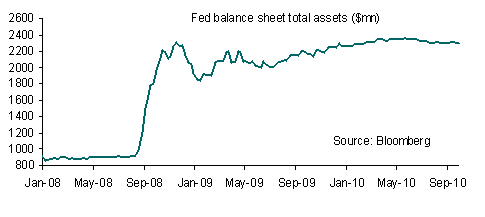
Ahead of today’s highly anticipated Fed FOMC meeting markets are holding their breath to determine exactly what the Fed will deliver. The consensus view is for the Fed to announce a programme of $500 billion in asset purchases spread over a period of 6-months. The reaction in currency markets will depend on the risks around this figure. Should the Fed deliver a bigger outcome, say in the region of $1 trillion or above, the US dollar will likely come under renewed pressure. However, a more cautious amount of asset purchases will be US dollar positive.

It has to be noted that the Fed will likely keep its options open and keep the program open ended depending on the evolution of economic data which it will use to calibrate its asset purchases. The USD will likely trade with a soft tone ahead of the Fed outcome, but with so much in the price, it may be wise to be wary of a sell on rumour, buy on fact outcome.

Whatever the outcome many currencies are at pivotal levels against the USD at present, with AUD/USD flirting around parity following yesterday’s surprise Australian rate hike, EUR/USD holding above 1.4000, GBP/USD resuming gains above 1.600 despite a knock back from weaker than forecast construction data, whilst USD/JPY continues to edge towards 80.00. Also, both AUD and CAD are trading close to parity with the USD. The Fed decision will be instrumental in determining whether the USD continues to remain on the weaker side of these important levels.

Going into the FOMC meeting the USD has remained under pressure especially against Asian currencies as noted by the renewed appreciation in the ADXY (a weighted index of Asian currencies) against the USD this week. Although it appears that the central banks in Asia have the green light to intervene at will following the recent G20 meeting the strength of capital inflows into the region is proving to be a growing headache for policy makers. One option is implementing measures to restrict “hot money” inflows but so far no central bank in the region has shown a willingness to implement measures that are deemed as particularly aggressive.

There has been some concern that Asia’s export momentum was beginning to fade as revealed in September exports and purchasing managers index (PMI) data in the region and this in turn could have acted as a disincentive to inflows of capital, resulting in renewed Asian currency weakness. The jury is still out on this front but its worth noting that Korean exports in October reversed a large part of the decline seen over previous months. Moreover, the export orders component of Korea’s PMI remained firm suggesting that exports will resume their recovery.

Nonetheless, manufacturing PMIs have registered some decline in October in much of Asia suggesting some loss of momentum, with weaker US and European growth likely to impact negatively. However, China’s robust PMI, suggests that this source of support for Asian trade will remain solid. Similarly a rise in India’s manufacturing PMI in October driven largely by domestic demand, highlights the resilience of its economy although with inflation peaking its unlikely that the Reserve Bank of India (RBI) will follow its rate hike on Tuesday with further tightening too quickly.

Contemplating Rate Hikes

The market mood has definitely soured and risk appetite has faltered.  This is good for the USD but bad for relatively high yielding/commodity risk trades. The USD is set to retain a firm tone over the near term even if is temporary, which I believe it is.  

Whether it’s profit taking on crowded risk trades, a lot of good news having already been priced in, fears that other countries will follow Brazil’s example of taxing capital inflows to dampen currency strength, or a reaction to weaker economic data, it is clear that there are many reasons to be cautious. 

It is also unlikely to be coincidental that the rise in risk aversion and drop in equity markets is happening at a time when many central banks are contemplating exit strategies and when many investors are pondering the timing of interest rates hikes globally following the moves by Australia and Israel. 

One of the reasons for the worsening in market mood is that some parts of the global economy may not be ready for rate hikes.  Certainly there is little chance of a US rate hike on the horizon and perhaps not until 2011 given the prospects of a sub par economic recovery.  This projection was given support by the surprise drop in US consumer confidence in October.

It is not just the US that is unlikely to see a quick reversal in monetary policy.  As indicated by the bigger than expected decline in annual M3 money supply growth in the eurozone, which hit its lowest level since the series began in 1980, as well as the drop in bank loans to the private sector, the ECB will be in no hurry to wind down its non-standard monetary policy measures. 

The chances of any shift in policy at next week’s ECB meeting are minimal, with the ECB’s cautious stance emboldened by the subdued money supply and credit data.  As long as EUR/USD remains below 1.50 ECB President Trichet is also unlikely to step up his rhetoric on the strength of the EUR.  

Although the major economies of US, Eurozone, Japan and UK are likely to maintain current policies for a long while yet, the stance is not shared elsewhere.  The Reserve Bank of India did not raise interest rates following its meeting this week but edged in this direction by requiring banks to buy more T-bills. Other central banks in the region are set to move in this direction.

In terms of developed economies, Norway was the latest to join the club hiking rates by 25bps and adding to the growing list of countries starting the process of policy normalisation.   Australia is set to hike rates again at next week’s meeting although a 50bps hike looks unlikely, with a 25bps move more likely.