Bernanke Boost

Last week ended with a downward revision to US Q2 GDP. The data clarified that growth momentum going into Q3 was indeed quite weak though it probably didn’t take the GDP revision to tell us this nugget of information, something that has been evident from the run of weak data over recent months.

Softer growth in Q2 placed particular attention on the Jackson Hole speech by Fed Chairman Bernanke in which he acknowledged the slowing in the pace of growth, but also forecast a moderate economic recovery in H2 2010. Importantly if the Fed is proven wrong he noted the FOMC would undertake unconventional (quantitative easing) QE II measures if needed.

The net impact on Bernanke’s speech and the smaller than expected downward revision to US Q2 GDP was to provide a boost to risk appetite. Sentiment will at least begin this week on a positive note in the knowledge that the Fed stands ready to act although double dip fears are far from over.

One trigger for Fed action will be a further deterioration in job market conditions and markets will pay close attention to the August US jobs report at the end of the week. Bloomberg consensus estimates forecast a 100 drop in payrolls, with private payrolls up 47k and the unemployment rate edging higher to 9.6%. Such an outcome would do little to boost confidence in a jobs market recovery.

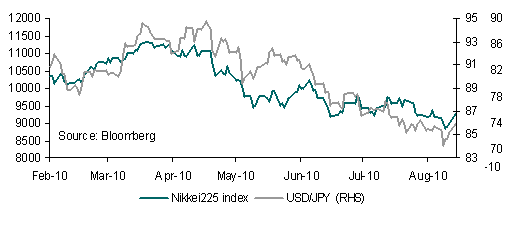
The week begins with all eyes on Japan however, with an emergency Bank of Japan (BoJ) meeting in focus. USD/JPY has already jumped higher on the belief that concrete action will emerge to weaken the JPY. The risk of disappointment is high and at most the BoJ will announce measures to extend loans to banks. A lack of other action especially in the form of FX intervention alongside a likely increase in risk aversion once the Bernanke bounce wares off, will result in a renewed USD/JPY move lower, with a breach of 85.00 likely. As seen in the chart below a decisive turn in the Japanese stocks will be a key factor in helping to eventually drive USD/JPY higher.
Two other central bank meetings of note this week are the European Central Bank (ECB) and Sweden’s Riksbank meetings on Thursday. No change in policy by the ECB will be of little surprise but the release of new staff projections, with growth likely to be revised up in 2010 but left unchanged for 2011, will be of interest. Developments regarding open market operations will also be of attention. In contrast, the Riksbank is widely expected to hike rates by 25bps on the back of a firming economy and house price inflation.

A UK holiday today will likely keep liquidity thin and as noted above risk currencies including AUD, NZD and CAD as well as Asian currencies will start the week firmer but will struggle to hold gains as the week progresses. EUR/USD has benefited little from improved risk appetite and will have a hard time this week making much any headway although potential EUR/CHF buying from the SNB may give some, albeit limited support.

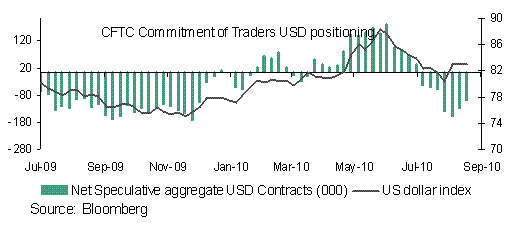
A renewed downside move to support around EUR/USD 1.2455 remains on the cards in the short term. Overall USD sentiment has become less negative as reflected in the CFTC IMM positioning data in contrast to a renewed deterioration in EUR speculative sentiment. We look for more of the same.
Dollar on top as central banks deliberate

There has been a veritable feast of central bank activity and decisions with most attention having been on the Fed’s decision.  In the event the FOMC meeting delivered no surprises in its decision and statement.  Basically the Fed acknowledged the recent improvement in economic activity but continued to see inflation as subdued and maintained that policy rates will remain low for an “extended period”.  The Fed also noted that most liquidity facilities were on track to expire on 1 February suggesting that they remain on track to withdraw liquidity.  

There was similarly no surprise in the Riksbank’s decision in Sweden to leave interest rates unchanged, with the Bank reiterating that it would maintain this stance through the autumn of 2010.  The SEK has been stung by outflows due to annual payments of premiums to mutual funds by the Pension Authority but the impact of this has now largely ended leaving the currency in better position.  Norway’s Norges Bank unexpectedly raised interest rates, for a second time, increasing its deposit rate by 25bps to 1.75%, with the surprise evident in the rally in NOK following the decision.   The other central bank to surprise but in the opposite direction was the Czech central bank which cut interest rates by 25bps.  

In contrast to the Norges Bank’s hawkish surprise the RBA has helped to toned down expectations for further rate hikes in Australia, with Deputy Governor Battellino suggesting that monetary policy was back in a “normal range” in contrast to the perception that policy was still very accommodative.   Weaker than expected Q3 GDP (0.2% QoQ versus forecasts of a 0.4% QoQ rise) data fed into the dovish tone of interest rate markets fuelling a further scaling back of rate hike expectations, casting doubt on a move at the February 2010 RBA meeting and pushing the AUD lower in the process.  Against this background AUD continues to look vulnerable in the short term, especially under the weight of year end profit taking and the resurgent USD.  

There was also some surprise in the amount of lending by the ECB, with the Bank lending EUR 96.9 bn in third and final tender of 1-year cash despite the cost of the loan being indexed to the refi rate over the term of the loan rather than being fixed at 1%.  There was also a sharp decline in the number of banks bidding compared to earlier 1-year auctions but at a much higher average bid.  This implies that some banks in Europe remain highly dependent on ECB funding despite the improvement in market conditions.   The EUR continues to struggle and its precipitous drop has shown little sign of reversing, with the currency set for a soft end to the year.  A break below technical support around 1.4407 opens the door to a fall to around 1.4290.   

The USD is set to retain its firmer tone in the near term though we would caution at reading its recent rally as marking a broader shift in sentiment.  The move in large part can be attributed to position adjustment into year end and is being particularly felt by those currencies that have gained the most in recent months.  Hence, the softer tone to Asian currencies and commodity currencies which appear to be bearing the brunt of the rebound in the USD.   Going into next year USD pressure is set to resume but for now the USD is set to remain on top, with the USD index on track to break above 78.000.

What’s driving FX – Interest rates or risk?

The November US retail sales report has really set the cat amongst the pigeons. For so long we have become accustomed to judging the move in the USD based on daily gyrations in risk aversion. Well, that may all be about to change. There was an inkling that all did not look right following the release of the November jobs report which unsurprisingly helped to boost risk appetite but surprisingly boosted the USD too.

It was easy to dismiss the USD reaction to year end position adjustment, markets getting caught short USDs etc. What’s more the shift in interest rate expectations following the jobs report in which markets began to price in an earlier rate hike in the US was quickly reversed in the wake of Fed Chairman Bernanke’s speech highlighting risks to the economy and reiterating the Fed’s “extended period” stance.

However, it all has happened again following the release of the November retail sales data, which if you missed it, came in stronger than expected alongside a similarly better than forecast reading for December Michigan confidence. The USD reaction was to register a broad based rally as markets once again moved to believe that the “extended period” may not be so extended after all.

Interest rates will become increasingly important in driving currencies over the course of the next few months but if anyone thinks that the Fed will shift its stance at this week’s FOMC meeting, they are likely to be off the mark. No doubt the Fed will note the recent improvement in economic data but this is highly unlikely to result in a change in the overall stance towards policy.

Further improvements in US data this week including industrial production, housing starts, Philly Fed and Empire manufacturing may lead markets to doubt this but the Fed calls the shots and a potentially dovish statement may act to restrain the USD this week. Also, it’s probably not a good idea to rule out the influence of risk appetite on currencies just yet and with a generally positive slate of data expected, firmer risk appetite will similarly act as a cap on the USD this week.

Other than the US events there is plenty of other potentially market moving data to digest this week. More central banks meet this week including the Riksbank, Norges Bank and Bank of Japan. No change is expected from all three but whilst the Riksbank is set to maintain a dovish stance the Norges Bank meeting is a closer call. So soon after the emergency BoJ meeting, a shift in policy appears unlikely but the pressure to increase Rinban (outright JGB buying) operations could throw up some surprises for markets.

Europe also has its fair share of releases this week including the two biggest data for markets out of the eurozone, namely, the German ZEW and IFO surveys as well as the flash December PMI readings. The biggest risk is for the ZEW survey which could suffer proportionately more in the wake of recent sovereign concerns in the Eurozone. Sovereign names may still lurk to protect the downside on EUR/USD and if the USD finds it tougher going as noted above, the EUR may be able to claw back some of its recent losses.

Earnings in focus

The majority of US Q3 earnings have beaten market expectations resulting in a boost to risk appetite and further pressure on the US dollar. At the time of writing, 61 companies have reported earnings in the S&P 500 and an impressive 79% have beaten forecasts according to Thomson Reuters. This week there are plenty of earnings on tap and although a lot of positive news appears to be priced in the overall tone to risk appetite remains positive. This implies a weaker US dollar bias given the strong negative correlation between US equities and the USD index.

Aside from the plethora of earnings there are plenty of data releases on tap this week including housing data in the US in the form of building permits and starts as well as existing home sales. The data will likely maintain the message of housing market stabilisation and recovery in the US. There will also be plenty of Fed speakers this week and markets will once again scrutinize the speeches to determine the Fed’s exit strategy.

Highlights this week also include interest rate decisions in Canada and Sweden. Both the BoC and Riksbank to leave policy unchanged and expect a further improvement in the German IFO in October though at a more gradual pace than in recent months. There will be plenty of interest in the UK MPC minutes given conflicting comments from officials about extending quantitative easing. RBA minutes will be looked at for the opposite reason, to determine how quickly the Bank will raise interest rates again.

The USD index managed a slight rebound at the end of last week but is likely to remain under pressure unless earnings disappoint over coming days. US dollar Speculative sentiment became more bearish last week according to the CFTC IMM data, with dollar bloc currencies including the AUD, NZD and CAD benefiting the most in terms of an increase in speculative appetite. GBP short positions increased to a new record but the rally towards the end of last week may have seen some of these short positions being covered. Overall any recovery in the USD this week may just provide better levels to go short.