Sell Risk Trades On Rallies

It seems that every time there is a bounce in risk appetite it quickly dissipates as worries about growth, fiscal deficits, sovereign debt, etc, return to dent sentiment. This was again the case overnight as markets sold off late in the US session, with an early bounce in sentiment proving too fragile to last. This pattern of trading is set to persist for a long while yet, with the overall tone of selling risk trades on rallies remaining in place.

Fears over a double dip global recession have increased since the release of Friday’s disappointing US jobs report even if it is too early to pass judgment based on the basis of one month’s data. Coupled with worries about slowing growth momentum in China, hopes that slower growth in the eurozone could be counterbalanced by firm growth elsewhere are being dashed. The problem is that despite a strong quarter of growth for most economies in Q2 2010 the outlook for the second half of the year is far more uncertain.

European Union officials sought to calm worries about the potential for renewed fiscal crises in the future by agreeing to monitor national budgets more closely and at an earlier stage whilst introducing a wider range of sanctions on excessive deficits. Unfortunately this is akin to the idiom about closing the stable door after the horse has bolted. The steps aren’t going to help resolve the current crisis. Evidence of implementation, execution and results on the deficit cutting front will help however, but this is a process that will take months rather than days or weeks.

A couple of factors may have prevented the EUR from extending losses overnight. 1) Germany announced EUR 80 billion in spending cuts along with 15,000 public sector job cuts. Germany also is pushing for a financial transactions tax on tap of the bank levy. 2) European finance ministers finalised details of the EUR 440 bn Financial Stability Facility which aims to sell AAA rated bonds to make loans to eurozone countries. The only question is the approval process. The statement on the funds operations only said that “national legal procedures to participate in the facility are well on track”. EUR/USD is likely to range between 1.1826 and 1.2110 over the short-term.
Shaking Off The Bad News

Markets managed to shake off the initial shock of the SEC’s fraud case against Goldman Sachs following news that the charge was not approved unanimously, but with a 3-2 vote. This was interpreted by some to imply that there was more of a political rather than economic bias behind the charge, with two Democrats voting for and two Republicans voting against and SEC Chairman Schapiro siding with the Democrats.

Stronger than forecast earnings from Citigroup and a bigger than expected 1.4% jump in US March leading indicators also helped to calm market nerves, with US equities closing higher and the VIX volatility index reversing some of its spike higher. Attention is still firmly fixed on earnings and with 121 S&P 500 companies due to release earnings this week including Apple, Goldman Sachs, Johnson & Johnson and Yahoo today.

Nonetheless, it is difficult to see sentiment improve too much against the background of ongoing worries about Greece as reflected in the renewed widening in Greek debt spreads yesterday. Moreover, the negative economic impact of the spread of volcanic ash from Iceland, and potential for more lawsuits related to CDOs from regulators as well as investors, against banks, will continue to act as a drag on market risk appetite.

Earnings have been positive so far into the season and as seen overnight, this is helping to counter market negatives, giving risk appetite some support. In turn, this will give risk currencies some relief but given the gyrations between positive and negative news it is difficult to see most currencies breaking out of recent ranges.

My overall bias is for positive earnings and data to overcome the negatives this week, leaving the likes of the AUD, NZD and CAD as well Asian currencies firmer. The EUR and GBP are likely to remain the weakest links, with both currencies set to retrace lower and EUR/USD finding plenty of sellers above 1.3500.

Greek Aid Boosts Euro

Greece is never far from the headlines and the big news over the weekend was once again centred on this small (in terms of economy size) eurozone Country, with the agreement by Eurozone members to provide up to EUR 30 billion in loans to Greece. This will be supplemented by additional contributions from the IMF to the tune of around EUR 15 billion. The rate of around 5% for the three-year fixed loan is well below that yielding on Greek debt but above the International Monetary Fund (IMF) standard lending rate. In other words, the terms of the loan are far more favourable than they would currently face in the market.

After weeks of haggling the decision to detail the amount and terms of a loan for Greece will help reassure markets and likely result in a narrowing in Greek spreads over the near term. Further details will be finalised early in the week including conditions imposed on Greece as well as the exact amount of the IMF contribution but the real test of confidence will be the reception to Greece’s EUR 1.2 billion sale of 3 and 6-month paper at the beginning of the week.

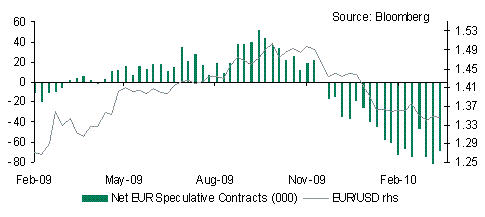
Markets were already embarking on a short covering exercise in EUR/USD early last week according to the latest CFTC IMM report which showed a reduction in net EUR short speculative positions. As a result of the weekend’s agreement the EUR looks set to consolidate its gains into the beginning of this week. Further out, there are still plenty of risks ahead and sellers are likely to emerge around EUR/USD resistance at 1.3696.


Data releases this week will be conducive to maintaining further support for risk appetite whilst shoring up recovery expectations. In particular US March retail sales are set to jump on the back of strong autos spending (consensus 1.2% monthly gain). March industrial production is also likely to record a healthy reading (consensus 0.7% month-on-month), whilst gains in both manufacturing (Empire manufacturing and Philadelphia Fed) and consumer confidence (Michigan confidence) for April are likely.

There will also be plenty of attention on Chinese data this week with a plethora of releases over coming days including FX reserves, GDP, loans data, inflation, retail sales and industrial production. In short, the data will continue to reveal a robust economic performance, which will be good for risk appetite and Asian currencies, but will also add to the pressure to revalue the Chinese currency, CNY, soon.

The USD impact will depend on whether the market reacts to firmer risk appetite or signs of stronger US growth. I suspect the former will apply for now, likely keeping the USD on the back foot early in the week. The main beneficiaries include risk currencies such as AUD, NZD and CAD as well as most Asian currencies. AUD/USD is set to target technical resistance around 0.9407 whilst NZD/USD will set its sights on resistance around 0.7252 over the next few days.

Greece In The Spotlight (again)

Once again Greek worries are hogging the limelight and although the Greek saga has become a rather tedious affair for markets, concerns are well founded.  The latest issue is whether Greece is willing to adhere to potentially tough measures that would be associated with IMF assistance for the country.  Latest speculation suggests that Greece may side step the IMF to avoid such measures though this was belatedly denied by the Greek authorities. 

Given the huge amount of bonds Greece needs to sell over the coming weeks renewed nervousness does not bode well for a good reception to this issuance. As it is financing costs are rising once again in the wake of a renewed widening in Greek sovereign bond spreads and servicing this debt will add to the economic misery.  Greece has little by way of upside over coming months and years.  Tough and necessary austerity measures mean that sharp growth deterioration is inevitable, deepening recession.

The lack of flexibility for Greece to devalue its way out of its quagmire means much more economic pain with no release valve.   The same applies to the likes of Spain and Portugal.  The overall loser will be the EUR which looks likely to succumb to further weakness in the months ahead; the parity trade remains a prospect. Perversely a weaker EUR may be exactly what is necessary to alleviate some of the pain for Southern European economies though the EUR would need to weaken by much more than we forecast to be of much help.   

Aside from Greek gyrations the overall market tone looks somewhat positive.  The Fed’s dovish minutes of its March 16 meeting in which it marginally downgraded growth and inflation forecasts, highlights that interest rates are unlikely to be raised by the Fed this year. This will keep in place an accommodative policy stance conducive to further improvements in risk appetite.     Moreover, data releases such as the US ISM manufacturing and non-manufacturing surveys, have been generally supportive to recovery,

Easing tensions on China/US exchange rate policy have also helped sentiment as the issue has been put to one side after the US administration delayed the decision whether to officially label China as a currency manipulator.  Pressure from the US Congress suggests that the issue will not be on the back burner for long and the issue of CNY revaluation will likely be a topic at the during the various meetings between US and Chinese officials over coming weeks. 

Nonetheless, the delay in the US Treasury report will work in favour of a Chinese currency revaluation sooner rather than later as China will likely react more favourable to less international pressure to revalue.

Disappointments Galore

Well the calm at the beginning of the week did not last very long.  Although the overnight price action can hardly be labelled as panic given both FX and equity volatility remain relatively well behaved, there is no doubt that worries are creeping back into the market psyche.  It seems that markets are once again trading on each piece of news and for the most part the news is not encouraging.  

A plethora of disappointments will set a negative tone for markets today.   Risk has come off the table in the wake of the worse than expected February German IFO business confidence survey and US Conference Board consumer confidence.   Cautious comments by Bank of England Governor King in which he kept the door open to further quantitative easing and a ratings downgrade of four of the largest Greek banks has added to the damage.

The German IFO was likely dealt a temporary blow by severe weather conditions.   The 10.5 point fall in US consumer confidence from an already relatively low level had no mitigating factors however, and revealed a deterioration in job market conditions, which combined with renewed weakness in jobless claims, does not bode well for next week’s US payrolls report, pointing to a decline of around 40k in February payrolls.

Overall, the market mood has darkened and there is little to turn sentiment around in the near term.  In prospect of likely weak reading for US payrolls next week and continuing worries about European fiscal/debt problems any improvement in risk appetite is likely to be limited.  This will help bond markets, the USD and JPY but most risk trades will face pressure. 

It is still worth being selective in FX markets.  The EUR remains the weak link and is set to struggle to make any headway, with upside likely to be restricted to resistance around 1.3747.  Similarly GBP is set to struggle in the wake of King’s comments as well as ongoing economic and deficit concerns, with GBP/USD vulnerable to a drop to around 1.5293.   In contrast, Asian currencies and commodity currencies look far more resilient.