What To Watch This Week

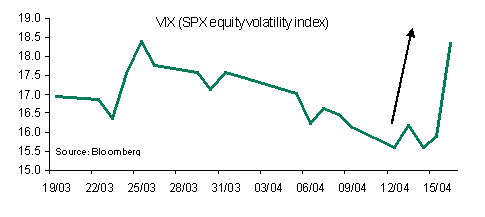
Well so much for a “risk on” week. Market sentiment soured at the end of last week following The US Securities and Exchange Commission (SEC) civil action against Goldman Sachs, in which they accused the bank of fraud. The impact reverberated across markets and risk trades were pulled back as a consequence. Bulls shouldn’t be too downhearted though as the drop in risk trades followed several days of gains and part of the pullback could be attributed to profit taking.

Speculation of similar probes in Europe by financial regulators will cast a shadow over markets early this week. Nonetheless, direction will at least in part come from earnings. So far the run of earnings looks upbeat, with around 83% of the 48 S&P 500 companies reporting, beating analysts’ estimates. Overall profits are forecast to increase by around 30% from a year ago but are on track to easily beat this estimate. Bellwether names including IBM, Apple, Coca-Cola, Boeing, Microsoft, and AT&T report this week.

The meeting between Greek officials, ECB, IMF and EU has been delayed until Wednesday. There is little likelihood of Greece seeing any loan money soon as the need for parliamentary approval in some EU countries and upcoming regional elections in Germany on 9 May will put a spanner in the works. An issue of EUR 1.5bn of 3-month Greek debt tomorrow will act another test of market confidence but the recent widening in Greek debt spreads suggests a less positive reception than the previous sale.

There are also a few central bank meetings to contend with this week including Canada, Sweden, India, Philippines and Thailand. The only Bank likely to hike interest rates out of this bunch is the RBI in India with another hike expected, following closely on the heels of the March move. Canada and Sweden are unlikely to shift policy until at last after the end of Q2 whilst protests in Bangkok, Thailand, and the knock on impact on consumer confidence, have effectively sealed the case for no rate move there.

On the data front, attention will turn to US housing market activity. Markets will be able to gauge further clues to whether recovery in the housing market has stalled. An increase in both existing (Thu) and new home sales (Fri) in March is expected, which may allay some concerns although any improvement is likely to continue to fragile against the background of tight credit and high foreclosure levels.

In Europe, aside from the ongoing Greek sage, sentiment surveys will garner most attention, with the release of the German ZEW (Tue) and IFO (Fri) surveys as well as manufacturing and service sector purchasing managers indices (PMIs) across Europe. On the whole the surveys are likely to reveal some improvement as confidence.

Risk aversion will be slightly elevated at the beginning of this week but strong earnings and improving data will help to prevent too much damage. Consequently Risk currencies will start the week under pressure but any pullback will be limited. Given that speculative positioning in risk currencies such as the AUD, NZD and CAD is well above their three-month average according to the latest Commitment of Traders’ IMM data there will be some scope for profit taking. EUR speculative sentiment has seen some improvement but EUR/USD remains vulnerable to a further pull back to technical support around 1.3302 this week.

What To Watch This Week

As usual the G7 meeting will leave markets with little to chew on. G7 officials maintained their commitment to stimulus measures and timely exit strategies but there was little of note for FX markets aside from the usual comments about wanting to avoid excess FX volatility. There was certainly know step up in pressure on China to strengthen though a report prepared for the meeting did push for countries with inflexible currencies to make adjustments. Meanwhile US officials mouthed the usual “strong dollar” mantra.

Where does this leave markets this week? Well I must admit my bullish view on risk currencies is clearly suffering after a positive start to the year. The pullback in high beta currencies (those with the highest sensitivity to risk aversion) has been dramatic. I have highlighted many of the factors weighing on sentiment in previous posts and whilst I still think the US dollar will find itself under renewed pressure over coming months the current environment remains conducive to more USD and JPY buying and selling of currencies such as the AUD, NZD, CAD, GBP, NOK, SEK, ZAR etc.

Ironically the US and Japan have arguably more severe deficit/debt concerns than some of the European countries under pressure but as most of Japan’s debt is held domestically there is little worry of a collapse in JGBs. Unlike Japan foreign investors hold over half of US debt but are not yet losing confidence with US Treasuries though this may not last unless there is some tangible sign that the burgeoning US budget deficit is being reduced. For now, attention remains firmly focussed on Greece, Spain, Portugal and to a lesser extent Italy.

Like the G7 meeting the US January jobs report released at the end of last week will give little direction for markets. Although the 20k drop in payrolls and revisions to past months were slightly disappointing the surprise drop in the unemployment rate was better news. This week’s data highlights include the January US retail sales report and December trade balance. The sales data is likely to help allay some concerns about faltering economic recovery, with retail sales forecast to rise over the month despite a likely pull back in autos spending.

How will this play out for currencies this week? Overall, the risk off tone is set to continue though the moves are looking increasingly stretched. The USD, JPY and CHF will remain on the front foot whilst risk currencies will remain under pressure. The EUR is set to continue to struggle against the background of eurozone deficit concerns and after its dive through 1.40 last week 1.35 now looms large. Meanwhile, the AUD may also struggle following the recent reassessment of interest rate expectations after the recent Reserve Bank of Australia (RBA) meeting in which interest rates were left unchanged.

UK markets will focus on the Quarterly Inflation Report from the Bank of England though the political situation may hold some interesting implications for GBP if polls continue to show that the gap between the governing Labour party and Conservative opposition continues to narrow. Prospects of a hung parliament will hardly hold any positive implications for GBP, a prospect which could limit any potential for GBP to recover ahead of May elections. The drop below 1.60 for Cable (GBP/USD) could extend further, especially as the BoE has kept the door open to further asset purchases if needed.

PIIGS fears fuelling risk aversion

Risk aversion has come back with a vengeance over the last 10 days driven by a host of concerns that continue to damage market sentiment. As has been evident over the past year the USD and JPY remain the best currency plays against the background of rising risk aversion and both currencies look well supported.

Market concerns are not going away quickly but some of the fears plaguing markets have at least receded especially on the US political front, with Obama’s State of the Union address, Geithner’s testimony on AIG and Bernanke’s reappointment all passing without too much incident, at least from a market perspective. I still believe that market fears are overblown but it is clearly evident that the market is not in the mood to concur. More pain is likely in the weeks ahead.

Euro-sovereign spreads continue to suffer from the ongoing Greek saga whilst the other major fear remains further monetary tightening in China. Rumours that China is about to imminently revalue the CNY are also running rife. The bigger than expected hike in the reserve ratio in India reflects the fact that Asia is on a faster track to tighten policy than Western economies.

As regular readers probably noticed, my articles on econometer.org have been sporadic recently. This is due to the fact that I have been on the road for the last two weeks giving client seminars across several countries in Asia. Without giving too much away it is evident that pessimism is pervasive and most investors I polled are looking for a “W” or “double dip” profile for economic growth in the G7 economies over coming months. Hardly anyone looked for a “V”.

The other casualty emanating from Greece’s woes, as well as worries that other European PIIGS (Portugal, Italy, Ireland, Greece, Spain) face ratings downgrades, is the EUR. EUR/USD slipped below the psychologically important level of 1.40 this week and is showing no sign of turning around. Warnings by S&P ratings that Portugal faces challenges on the fiscal front show that these sovereign concerns will be with us for a long while yet.

After letting investors believe that the European Commission would offer no support for Greece, there appears to be a growing realization that Greece is not simply a local problem but a Euro wide problem, as noted by European Commission President Barroso. Whilst this may be good for Greek debt the path to recovery is still likely to be a massively painful one, and the EUR may gain little support from this news.

The UK has not escaped the clutches of ratings agencies and warnings by S&P that UK banks are no longer among the “most stable and low-risk” in the world highlights the headwinds faced by GBP at present. The weaker than expected out-turn for Q4 GDP (0.1%) highlights the fact that UK economic recovery is fragile, which in turn plays negatively for the banking sector. This news has put a break on GBP but there appears to be plenty of demand for GBP above 1.600 vs USD.

Optimism dissipates

Markets have been highly fickle so far this year. Optimism about strong recovery led by China – recall the fact that disappointment from the surprisingly weak US non-farm payrolls report in December was outweighed by strong Chinese trade data – has dissipated. Instead of rejoicing at China’s robust GDP report last week, which revealed a 10.7% rise in the fourth quarter of 2009, investors began to fret about whether China would have to move more aggressively to tighten monetary policy. Fuelling these fears was the release of Consumer price data which showed inflation rising above expectations to 1.9% YoY in China.

If such fears were not sufficient to hit risk appetite, US President Obama’s plan to limit the size and trading activities of financial institutions dealt another blow to financial stocks. The plan followed quickly after the Democrats lost the state of Massachusetts to the Republicans and managed to shake confidence in bank stocks whilst fuelling increased risk aversion. Meanwhile, rumblings about Greece continue to weigh on markets and Greek debt spreads continued to widen even as global bond markets rallied.

Following the US administration’s plans to restrict banks’ activities the fact that the rise in risk aversion was US led rather than broad based led to an eventual pull back in the dollar which helped EUR/USD to avoid a break below 1.40. Risk trades including the AUD came under pressure as risk appetite pulled back. A drop in commodity prices did not help. The AUD was also hit by news that Australia’s Henry Tax Review would look to tax miners in the country. As a result AUD/USD dropped below 0.90 though this level is likely to provide good buying levels for those wanted to take medium term AUD long positions. The one currency that did benefit was the JPY which managed to drop below sub 90 levels.

The aftermath of the “Volker Plan” will reverberate around markets this week keeping a lid on equity sentiment. Meanwhile Greece will be in the spotlight especially its bond syndication. A bad outcome could be the trigger for EUR/USD to sustain a move below 1.40 though it looks as though it may find a bottom around current levels, with strong support seen around 1.4029. The German IFO business survey for January will be important to provide some direction for EUR and could be a factor that weighs on the currency if as expected it reveals some loss of momentum in the economy.

Aside from the Fed the other G3 central bank to meet this week is the Bank of Japan but unless the Bank is seen to be serious about fighting deflation, USD/JPY may remain under downward pressure against the background of elevated risk aversion. Below 90.0 there does appear to be plenty of USD/JPY buyers however, suggesting that further upside for the JPY will be limited. USD/JPY will find strong support around 88.84.

Much will depend on the key events in the US this week including the Fed FOMC meeting and the President’s State of the Union speech. USD bulls will look for some indication that the US government is serious about cutting the burgeoning budget deficit. Also watch out for the confirmation vote on the renomination of Bernanke as Fed Chairman which could end up being close. There is a heavy slate of data to contend with including new and existing home sales, consumer confidence, durable goods orders, the first glance at Q4 GDP and Chicago PMI.

What’s driving FX – Interest rates or risk?

The November US retail sales report has really set the cat amongst the pigeons. For so long we have become accustomed to judging the move in the USD based on daily gyrations in risk aversion. Well, that may all be about to change. There was an inkling that all did not look right following the release of the November jobs report which unsurprisingly helped to boost risk appetite but surprisingly boosted the USD too.

It was easy to dismiss the USD reaction to year end position adjustment, markets getting caught short USDs etc. What’s more the shift in interest rate expectations following the jobs report in which markets began to price in an earlier rate hike in the US was quickly reversed in the wake of Fed Chairman Bernanke’s speech highlighting risks to the economy and reiterating the Fed’s “extended period” stance.

However, it all has happened again following the release of the November retail sales data, which if you missed it, came in stronger than expected alongside a similarly better than forecast reading for December Michigan confidence. The USD reaction was to register a broad based rally as markets once again moved to believe that the “extended period” may not be so extended after all.

Interest rates will become increasingly important in driving currencies over the course of the next few months but if anyone thinks that the Fed will shift its stance at this week’s FOMC meeting, they are likely to be off the mark. No doubt the Fed will note the recent improvement in economic data but this is highly unlikely to result in a change in the overall stance towards policy.

Further improvements in US data this week including industrial production, housing starts, Philly Fed and Empire manufacturing may lead markets to doubt this but the Fed calls the shots and a potentially dovish statement may act to restrain the USD this week. Also, it’s probably not a good idea to rule out the influence of risk appetite on currencies just yet and with a generally positive slate of data expected, firmer risk appetite will similarly act as a cap on the USD this week.

Other than the US events there is plenty of other potentially market moving data to digest this week. More central banks meet this week including the Riksbank, Norges Bank and Bank of Japan. No change is expected from all three but whilst the Riksbank is set to maintain a dovish stance the Norges Bank meeting is a closer call. So soon after the emergency BoJ meeting, a shift in policy appears unlikely but the pressure to increase Rinban (outright JGB buying) operations could throw up some surprises for markets.

Europe also has its fair share of releases this week including the two biggest data for markets out of the eurozone, namely, the German ZEW and IFO surveys as well as the flash December PMI readings. The biggest risk is for the ZEW survey which could suffer proportionately more in the wake of recent sovereign concerns in the Eurozone. Sovereign names may still lurk to protect the downside on EUR/USD and if the USD finds it tougher going as noted above, the EUR may be able to claw back some of its recent losses.