Caution ahead of US payrolls

The weaker than forecast November US ISM non-manufacturing, a negative UK press report about the problems in Dubai and caution ahead of the US jobs report have dampened risk appetite overnight though there is expected to be little action until the release of the US jobs report today, with some USD short covering likely ahead of the release.  The jobs data could add to disappoint, with data this week including the ADP jobs report, and the employment components of the ISM surveys consistent with a worse than consensus (-125k) reading.  

It was encouraging however, that jobless claims revealed a further decline (457k) to its lowest since November 2008 indicating further improvement in the jobs market, though the data will have little bearing on today’s payrolls data which as noted above will likely disappoint expectations.  A below consensus may fuel some increase in risk aversion and a slightly firmer USD though markets are most likely to settle into ranges in the near term. 

The JPY may make up some lost ground against the background of weaker equity performance.  Amidst the confusing messages on the JPY over recent weeks officials appear to be giving stronger hints at intervention, leaving the currency on the back foot over recent days.  The drop in the JPY may prove temporary however, if official rhetoric is not followed up by action; USD/JPY is likely to struggle to break through resistance around 88.60.  

Following the BoJ’s disappointing JPY P10 trillion operation announced this week attention turns to the announcement of new government stimulus measures which were reportedly expected today.  This may also prove disappointing however, as there appears to be disagreement between coalition partners on the size and composition of stimulus.  Finance Minister Hatoyama was expected to announce additional spending of up to JPY 4 trillion.  

There was no surprise that the ECB left the refi rate unchanged at 1% yesterday but some surprise in the steps to withdraw provision.  The ECB announced that the interest rate on the December 12-month tender will be indexed to the refi rate and that the full allotment at most of the ECB’s refinancing operations is extended until 13 April 2010 only. As much as ECB President Trichet tried to play down the perception that the steps were a signal of a tighter policy markets are unlikely to interpret it this way. 

Despite the shift in the ECB’s stance EUR/USD pared gains after reaching a high around 1.5141 but failed to test resistance at 1.5150 which is likely to provide strong resistance in the days ahead, reflecting the fact that markets had priced in a hawkish shift by the ECB already.   Going forward, if the market perceives the ECB as prematurely shifting towards a more hawkish stance against the EUR could suffer rather than find any support from such actions
Gold / FX correlations

There is no shortage of cash rich investors in Asia even amidst the current troubles in Dubai. Indeed, sentiment in the gemstones market is particularly upbeat, with a rare five-carat pink diamond selling for a record HK$84.24 million in Hong Kong. Perhaps this is a good reflection of abundant liquidity and of course wealth in Asia and in particular China, with talk that mainland Chinese investors were strong participants in the diamond auction.

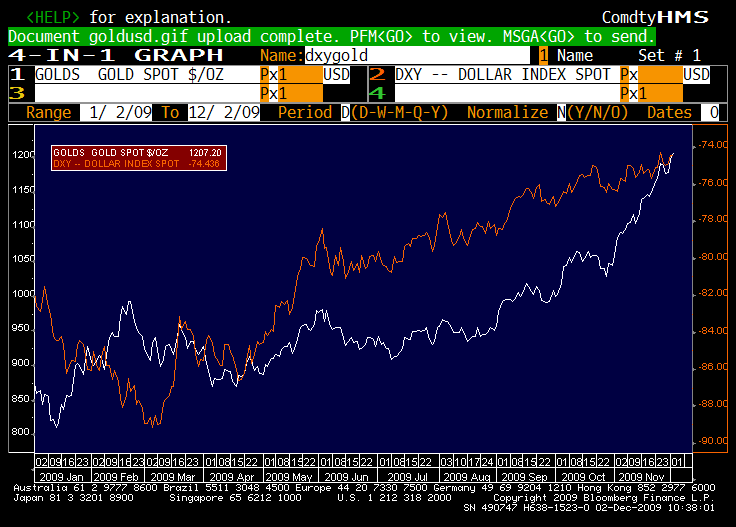
It’s not just diamonds that are selling for record prices; gold hit a fresh high above $1,200 and once again at least part of this is attributable to the appetite of Asian central banks as well as demand from China as the country tries to increase its gold reserves. The rise in gold prices has coincided with a bullish announcement from the world’s top gold producer that it has completely eliminated its market hedges earlier than forecast due to the positive outlook on prices and waning supply.

The correlation between gold prices and the USD remains very strong at -0.88 over the last 3-months, with firmer gold prices, implying further USD weakness. In fact, the gold / USD correlation has been consistently strong over the past few months and is showing little sign of diminishing.

Over the past 6-months the correlation has been -0.91 and over the past 1-month it was -0.75.  Assuming that anything above 0.70 can be considered statistically significant, the relationship shows that USD weakness has been well correlated with gold strength and that despite talk of a breakdown in the relationship it appears to remain solid. 

As long as the bullish trend in gold continues, the pressure on the USD will remain in place.  Adding to this pressure is the fact that risk is back on for now. Markets took the news of a fall in the ISM manufacturing index and in particular the drop in the employment component in its stride even though it supports the view of a weaker than consensus drop in payrolls in November when it is published on Friday.

There are still plenty of reasons to be cautious in the weeks ahead and although we appear to be back in a “risk on” environment markets are likely to gyrate between “risk on” and “risk off” over coming weeks. At least for now, the USD looks to remain under pressure but if risk aversion creeps back up as I suspect it may then the USD will see a bit more resilience into year end. 

Moreover, central banks globally are reaching the limits of their tolerance of USD weakness and will be tested once again, with EUR/USD back above 1.5000, EUR/CHF moving back below 1.5100 and the USD/JPY set to re-test 85.00 following the relatively benign measures announced by the BoJ in which the Bank did little to stem deflationary pressure or weaken the JPY.

Dubai’s aftermath

Dubai’s bolt out of the blue is hitting markets globally, with the aftershock made worse by the thin liquidity conditions in the wake of the US Thanksgiving holiday and Eid holidays in the Middle East.  The sell off followed news by government owned Dubai Holdings of a six month debt freeze.  Estimates of exposure to Dubai vary considerably, with European banks estimated to have around $40 billion in exposure though what part of this is at risk is another question. 

The lack of information surrounding the Dubai announcement made matters worse.  The aftermath is likely to continue to be felt over the short term, with further selling of risk assets likely.  Indeed, there is still a lot of uncertainty surrounding international exposure to Dubai or what risk there is to this exposure and until there is further clarity stocks look likely to face another drubbing.

The most sensitive currencies with risk aversion over the past month have been the JPY, and USD index, which benefit from rising risk aversion whilst on the other side of the coin, most Asian currencies especially the THB and KRW as well as the ZAR, and AUD look vulnerable to any rise in risk aversion.  JPY crosses look to be under most pressure, with the likes of AUD/JPY dropping sharply and these currencies are likely to drop further amidst rising risk aversion. 

The rise in the JPY has been particularly dramatic and has prompted a wave of comments from Japanese officials attempting to talk the JPY lower including comments by Finance Minister Fujii that he “will contact US and Europe on currencies if needed”.  So far, these comments have had little effect, with USD/JPY falling briefly through the key psychological level of 85.00, marking a major rally in the JPY from a high of 89.19 at the beginning of the week.  Unless markets believe there is a real threat of FX intervention by Japan the official comments will continue to be ignored.

It’s not all about risk aversion for the JPY, with interest rate differential playing a key role in the downward move in USD/JPY over recent weeks.  USD/JPY has had a high 0.79 correlation with interest rate differentials over the past month.  The US / Japan rate differential narrowed sharply (ie lower US rate premium to Japan) to just around 4.5bps from around 100bps at the beginning of August.  With both interest rate differentials and risk aversion playing for a stronger JPY the strong JPY bias is set to continue over the short term.

Is this the beginning of a new rout in global markets?  It is more likely another bump on the road to recovery, with the impact all the larger due to the surprise factor of Duba’s announcement as it was widely thought that Dubai was on the road to recovery.  The fact that the news took place on a US holiday made matters worse whilst the weight of long risk trades suggests an exaggerated fall out over the short term.

Buffer for risk trades

Firmer data, most recently in the form of the stronger than expected US consumer confidence and dovish Fed comments as reiterated in the Fed FOMC minutes will provide a buffer for risk trades, supporting the USDs role as the prime funding currency over coming weeks.  Nonetheless, any improvement in sentiment will have to push against the weight of position adjustment into year-end as investors book profits on risk trades.  The net effect could be an increase in volatility especially in thinning liquidity expected in the wake of holidays in Japan and the Thanksgiving holiday in the US.

This could make it difficult for many asset markets to sustain key psychological and technical levels.  Whether the S&P 500 can hold gains above 1100 could prove significant as could EUR/USD’s ability to hold onto gains above 1.50.  The expiry of last week’s EUR/USD 1.48/1.51 option may provoke a move out of its range but there seems to be little appetite for a sustained break above the 23rd October high around 1.5061.  Even so, an upside bias is more likely given the likely softer tone to the USD. EUR/USD looks well supported around 1.4865.

Position adjustment towards the end of the year has been particularly evident in FX markets.  For instance, the latest CFTC Commitment of Traders’ data revealed that speculative investors have sharply reduced net long EUR positions into last week whilst there was a significant degree of short covering of GBP positions.  It is worth noting however, that aggregate USD net short speculative positions actually increased, largely due to a sharp jump in net JPY positioning, suggesting that overall sentiment for the USD remains very negative.

It is difficult to see a strong reversal in USD sentiment into year-end and the Fed’s commitment to maintaining interest rates at a low-level for an “extended period” taken together with hints of extending asset purchase programmes suggests little support to the USD over the short-term unless there is a more significant increase in risk aversion and or profit taking/book closing into year-end.  It seems that the impact of improved risk appetite is winning for now, giving no respite to the USD.

Fed keeps the risk trade party going

Risk is back on and the liquidity taps are flowing. Fed Chairman Bernanke noted that it is “not obvious” that US asset prices are out of line with underlying values, comments that were echoed by Fed Vice Chairman Kohn, effectively giving the green light to a further run up in risk trades. The last thing the Fed wants to do is ruin a good party and the comments indicate that the surge in equities over recent months will not be hit by a reversal in monetary policy any time soon.  

Aside from comments by Fed officials risk appetite was also boosted by a stronger than forecast rise in US October retail sales, with US markets choosing to ignore the sharp downward revision to the previous month’s sales, the weaker than forecast ex-autos reading and a surprisingly large drop in the Empire manufacturing survey in November.

Fed comments were not just focussed on the economy and equity markets as Bernanke also tried to boost confidence in the beleaguered USD, highlighting that the Fed is “attentive” to developments in the currency.  He added that the Fed will help ensure that the USD is “strong and a source of global financial stability”.  The comments had a brief impact on the USD and may have given it some support but this is likely to prove short lived. 

The reality is that the Fed is probably quite comfortable with a weak USD given the positive impact on the economy and lack of associated inflation pressures and markets are unlikely to take the Fed’s USD comments too seriously unless there is a real threat of the US authorities doing something to arrest the decline in the USD, a threat which has an extremely low probability.

It is perhaps no coincidence that the Fed is attempting to talk up the USD at the same time that US President Obama meets with Chinese officials.  The comments pre-empt a likely push by China for the US not to implement policies that will undermine the value of the USD but comments by Obama appear to be fairly benign, with the President noting that the US welcomes China’s move to a “more market based currency over time”. The relatively soft tone of these comments will further dampen expectations of an imminent revaluation of the CNY.