JPY, SEK and GBP view

USD/JPY remains stuck within a tight range having reversed its recent break higher towards the 80.00 level, once again settling back below 79.00. Once again the main determinant of the exchange rate appears to be yield differentials and notably the JPY has had a very low sensitivity to gyrations in risk over recent months.

For JPY bears it it’s worth noting that US 2-year bond yields have began to edge higher this week, suggesting some upward pressure on USD/JPY. The speculative market remains net long JPY suggesting scope for a drop in JPY speculative appetite too, but any upside is set to be gradual, with a technical hurdle at around 79.37 likely to be tough level to break above.

EUR/SEK has edged higher over recent days following its dramatic multi month drop. Why has the currency pair turned now? One of the key factors appears to be an increased sensitivity to risk which is playing negatively now that risk aversion is rising again. Indeed my risk barometer has been moving higher since around the middle of the month, in turn dragging SEK lower.

My quantitative model estimate based on interest rate differentials, relative equity performance and risk aversion, suggests that the SEK has further to weaken especially against the EUR. Based on the results of the model I suggest playing for such a move, targeting 8.7252, with a stop loss at 8.1616.

Another currency for which I am bearish on versus EUR is GBP. Although the move higher in EUR/GBP has been a slow grind, I continue to see value in this trade. Indeed, my models show that there is still much upside potential left for EUR/GBP based on the current levels of yield differentials and risk aversion.

As for cable (GBP/USD) it appears to be stuck to the coattails of EUR/USD but I expect it to lag any move higher in EUR/USD going forward. Moreover, if as I expect EUR/USD loses momentum into next week, this will leave GBP/USD rather exposed to downside risks.

GBP vulnerable, AUD outperforms

Risk assets edged higher as the Bernanke effect rippled through markets. The fact that the Fed chief maintains and easing bias as reiterated to the Senate yesterday looks sufficient to provide a floor under risk assets over coming weeks. Sentiment was helped by a 6.9% jump in June US housing starts and positive earnings while the Fed’s Beige Book highlighted that growth was “modest to moderate’.

Q2 earnings have exceeded estimates for 72% of S&P 500 companies reporting so far providing a further element of support to risk assets. Hopes of further stimulus in China have also helped. Unfortunately all of this suggests that the market is looking for more artificial stimulus rather than underlying structural improvements. The efficacy of such stimulus is likely to more limited than in the past, suggesting plenty of scope for disappointment.

GBP took a hit on the chin yesterday as the Bank of England opened the door to a rate cut in the latest set of MPC minutes which were on balance seen as dovish. The currency will face another test today in the wake of the June retail sales report which could come in weaker than consensus.

Added to the fact that my quantitative models point to downside risks for GBP both against the USD and EUR the stars are aligning in the direction of growing GBP pressure over coming weeks. I look for GBP/USD to edge back town to technical support around 1.5518 while EUR/GBP is set to re test resistance around 0.7951 in the short term.

AUD’s outperformance continues unabated and the currency is set to make further strides in the days ahead. While AUD remains a relatively high beta currency, it is also a China play. In this respect it has benefited from expectations of more stimulus measures from China. Separately my risk barometer remains in ‘risk neutral’ territory, conducive for risk currencies.

While weak Aussie jobs data last week may have instigated a degree of caution into AUD bulls the currency is likely to continue to grind higher in the absence of a bout a rising risk aversion. Q2 inflation data next week will provide further direction but to be frank the market is already pricing in around 75bps of further policy rate cuts this year, and a benign inflation reading will do little to change this. The key resistance level on the top side for AUD/USD is 1.0475.

Risk and carry attraction increasing

The outcome of the EU Summit together with hopes of monetary stimulus has definitely helped to put a floor under risk appetite. Indeed, such monetary stimulus expectations are reflected in the price of gold which continued to rise overnight. Risk assets in general have maintained a positive tone recently and even forward looking indicators of global activity such as the Baltic Dry Index have been trending higher.

Although it is difficult to become too positive given the still very significant downdraft to global growth officials in Europe have bought some time to get their collective house back in order. Whether they will use it wisely is another question entirely. It is difficult to see much of a market move ahead of the ECB Council meeting and US June jobs report this week. Moreover, the US Independence Day holiday will keep trading subdued today.

My Risk Barometer has moved back into ‘risk neutral’ territory following several weeks of remaining in ‘risk hating’ territory. Consequently the backdrop for risk currencies has turned positive. Although FX trading has become more subdued amid summer conditions and a US holiday today as reflected in the drop in implied volatilities, there is a clear sense that investors are increasingly moving into carry trades.

My Yield Appetite Index {YAI) has surged over recent weeks, now at its highest in several months. I remain concerned that markets are addicted to stimulus while underlying economic conditions remain weak as likely revealed in today’s releases of June service sector purchasing managers’ indices in Europe.

Nonetheless, it seems likely according to my risk measures that the current tone of risk / carry attraction will persist for some weeks to come. The currencies that will benefit in an environment of improving risk appetite / yield attraction are the ZAR, MXN, PLN, CAD & NOK by order of magnitude of correlation with our risk barometer.

However, the beneficiaries are by no means limited to these currencies. Almost every currency except the ARS and PHP has a statistically significant correlation with the risk barometer. The only currencies that come under pressure as risk appetite improves are the USD and JPY given their negative correlations.

Currencies with healthy carry such as the AUD, which broke above its 200 day moving average versus USD overnight, will be even bigger beneficiaries as investors pile into carry trades over coming weeks as indicated by the jump in our YAI.

Notably there is plenty of scope to build carry positions as our speculative measure of yield attraction (based on CFTC IMM data) remains relatively low, suggesting that leveraged investors have still not jumped on the carry bandwagon.

Is gold losing its lustre?

Hopes and expectations of more Fed quantitative easing in the wake of a run of weak US data, including the US May jobs report, has been attributable to the bounce in gold prices over recent weeks. However, Fed Chairman Bernanke dampened such hopes in his speech to Congress, in which he did not indicate a desire to move towards more QE. The Fed is unlikely in my view to embark on more QE any time soon.

Clearly, should the Fed implement more QE it will help to renew the attraction of gold. Once again markets will see the consequences of Fed QE as a means to debase the USD. A shift in Fed stance cannot be ruled out if US economic conditions worsen further and/or the Eurozone crisis escalates. Assuming no more QE and no more USD debasement, gold prices ought to decline over coming months.

One of the biggest factors putting downward pressure on gold prices has been the strength of the USD. While I do not expect the USD to continue to strengthen at the same pace as it has done recently, further gradual gains in the currency are likely. My FX forecasts predict a further small gain for the USD index by the end of the year but I also believe that the recent run up in the USD may have been too rapid. Assuming that the USD continues on a gradual upward trajectory I expect it to exert a negative influence on gold prices.

Gold appears to have lost its sensitivity to risk aversion. Indeed, gold’s relationship with risk has actually inverted over recent months, with a negative but significant relationship registered over the past 3 months between gold prices and my Risk Aversion Barometer. In other words as risk aversion goes up, gold prices actually drop.

The lack of reaction to higher risk aversion shows that the lustre of gold as a safe haven has faded as investors pull capital out of this as well as many other asset classes. However, gold’s drop is not unusual when compared to other commodity prices, with oil and copper prices falling too and gold maintaining a strong correlation with these commodities.

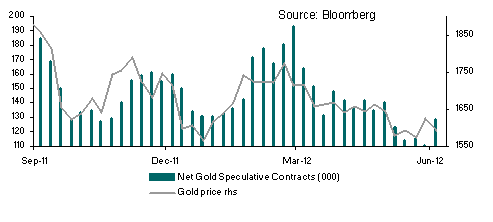
Some deterioration in sentiment towards gold prices has been reflected in the drop in speculative appetite for the commodity. Speculative demand for gold hit a cyclical high in August 2011 but since then there has been a steady reduction in appetite for gold from these investors. Indeed, CFTC IMM data reveals that speculative gold positioning dropped well below its three-month average. However, positioning is still well above its all time lows reached in February 2005, suggesting if anything, there is scope for more declines.
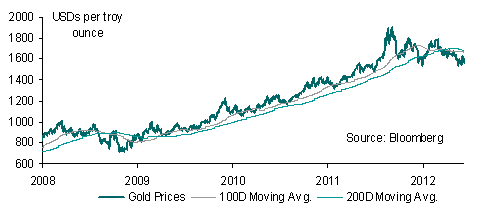
On top of the drop in speculative appetite for gold the technical picture has turned bearish. Since March 2009 at the height of the financial crisis the 100 day moving average price of gold had been trading above the 200 day moving average. On 27 March 2012 the 100 day moving average crossed below the 200 day moving average. Moreover, gold is now trading below both the 100 and 200 day moving average prices which sends a bearish technical message. Over the near term some key levels to look for are the 100 day moving average around 1658 on the topside and trendline support around the 1530 level on the bottom.
Another determinant of gold prices is demand from India and China. Growth in both countries is slowing, suggesting that gold demand is also weakening. While I certainly do not expect a collapse in demand from either country I have no doubt that compared to last year the strength of demand will be softer over coming months. Although I still look for a soft landing in China the Indian economic picture has clearly deteriorated while the Indian rupee has weakened. A weaker INR means that has become increasingly more expensive to import gold to India for domestic purchasers.

Overall, a weaker real demand picture taken together with reduced speculative appetite implies little support for gold prices. Moreover, a firmer USD in general will continue to weigh on prices. Perhaps a dose of inflation would help gold prices but there is little risk of this given the still sizeable amount of excess capacity in major economies.

Uncertainty about QE will help to limit any downside pressure on gold prices but elevated risk aversion will provide little assistance to gold. If however, the Eurozone and global picture deteriorates further gold will find itself with a lifeline but only if this means more currency debasement and a Fed engineered lower USD. If not, a further decline is on the cards and I forecast a drop in gold prices to around USD 1475 by the end of the year.

Risk assets rally, AUD jumps on strong jobs data

Risk assets rallied hard overnight overcoming, albeit temporarily, fears of a Eurozone calamity. The boost to markets appeared to come from hopes of stimulus on many fronts. Although the European Central Bank (ECB) did not cut policy interest rates President Draghi did note that he ‘stands ready to act’ if needed. This implies that rates cuts are in the pipeline very soon but any more action will require European politicians to act first. Following the G7 conference call there is also speculation that EU officials are coordinating some form of support for Spain, especially for its banking sector but details of what this will entail is lacking.

Meanwhile, speculation that the Fed will at least extend ‘Operation Twist” if not opt for a further round of quantitative easing has helped to support the uplift to sentiment. Further clues will come from Fed Chairman Bernanke’s testimony to Congress today although we don’t expect him to signal a policy shift. Markets are clearly grasping for any potential positives in the form of potential policy support but the risk of disappointment remains high, especially in Europe where policy makers have yet to reveal any fresh plans.

The USD dropped further overnight as risk currencies rallied. Market positioning had become very long USDs and some correction of long positioning / profit taking is obviously taking place Data releases did not provide any support to the currency although the Beige Book did note that the economy was continuing to grow ‘moderately’ which was perhaps less negative than it could have been. The USD may find some support from the Bernanke’s testimony today. Although the Fed chief is set to be cautious in his outlook he is unlikely to point to further stimulus at this stage.

It’s worth highlighting the Australian data this morning. Employment rose by surprisingly strong 38.9k. The details of the jobs report are even better than the headline. Full time employment was up 46.1k, while part time jobs were down 7.2k. The only slight negative is the rise in the unemployment rate to 5.1% but this was largely due to a rise in the participation rate to 65.5% from 65.2%. This is the second solid Australian reading in a row following on from the Q1 GDP data yesterday. Given today’s jump in risk assets the data will help compound AUD gains in the short term. AUD/USD will face strong resistance around 1.0021.