Q4 earnings and Chinese data

Since the start of the year the market has gyrated from “risk on” to “risk off” and back again. On balance the overall tone has been just about positive, with firmer economic data, most notably in China outweighing sovereign debt concerns in Greece and elsewhere. Although debt concerns are unlikely to dissipate quickly, especially given Greece’s inability to convince markets of its plans to cut its burgeoning budget deficit, the “risk on” tone is likely to win.

“Risk off” may be the tone at the start of the week however, as US equities ended the week on a negative note ahead of the Martin Luther King holidays. The holidays will likely keep trading slow. Data wise the main US events housing starts on Wednesday and the Philly Fed on Thursday. Q4 US earnings are likely to take a bigger share of market attention as the earnings season rolls on. Bank earnings will be a key focus, with Citigroup, Morgan Stanley, BoA, Wells Fargo and Goldman Sachs set to report this week.

Given the growing influence of Chinese data on markets the monthly data pack from China will capture more attention than usual on Thursday. In particular, GDP and inflation data will be of most interest. GDP data is likely to reveal an acceleration in growth in Q4 YoY to above 10% but given worries about over heating and following last week’s tightening in China’s monetary policy CPI data will be closely scrutinized. Inflation is likely to pick up further maintaining the pressure for further monetary tightening as well as a stronger CNY.

Elsewhere, in the eurozone the main event is the German ZEW survey tomorrow, which is likely to show further signs of flagging, due to Greek concerns. There is also an interest rate decision to contend with; the Bank of Canada is unlikely to surprise markets as it keeps policy unchanged tomorrow. The UK has a relatively heavier data slate, with CPI tomorrow, Bank of England minutes on Wednesday and retail sales at the end of the week.

The UK data kicked off on a positive note this week, with house prices rising 0.4% MoM in January and 4.1% YoY according to UK property website Rightmove, the biggest annual gain in over a year. Moreover, activity on Rightmove’s website reached a record high in the first full week of the year. The data as well as expectations that Kraft will raise its bid for Cadbury will likely help GBP in addition to other GBP positive M&A news. GBP/USD will look to test resistance around 1.6365 this week.

After a slightly firmer start helped by the weak close to US equity markets on Friday the USD is likely to generally trade on the back foot over the week. Speculative sentiment for the USD has definitely soured into the new-year as reflected in the CFTC IMM data which revealed a big jump in net short positions in the week ending 12 January 2010. Net aggregate USD positions shifted from +1.6k to -51.9k over the week, with the main beneficiaries being the EUR, and risk trades including AUD, NZD and CAD.
Modest growth in the G3 economies

A few themes are already becoming evident into 2010. Firstly, the dominance of China and any news on the Chinese economy is becoming increasingly apparent as reflected in the market reaction to trade data and hike in reserve requirements this week. Despite the odd setback the second theme that is developing this year is the “risk on” environment for asset markets. Another theme is the problems and concerns about sovereign debt and ratings, which will likely intensify further.

I could add one more to the list; the underperformance of the Eurozone economy, a theme that is likely to become more apparent as the year progresses. As markets become increasingly bullish about the prospects for China’s economy the opposite is true for the eurozone. Growth over Q4 2009 appears to have lost momentum according to recent data. There is however, expected to be a rebound in November industrial production but this will follow a weak October reading, leaving overall output in Q4 looking lacklustre.

Economic conditions in Japan do not seem to be improving any more quickly, especially in the manufacturing sector as reflected in the surprisingly sharp 11.3% MoM drop in machinery orders in November. Orders have dropped by a whopping 20.5% annually sending a very negative signal for capital spending in the months ahead. Uncertainty over demand conditions has likely restrained capital spending plans whilst the strong JPY has not helped.

The US economy is showing more signs of life but even here the improvements are “modest” as reflected in the Fed’s Beige Book. Consumer spending showed some, limited improvement, whilst manufacturing performance was said to be mixed. In particular, the Beige Book noted that labour market conditions remained soft, with wage pressures subdued. Overall, the report highlighted the likely lack of urgency in a prospective Fed reversal of monetary policy.

In contrast to the modest growth improvements seen in the G3 economies, Australia seems to be powering ahead. Australian jobs data revealed a bigger than expected 35.2k increase in employment and surprise drop in the unemployment rate to 5.5% in December. The only slight negative about the jobs data was that many of the jobs (27.9k) were due to temporary hiring. Nonetheless, the report will give a boost to the AUD aiming for a test of resistance around 0.9326, and solidify expectations for a rate hike next month, when the RBA is set to hike by 25bps.

What to watch this week

The 85k drop in US non-farm payrolls in December was obviously disappointing given hopes/expectations/rumours of a positive reading over the month.  There was a small silver lining however, as November payrolls were revised to show a positive reading of +4k, the first monthly gain in jobs since December 2007.  Overall, the US labour market is still gradually improving as the trend in jobless claims and other indicators show. 

The fact that the market took the drop in US payrolls in its stride highlights the fact that recovery is becoming more entrenched despite the occasional set back.  More significantly weaker US jobs disappointment has been countered by strong Chinese trade data, which showed both strong imports and exports growth in December.  Whilst the data, especially the strength in exports, will support calls for a stronger CNY, it also highlights China’s growing influence on world trade and the important role that the country is providing for global economic recovery.

Market resilience in the wake of the drop in US payrolls and positive reaction to Chinese trade data will maintain a “risk on” tone to markets this week.  In particular, the USD is set to start the week on the back foot and despite data last week showing that Eurozone unemployment reached an 11-year high of 10% and growing evidence that the Eurozone economy is falling behind the pace of recovery seen elsewhere, EUR/USD held above technical support (200 day moving average) around 1.4257, and is setting its sights on the 16 December 2009 high of 1.4591 helped by renewed Asian sovereign interest.  

The main event in the Eurozone is the ECB meeting on Thursday no surprises are expected, with the Bank set to keep policy unchanged whilst maintaining current liquidity settings.  The bigger concern for European markets is ongoing fiscal woes in the region, with press reports warning of a ratings downgrade for Portugal and still plenty of attention on Greece and its attempts at deficit reduction.  Fiscal concerns are not going to go away quickly and will clearly act as a restraint on market sentiment for European assets. 

In a holiday shortened week in the US as markets close early on Friday ahead of the 3-day MLK holiday, there are a number of data this week that will shed further light on the shape of US recovery. The main event is the December advance retail sales report on Thursday, which is expected to record a reasonable gain, helped by firm autos sales. 

Preceding this, tomorrow there is expected to be a renewed widening in the US trade deficit in November whilst on Wednesday the Fed’s Beige Book as well as various Fed speakers this week including Bullard, Lockhart, Fisher, Plosser, Evans and Lacker, will give important clues ahead of the January 27 Fed FOMC meeting.  Bullard sounded dovish in his comments in Shanghai, as he highlighted that US interest rates will remain low for some time. 

At the end of the week there will be a heavy slate of releases including December CPI, industrial production, capacity utilization, January Empire manufacturing and Michigan confidence. The outlook for these data is generally positive, with gains expected in both manufacturing and consumer confidence, whilst hard data in the form of industrial production is likely to record a healthy increase and CPI is set to reveal another benign reading.

“Risk On”- Which Currencies Will Benefit?

It was a “risk on” beginning of the week as equity markets rallied, commodities prices rose, and G10 bonds and USD came under pressure. Stronger manufacturing PMIs helped to boost confidence in the global economic recovery, with solid PMIs revealed in China, and across the rest of Asia, UK, and the US. The US ISM manufacturing which rose to its highest since April 2006 also revealed a rise in the unemployment component, consistent with view of an unchanged reading for December payrolls.

In the Eurozone the PMI matched the flash release and remained in expansion territory though there was some slippage in Germany, Spain, and Italy, underscoring the likely underperformance of the Eurozone economy relative to expectations of faster recovery in the US. Nonetheless, the PMIs continued to show a picture of expansion, with the Eurozone PMI at its highest in 21-months.

The USD lost ground against the background of improved risk appetite and looks set to fall further abruptly ending its short covering rally. The USD appears to be finding little support from interest rate expectations, with the correlation between most currencies and relative interest rate differentials remaining relatively low for the most part (just -0.04 over the past 3-months between the USD index and US rate futures).  The correlation between the USD and US 10-year bond yields looks somewhat stronger however, and could offer some relief to the USD if yields continue to push higher.

Speculative (CFTC Commitment of Traders) data reveals just how massive the shift in USD positioning has been over recent weeks, with net aggregate USD positioning (vs EUR, JPY, GBP, AUD, NZD, CAD, CHF) registering its first net long USD position since May 2008. The swing in positioning has been dramatic, from -167k contracts on 15 September 2009 to +8.7k in the week ending 29th December 2009. The data also reveals the sharp deterioration in sentiment for the EUR to its lowest since September 2008. Likewise net JPY positions have shifted to their biggest net short since August 2008.

What does this imply? The market is very short EUR and JPY but the JPY has much further to go on the downside as it increasingly retakes the mantle of funding currency.  In any case compared to historical positioning JPY shorts are not so big suggesting more room to increase short positions.   

The EUR has moved into a short term uptrend, with the MACD (12,26,9) having crossed its signal line and positioning supports further upside. EUR/USD will need to take out strong resistance at 1.4459 (December 29) before it can embark on a more significant move higher. Asian currencies also look set to take more advantage of a resumption of USD weakness, especially in the wake of strong risk seeking capital flows into the region. KRW, TWD, IDR and PHP look bullish technically.

Gold / FX correlations

There is no shortage of cash rich investors in Asia even amidst the current troubles in Dubai. Indeed, sentiment in the gemstones market is particularly upbeat, with a rare five-carat pink diamond selling for a record HK$84.24 million in Hong Kong. Perhaps this is a good reflection of abundant liquidity and of course wealth in Asia and in particular China, with talk that mainland Chinese investors were strong participants in the diamond auction.

It’s not just diamonds that are selling for record prices; gold hit a fresh high above $1,200 and once again at least part of this is attributable to the appetite of Asian central banks as well as demand from China as the country tries to increase its gold reserves. The rise in gold prices has coincided with a bullish announcement from the world’s top gold producer that it has completely eliminated its market hedges earlier than forecast due to the positive outlook on prices and waning supply.

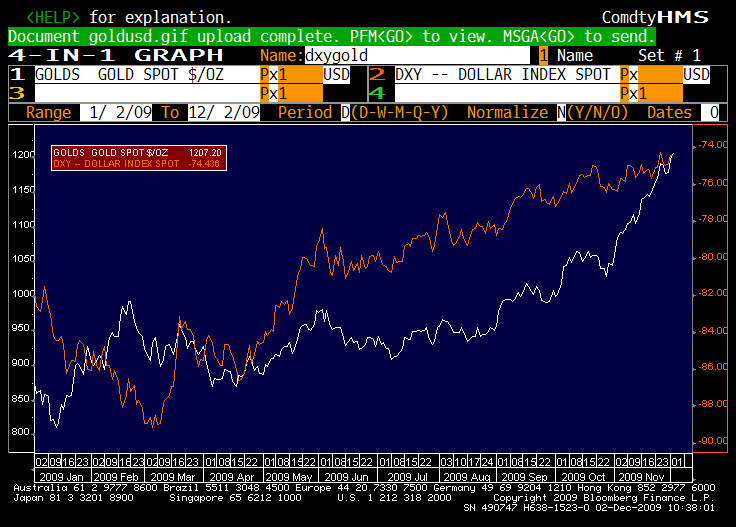
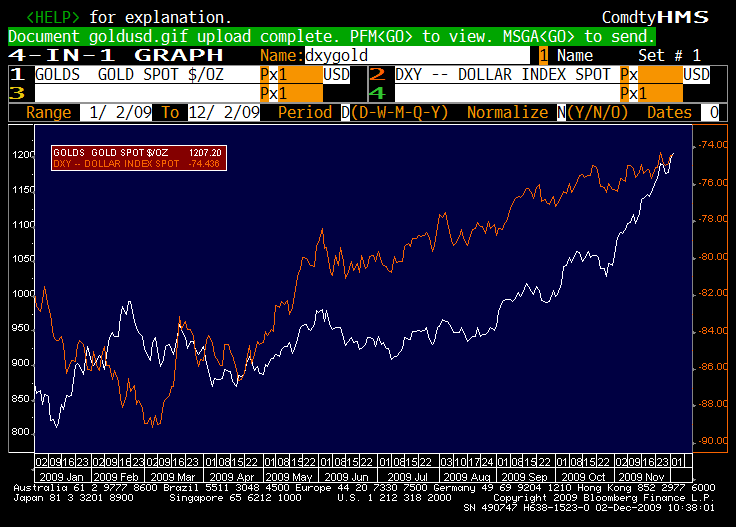
The correlation between gold prices and the USD remains very strong at -0.88 over the last 3-months, with firmer gold prices, implying further USD weakness. In fact, the gold / USD correlation has been consistently strong over the past few months and is showing little sign of diminishing.

Over the past 6-months the correlation has been -0.91 and over the past 1-month it was -0.75.  Assuming that anything above 0.70 can be considered statistically significant, the relationship shows that USD weakness has been well correlated with gold strength and that despite talk of a breakdown in the relationship it appears to remain solid. 

As long as the bullish trend in gold continues, the pressure on the USD will remain in place.  Adding to this pressure is the fact that risk is back on for now. Markets took the news of a fall in the ISM manufacturing index and in particular the drop in the employment component in its stride even though it supports the view of a weaker than consensus drop in payrolls in November when it is published on Friday.

There are still plenty of reasons to be cautious in the weeks ahead and although we appear to be back in a “risk on” environment markets are likely to gyrate between “risk on” and “risk off” over coming weeks. At least for now, the USD looks to remain under pressure but if risk aversion creeps back up as I suspect it may then the USD will see a bit more resilience into year end. 

Moreover, central banks globally are reaching the limits of their tolerance of USD weakness and will be tested once again, with EUR/USD back above 1.5000, EUR/CHF moving back below 1.5100 and the USD/JPY set to re-test 85.00 following the relatively benign measures announced by the BoJ in which the Bank did little to stem deflationary pressure or weaken the JPY.