SNB shakes up FX markets – Pressure now on Japan?

The action by the Swiss National Bank yesterday rippled through FX markets fuelling sharp moves across major currencies. In case you missed it the SNB introduced a currency floor in EUR/CHF at 1.20 and committed itself to buy FX in unlimited amounts. The last time the SNB did something similar was in 1978 when a ceiling was set against the Deutsche Mark. The sharp initial reaction to the news saw EUR/CHF jump by around 8.5% largely as a result of the shock from the announcement.

The SNB will not need to worry about the inflationary implications of pumping CHF into the market while it is clear that the currency is highly overvalued, supporting their cause. However, the real test will be evident over coming days and weeks in the commitment to hold the 1.20 level at a time when the situation in the eurozone periphery continues to deteriorate and demand for CHF remains strong. The risk is that the SNB may have simply set up a target for markets to attack. One other implication of the SNB’s move is that it could be a trigger for an intensification of ‘currency wars’.

The onus is now on the Japanese authorities to act more aggressively especially if safe haven flows focus increasingly on the JPY and less on the CHF given the new EUR/CHF floor. So far FX interventions have clearly not worked as was the case in Switzerland and Japan’s new Prime Minister is likely to want to prove his credentials. Japan has had a tendency to underwhelm with regard to JPY measures in the past and unless there is a major announcement today USD/JPY is likely to move lower again below 77.00.

Scandinavian currencies are also set to be beneficiaries of the SNB’s decision. EUR/SEK has come under increasing downside pressure over recent weeks even as risk aversion has intensified and it appears that safe haven flows out of Europe are now targeting Scandinavian currencies. As the CHF is now less attractive in this respect, the SEK as well as NOK will find themselves under further upside pressure over coming days and weeks. Both NOK and SEK versus EUR and USD have had insignificant correlations with risk over recent months, highlighting their appeal as anti-EUR currencies.
All eyes on G20

Although we move from feast to famine this week in terms of data there are still a few events that are noteworthy. In the US the September trade balance (Wed) will be of interest with a narrowing expected. Net exports negatively impacted GDP in Q3 but this is likely to reverse in Q4. Michigan confidence at the end of week is also likely to reveal better news with a rebound expected in October in the wake of firming equities, whilst the October budget statement is likely to reveal a sharp narrowing compared to October last year. Several Fed speakers over the week will be also be in focus as markets try to gauge the level of support within the FOMC for the QE2 announced last week.

There are a few data releases of interest in the eurozone including the preliminary estimate of Q3 GDP. Worryingly the divergence across the eurozone between healthier northern Europe and weaker performing in Southern Europe is becoming increasingly stark, a big headache for the Eurozone Central Bank with its one size fits all policy. Elsewhere, in the UK the Bank of England Quarterly Inflation Report will be scrutinized to determine whether recently firmer data and sticky inflation has pushed the BoE away from following the Fed into QE2. Japan’s volatile machinery orders data marks the highlight of its calendar, with a sharp drop expected in September following two strong months.

The main event of the week is the G20 leaders meeting in Seoul at the tail end of the week. Rhetoric going into the meeting suggests little support for the US plan to limit current account surpluses to 4% of GDP and even US officials appear to have cooled on the idea. Moreover the G20 meeting will probably elicit further reaction to the Fed’s QE2 announcement. Reaction was highly critical initially but seems to have softened lately. Currencies will nonetheless, remain the major topic of discussion although expectations of a global agreement are likely to be disappointed.

The Fed’s QE2 announcement helped provide a prop to risk assets and weighed on the USD last week despite the amount of asset purchases being within expectations. The USD will remain a sell on rallies this week and once again the best way to play USD weakness is likely via the higher yielding commodity currencies, especially AUD and NZD. Scandinavian currencies also offer a good way to capitalize on USD weakness.

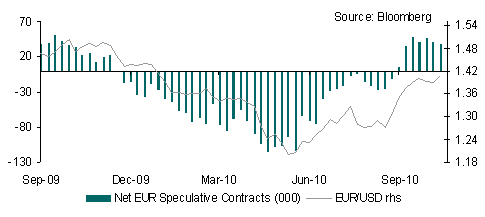
The EUR may also struggle this week given worries about peripheral Europe and widening in peripheral bond spreads. Ireland’s budget cuts announced last week have so far failed to shore up confidence whilst political uncertainties are also rising. Greece’s regional elections revealed that the ruling socialist party narrowly retained control allowing the government to continue with reforms suggesting a modicum of support for its debt. Nonetheless, with Irish and Portuguese sovereign worries continuing, the EUR will continue to lag. Notably the CFTC IMM data revealed that speculative EUR sentiment deteriorated in the latest week to its lowest in over a month. EUR/USD is likely to target 1.3864 after dropping swiftly below the 1.4000 level.

Perhaps best way to play EUR vulnerability is versus the AUD, with a further decline through 1.3800 likely to pave the way for a drop below the 13 September low around 1.3660. AUD/JPY may also be another cross worth exploring especially as Japan’s new fund begins buying JGBs today, which could limit JPY upside. A test of AUD/JPY 83.65 is on the cards shortly. If Australia’s October employment report on Thursday reveals another strong reading it will likely give the currency further support into the end of the week.