SNB shakes up FX markets – Pressure now on Japan?

The action by the Swiss National Bank yesterday rippled through FX markets fuelling sharp moves across major currencies. In case you missed it the SNB introduced a currency floor in EUR/CHF at 1.20 and committed itself to buy FX in unlimited amounts. The last time the SNB did something similar was in 1978 when a ceiling was set against the Deutsche Mark. The sharp initial reaction to the news saw EUR/CHF jump by around 8.5% largely as a result of the shock from the announcement.

The SNB will not need to worry about the inflationary implications of pumping CHF into the market while it is clear that the currency is highly overvalued, supporting their cause. However, the real test will be evident over coming days and weeks in the commitment to hold the 1.20 level at a time when the situation in the eurozone periphery continues to deteriorate and demand for CHF remains strong. The risk is that the SNB may have simply set up a target for markets to attack. One other implication of the SNB’s move is that it could be a trigger for an intensification of ‘currency wars’.

The onus is now on the Japanese authorities to act more aggressively especially if safe haven flows focus increasingly on the JPY and less on the CHF given the new EUR/CHF floor. So far FX interventions have clearly not worked as was the case in Switzerland and Japan’s new Prime Minister is likely to want to prove his credentials. Japan has had a tendency to underwhelm with regard to JPY measures in the past and unless there is a major announcement today USD/JPY is likely to move lower again below 77.00.

Scandinavian currencies are also set to be beneficiaries of the SNB’s decision. EUR/SEK has come under increasing downside pressure over recent weeks even as risk aversion has intensified and it appears that safe haven flows out of Europe are now targeting Scandinavian currencies. As the CHF is now less attractive in this respect, the SEK as well as NOK will find themselves under further upside pressure over coming days and weeks. Both NOK and SEK versus EUR and USD have had insignificant correlations with risk over recent months, highlighting their appeal as anti-EUR currencies.

FX Winners and Losers

There has been a sense of mean reversion in FX markets so far this year as some of last year’s winners have become losers. Namely NZD, CHF, JPY and AUD have all lost ground whilst EUR and GBP have gained ground. The odd one out is the SEK which has strengthened over 2010 and in 2011 versus USD. I expect this pattern to change and the likely winners over the next 3- months are NZD, AUD and CAD, with CHF and JPY the likely losers.

EUR held up reasonably well in the wake of slightly disappointing growth data, with eurozone GDP rising less than expected in Q4, and a smaller than expected gain in the February German ZEW investor confidence survey (economic sentiment component). My sense is that the net long EUR speculative position has already been pared back somewhat over recent days reducing the potential selling pressure on the currency in the near term.

Given that EUR/USD is one of the only major currency pairs being influenced by interest rate differentials, its direction will hinge more on policy expectations but in the near the announcement by the German Finance Minister this morning of a restructuring plan for WestLB may give the currency some support.

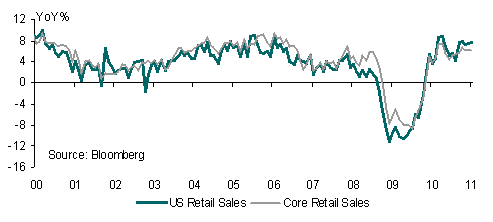
Perhaps one explanation for the stability of EUR/USD around the 1.3500 level is that US data was also disappointing yesterday. January retail sales rose less than forecast whilst revisions to back months suggest less momentum in Q4 consumer spending than previously envisaged. As with the eurozone data weather likely played a role in contributing to the outcome.

The net impact on currencies is that they are largely stuck within tight ranges. Further direction will come from the release of the Fed FOMC minutes for the January 26th meeting. The minutes may undermine the USD if a likely dovish slant continues to be expressed but given that the FOMC decision at that meeting to hold policy setting unchanged had no dissenters this should not come as a surprise.

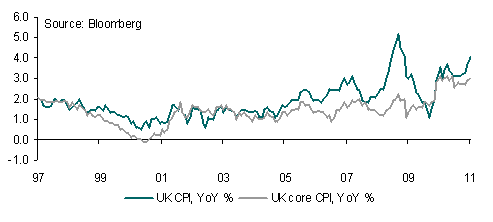
Whilst the battle between the USD and EUR ended in a stalemate GBP outperformed in the wake of the increase in UK January CPI inflation and in particular the letter from the BoE governor to the Chancellor keeping open the door to a rate hike. The Quarterly Inflation Report (QIR) today will be particularly important to determine whether the bounce in GBP is justified.

I remain hesitant to build on long GBP positions given the net long speculative overhang in the currency. The risks following yesterday’s jump in GBP are asymmetric, with a hawkish QIR likely to have less impact on the currency than the negative impact from a more dovish than expected report.

Econometer.org has been nominated in FXstreet.com’s Forex Best Awards 2011 in the “Best Fundamental Analysis” category. The survey is available at http://www.surveymonkey.com/s/fx_awards_2011

G20 Leaves The US Dollar Under Pressure

The G20 meeting of Finance Ministers and Central bankers failed to establish any agreement on clear targets or guidelines. Perhaps the problem of trying to achieve consensus amongst a variety of sometimes conflicting views always pointed to an outcome of watered down compromise but in the event the G20 summit appears to pass the buck to November’s summit of G20 leaders in Seoul where more concrete targets may be outlined.

Officials pledged to “move towards more market determined exchange rate systems” and to “refrain from competitive devaluation of currencies”. What does this actually mean? The answer is not a great deal in terms of practical implications. The first part of the statement is the usual mantra from such meetings and the addition of the latter part will do little to stop central banks, especially in Asia from continuing to intervene given that no central bank is actually devaluing their currency but rather preventing their currencies from strengthening too rapidly.

The communiqué highlighted the need for advanced economies being “vigilant against excess volatility and disorderly movements in exchange rates”, but once again this is the mantra found in the repertoire of central bankers over past years and is unlikely to have the desired effect of reducing the “excessive volatility in capital flows facing some emerging countries”. In other words many emerging countries will continue to have an open door to impose limited restrictions on “hot money” flows.

Although the language on currencies was stronger than in previous summits it arguably changes very little in terms of the behaviour of central banks and governments with respect to currencies. The communiqué is wide open to varying interpretations by countries and is unlikely to prevent the ongoing trend of USD depreciation and emerging market country FX appreciation and interventions from continuing over coming weeks.

The onus has clearly shifted to the November summit of G20 leaders but once again it seems unlikely that substantial agreements will be found. In the interim the November 3 Fed FOMC meeting will be the next major focus and if the Fed embarks on renewed asset purchases as widely expected FX tensions will remain in place for some time yet.

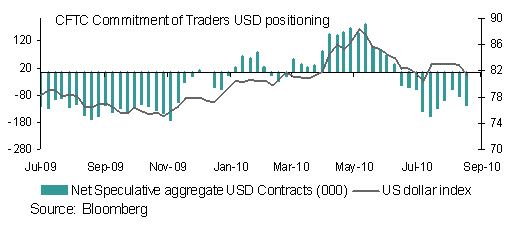
So whilst a “currency war” was always unlikely “skirmishes” will continue. In the meantime the USD is set to remain under pressure although it’s worth noting that speculative positioning has recorded a reduction in net aggregate USD short positions over the last couple of weeks, suggesting that some of the USD selling pressure may have abated. Whether this reflected caution ahead of the G20 meeting (as the data predates the G20 meeting) or indicated the USD having priced in a lot of quantitative easing (QE2) expectations already, is debatable.

The path of least resistance to USD weakness remains via major currencies including AUD, CAD and NZD. Officials in Europe are also showing little resistance to EUR strength despite the premature tightening in financial conditions and negative impact on growth that it entails. Scandinavian currencies such as SEK and NOK have also posted strong gains against the USD and will likely continue to show further outperformance.

The JPY has been the best performing major currency this year followed not far behind by the CHF despite the FX interventions of the authorities in Japan and Switzerland. Although USD/JPY is fast approaching the 80.00 line in the sand level expected to result in fresh FX intervention by the Japanese authorities, the path of the JPY remains upwards. Japan is unlikely to go away from the G20 meeting with any change in policy path as indicated by officials following the weekend deliberations.

The Week Ahead

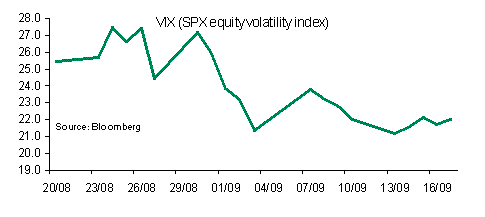
Equity markets and risk trades have generally performed well over the last couple of weeks, with for example the S&P 500 around 7.5% higher since its late August low, whilst equity and currency volatility have been generally low, the latter despite some hefty FX intervention by the Japanese authorities which did provoke a spike in USD/JPY volatility last week.

Risk appetite took a knock at the end of last week in the wake of worries that Ireland may seek EU / IMF assistance although this was denied by Irish officials. A similar worry inflicted Portugal, and as a result peripheral bond spreads were hit. Sovereign worries in Europe have not faded quickly and bond auctions in Greece, Spain and Portugal will garner plenty of attention this week. Renewed worries ahead of the auctions suggest that the market reception could be difficult.

Attention will swiftly turn to the outcome of the Fed FOMC meeting tomorrow and in particular at any shift in Fed stance towards additional quantitative easing following the decision at the August FOMC meeting to maintain the size of the Fed’s balance sheet. Given the recent improvement in US economic data the Fed is set to assess incoming data before deciding if further measures are needed.

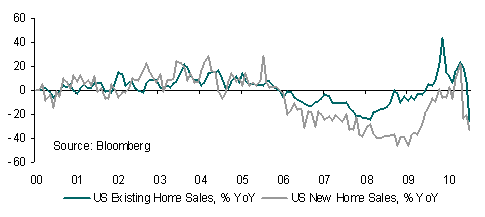
Housing data in the US will also garner plenty of attention, with several releases scheduled this week. Increases in August housing starts, building permits, existing and new home sales are also expected. Whilst this may give the impression of housing market improvement, for the most part the gains will follow sharp declines previously, with overall housing market activity remaining weak following the expiry of the government tax credit.

Weakness in house prices taken together with a drop in equity markets over the quarter contributed to a $1.5 trillion drop in US household net wealth in Q2. Wealth had been recovering after its decline from Q2 2007 but renewed weakness over the last quarter will not bode well for consumer spending. Household wealth is around $12.4 trillion lower than its peak at the end of Q2 2007.

Aside from the impact of renewed sovereign concerns, European data will not give the EUR much assistance this week either, with Eurozone September flash PMIs and the German IFO survey of business confidence set to weaken as business and manufacturing confidence comes off the boil. If the Fed maintains its policy stance whilst risk aversion increases over coming days the USD may find itself in a firmer position to recoup some of its losses both against the EUR and other currencies.

This will leave EUR/USD vulnerable to drop back down to around support in 1.2955 in the very short-term. As indicated by the CTFC IMM data there has been further short EUR position covering last week whilst sentiment for the USD deteriorated, suggesting increased room for short-USD covering in the event of higher risk aversion.

The impact of Sweden’s election outcome over the weekend is unlikely to do much damage to the SEK despite the fact that the coalition government failed to gain an outright majority. EUR/SEK has edged higher over recent days from its low around 9.1528 but SEK selling pressure is unlikely to intensify following the election, with EUR/SEK 9.3070 providing tough technical resistance.

Two-way FX risk returns

It appears that there is a bit of a sea change taking place in currency markets. Since early June the trend in currency markets would have looked like a one way bet to most casual observers. For instance, the USD index was declining fairly steadily and predictability as US growth worries intensified and markets anticipated a resumption of quantitative easing by the Fed. This changed quite dramatically over recent days, with a significant degree of two-way risk re-entering the market as the USD shook off worries about Fed quantitative easing and instead rallied in the wake of higher risk aversion.

The introduction of two-way risk into the market will cause a rethink of the increasingly fashionable view that the USD was about to embark on a renewed negative trend. This change in market perspective has coincided with renewed concerns about European sovereign risks, even as European growth has come in much stronger than expected over Q2. Other currencies have also lost ground against the USD more recently, with the notable exception of the JPY which remains close to the psychological level of 85.00.

Until recently the move in FX markets since early June contrasted with my view that Q3 would be a period of uncertainty and volatility. Improved risk appetite reflected a decline in uncertainty but whilst I now believe that Q3 will see less of an increase in risk aversion than previously anticipated, my core views remain unchanged. I see the USD resuming an appreciation trend against the EUR and funding currencies (JPY and CHF) whilst weakening against higher yielding risk currencies (AUD, NZD and CAD) over the medium term.

Although FX markets will likely gyrate between the influences of risk aversion on the one hand and growth/interest rates on the other, risk is likely to take the upper hand over the coming weeks. The influence of risk aversion has jumped sharply over the last few weeks for almost all currencies. As risk appetite was improving as it has done for much of the period since early June, it played negatively for the USD but the recent increase in risk aversion – brought about by renewed growth concerns, sovereign worries in the eurozone, with Ireland in particular coming under scrutiny – has managed to reverse this trend. The one-way bet for investors now appears to be over.

Only time will tell if the EUR’s recent bull run has come to an end but there is sufficient evidence to suggest that plenty of good news has now been priced in and that further upside will be much more difficult to achieve. Even the recently strong growth data in the eurozone has thrown up potential problems including growing divergence as well as the potential for a slowdown over coming quarters. Further strengthening of the EUR will be a particular problem for eurozone growth, especially for exporting countries such as Germany. In any case, even the recent drop in the EUR leaves the currency at an overvalued level and susceptible to further falls. Over the coming weeks a period of consolidation is likely, with the EUR set to take a weaker tone.

The JPY in contrast has shown little sign of weakening and continues to flirt with the key psychological level of 85.00 much to the detriment of the Japanese economy, leading to growing frustration from Japanese officials. Much weaker than expected Q2 GDP data has given even more reason to engineer a weaker JPY but as yet the only intervention has come verbally and even this has not been particularly strong. In the absence of FX intervention, the Japanese authorities may be forced to consider other options such as increasing outright JGB purchases.

Like the EUR and JPY, GBP will find it tough to extend gains against the USD especially given that the doves at the Bank of England will likely remain in the ascendancy as growth moderates. GBP is also less undervalued than it was just a few weeks back suggesting that the argument for GBP strength has weakened. Nonetheless, GBP is likely to outperform against a generally weaker EUR ending 2010 around 0.78.

Similarly, CHF will likely maintain its strength against the EUR in the short term but unlike GBP this will likely give way to weakness and a gradual move higher in EUR/CHF to around 1.37 by year end. An eventual improvement in risk appetite and some relative economic underperformance will undermine the case for holding CHF.

Scandinavian currencies are likely to struggle in the short term due to market nervousness about a US double dip in an environment of elevated risk aversion. Interest rates will also play an important role in driving NOK and SEK as will be the case for most currencies eventually. Divergence in rate views for Norway and Sweden suggests holding a short SEK long NOK position. Overall, with two-way risk now much more evident as many investors return from their summer break the FX market will look far less predictable than it did before they left.