Pressure, panic and carnage

Pressure, panic and carnage doesn’t even begin to describe the volatility and movements in markets last week. If worries about global economic growth and the eurozone debt crisis were not enough to roil markets the downgrade of the US sovereign credit rating after the market close on Friday sets the background for a very shaky coming few days. All of this at a time when many top policy makers are on holiday and market liquidity has thinned over the summer holiday period.

The downgrade of US credit ratings from the top AAA rating should not be entirely surprising. After all, S&P have warned of a possible downgrade for months and the smaller than hoped for $2.1 trillion planned cuts in the US fiscal deficit effectively opened the door for a ratings downgrade. Some solace will come from the fact that the other two main ratings agencies Moody’s and Fitch have so far maintained the top tier rating for the US although Fitch will make it’s decision by the end of the month.

Comparisons to 2008 are being made but there is a clear difference time this time around. While in 2008 policy makers were able to switch on the monetary and fiscal taps the ammunition has all but finished. The room for more government spending in western economies has now been totally used up while interest rates are already at rock bottom. Admittedly the US Federal Reserve could embark on another round of asset purchases but the efficacy of more quantitative easing is arguably very limited.

Confidence is shattered so what can be done to turn things around? European policy makers had hoped that their agreement to provide a second bailout for Greece and beef up the EFSF bailout fund would have stemmed the bleeding but given the failure to prevent the spreading of contagion to Italy and Spain it is difficult to see what else they can do to stem the crisis.

Current attempts can be likened to sticking a plaster on a grevious wound. Although I still do not believe that the eurozone will fall apart (more for political rather than economic reasons) eventually there may have to be sizeable fiscal transfers from the richer countries to the more highly indebted eurozone countries otherwise the whole of the region will be dragged even further down.

Where does this leave FX markets? The USD will probably take a hit on the US credit ratings downgrade but I suspect that risk aversion will play a strong counter-balancing role, limiting any USD fallout. I also don’t believe that there will be a major impact on US Treasury yields which if anything may drop further given growth worries and elevated risk aversion. It is difficult for EUR to take advantage of the USDs woes given that it has its own problems to deal with.

Despite last week’s actions by the Swiss and Japanese authorities to weaken their respective currencies, CHF and JPY will remain in strong demand. Any attempt to weaken these currencies is doomed to failure at a time when risk aversion remains highly elevated, a factor that is highly supportive for such safe haven currencies. From a medium term perspective both currencies are a sell but I wouldn’t initiate short positions just yet.
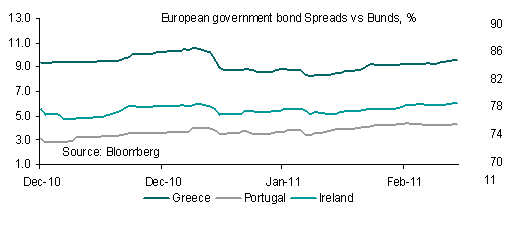
Eurozone peripheral tensions

The USD index remains under pressure but will likely continue to consolidate. The USD continues to be undermined by adverse interest rate differentials and is gaining little support from rising risk aversion. One factor that will help dictate USD direction over coming months is the prospects for further quantitative easing once QE2 ends.

Fed officials offered varied views on the subject. Dallas Fed President Fisher hinted he would support cutting short asset purchases before the end of June, whilst Atlanta Fed President Lockhart noted he was “very cautious” about further asset purchases. Meanwhile Chicago Fed President Evans noted that he believes the hurdle for altering the asset purchase plan is “pretty high”.

Although there is a lack of first tier data releases in the eurozone this week there is certainly plenty for markets to chew on in terms of peripheral country issues, which may just prevent the EUR from extending its gains. Eurozone peripheral debt spreads have undergone a renewed widening over recent weeks as debt fears have increased and worries that Portugal may follow Ireland and Greece in needing a bailout have risen.

Meanwhile news that Ireland’s incoming government will introduce legislation allowing the restructuring of some senior bank bonds, will add to tensions. Meanwhile, the downgrading of Greece’s government bond ratings to B1 from Ba1 dealt another blow sentiment following hot on the heels of Fitch’s downgrade of Spain’s outlook to negative although the EUR proved resilient to the news. EUR/USD continues to look as though it will consolidate around the 1.4000 level, but worsening sentiment towards the periphery may open up downside as the EUR’s resilience fades.

Upward revisions to eurozone growth and inflation forecasts and of course a hawkish shift in eurozone interest rate expectations may have justified the EUR move higher over recent weeks. However, there does not seem to be much that will provide the stimulus for further gains from current levels.

The market has already priced in an interest hike as early as next month’s European Central Bank (ECB) meeting and further tightening thereafter. The risk now appears asymmetric skewed to the downside especially if tensions between the eurozone core and peripheral countries deepen. How long the EUR can ignore such tensions?

It’s not only the eurozone periphery that should worry about ratings. Japan’s ratings agency R&I has warned that it may be forced to cut Japan’s sovereign ratings before April’s local elections due to current political problems. R&I’s concern revolve around the potential for political problems to delay fiscal reforms. As usual the JPY remains unmoved by political issues and is moving to the stronger side of its recent range against the background of elevated risk aversion.

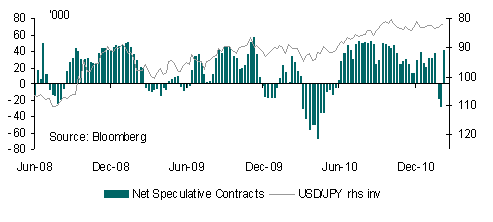
Although the JPY has not been particularly sensitive to risk over recent months shorter-term correlations shows that its sensitivity has increased. Given that Middle-East tensions do not appear to be easing the JPY will remain well supported. Indeed, speculative positioning data reveals the highest JPY net long position since November 2010. As risk appetite improves JPY positioning will be pared back but this is unlikely to be imminent, with USD/JPY set to remain close to support around 81.10.

Selling Risk Trades On Rallies

Disappointing earnings as well as a weaker than expected outcome for data on the health of the US service sector (the ISM non-manufacturing index failed to match expectations, coming in at 50.5 in January versus consensus of 51.0) has weighed on markets, undoing the boost received from the generally positive manufacturing purchasing managers (PMIs) indices earlier in the week. It was not all bad news however, as earnings from Cisco Systems beat expectations Meanwhile US ADP jobs data fell less than expected, dropping 22k whilst data for December was upwardly revised. These are consistent with a flat outcome for January non-farm payrolls.

Various concerns are still weighing on confidence. Sovereign ratings/fiscal concerns remain high amongst these and although much has been made of the narrowing in Greek debt spreads, attention now seems to be turning towards Portugal. Greece is also far from being out of the woods, and whilst the European Commission accepted Greece’s economic plans the country would be placed under much greater scrutiny by the EC.

The US has not escaped either, with Moody’s warning that the US AAA credit rating would come under pressure unless more stringent actions were taken to reduce the country’s burgeoning budget deficit. The move follows the US administration’s forecast of a $1.565 billion budget deficit for 2010, the highest as a proportion of GDP since the second world war, with the overall debt to GDP ratio also forecast to rise further.

The current environment remains negative for risk trades and the pullback in high beta currencies has been particularly sharp over recent weeks. Sentiment for the NZD was dealt a further blow from a surprisingly weak Q4 jobs report in New Zealand. Unemployment rose to a decade high of 7.3% over the quarter whilst employment growth contracted by 0.1%. The pull back in wage pressures will also be noted by interest rate markets, as it takes some of the pressure off the RBNZ to raise rates anytime soon.

Data in Australia will not help sentiment for the AUD too. Australian retail sales dropped by 0.7% in December, a worse than expected outcome. The data will only serve to reinforce market expectations that the RBA will no hike interest rates as quickly as previously expected. Nonetheless, I would caution reading too much into the data, with real retail sales volumes rising by a solid 1.1% over Q4 whilst other data showed a strong 2.2% jump in building approvals.

The overall strategy against this background is to sell risk trades on rallies. There are still too many concerns to point to a sustained improve in risk appetite. Moreover, the market is still long in many major risk currencies. Asian currencies have so far proven more resilient to the recent rise in risk aversion however, a reflection of the fact that a lot of concerns are emanating from the US and Europe. However, Asian currencies will continue to remain susceptible to events in China, especially to any further measures to tighten policy.

Further USD strength against this background is likely, which could see EUR/USD testing support around 1.3748, AUD/USD support around 0.8735, and NZD/USD support around 0.6916.