G20 Leaves The US Dollar Under Pressure

The G20 meeting of Finance Ministers and Central bankers failed to establish any agreement on clear targets or guidelines. Perhaps the problem of trying to achieve consensus amongst a variety of sometimes conflicting views always pointed to an outcome of watered down compromise but in the event the G20 summit appears to pass the buck to November’s summit of G20 leaders in Seoul where more concrete targets may be outlined.

Officials pledged to “move towards more market determined exchange rate systems” and to “refrain from competitive devaluation of currencies”. What does this actually mean? The answer is not a great deal in terms of practical implications. The first part of the statement is the usual mantra from such meetings and the addition of the latter part will do little to stop central banks, especially in Asia from continuing to intervene given that no central bank is actually devaluing their currency but rather preventing their currencies from strengthening too rapidly.

The communiqué highlighted the need for advanced economies being “vigilant against excess volatility and disorderly movements in exchange rates”, but once again this is the mantra found in the repertoire of central bankers over past years and is unlikely to have the desired effect of reducing the “excessive volatility in capital flows facing some emerging countries”. In other words many emerging countries will continue to have an open door to impose limited restrictions on “hot money” flows.

Although the language on currencies was stronger than in previous summits it arguably changes very little in terms of the behaviour of central banks and governments with respect to currencies. The communiqué is wide open to varying interpretations by countries and is unlikely to prevent the ongoing trend of USD depreciation and emerging market country FX appreciation and interventions from continuing over coming weeks.

The onus has clearly shifted to the November summit of G20 leaders but once again it seems unlikely that substantial agreements will be found. In the interim the November 3 Fed FOMC meeting will be the next major focus and if the Fed embarks on renewed asset purchases as widely expected FX tensions will remain in place for some time yet.

So whilst a “currency war” was always unlikely “skirmishes” will continue. In the meantime the USD is set to remain under pressure although it’s worth noting that speculative positioning has recorded a reduction in net aggregate USD short positions over the last couple of weeks, suggesting that some of the USD selling pressure may have abated. Whether this reflected caution ahead of the G20 meeting (as the data predates the G20 meeting) or indicated the USD having priced in a lot of quantitative easing (QE2) expectations already, is debatable.

The path of least resistance to USD weakness remains via major currencies including AUD, CAD and NZD. Officials in Europe are also showing little resistance to EUR strength despite the premature tightening in financial conditions and negative impact on growth that it entails. Scandinavian currencies such as SEK and NOK have also posted strong gains against the USD and will likely continue to show further outperformance.

The JPY has been the best performing major currency this year followed not far behind by the CHF despite the FX interventions of the authorities in Japan and Switzerland. Although USD/JPY is fast approaching the 80.00 line in the sand level expected to result in fresh FX intervention by the Japanese authorities, the path of the JPY remains upwards. Japan is unlikely to go away from the G20 meeting with any change in policy path as indicated by officials following the weekend deliberations.
Risk Aversion Back With A Vengeance

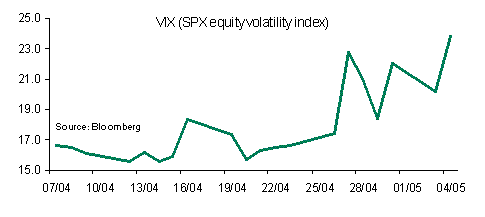
Risk aversion is back with a vengeance as reflected in the rise in equity volatility (VIX), drop in equity markets and rally in US Treasuries.  European peripheral debt markets sold off despite the EU/IMF aid package for Greece, whilst EUR/USD slid below 1.3000.  Various rumours dealt a blow to markets including talk of a sovereign ratings downgrade and a EUR 280 billion bailout for Spain.   The message is clear.  This situation is becoming increasingly dire by the day.  Europe is in big trouble and the whole euro project is under threat of unravelling.  

Concerns about parliamentary approvals, implementation/execution risk, prospects for relatively weaker growth in Europe, as well as contagion to Spain and Portugal, has tempered any enthusiasm towards the EU/IMF bailout package.  In addition, despite the large size of the EUR 110 billion loan package there are growing worries that it will be insufficient to cover Greece’s funding requirements over the next three years.  All of this implies that the EUR will remain under pressure for some time yet.  I have previously spoken about a drop to around EUR/USD 1.25 but the risk is for a much sharper decline is growing.

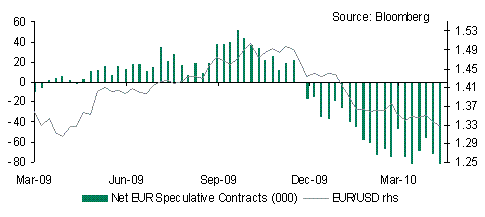
The USD is the clear winner, spiking to its highest level since May 2009 and is looking well set to consolidate its gains over the short-term despite the fact that net aggregate USD speculative positioning has already reached its highest level since September 2008 (according to the CFTC Commitment of Traders IMM data) in contrast to EUR positioning, which is at a record low.  This is unlikely to stand in the way of further downside for EUR/USD, with the next technical support level seen at 1.2885, which would match the previous lows see in April 2009.

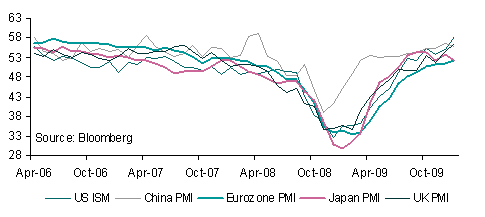
A combination of worries including contagion to Spain and Portugal, policy tightening in China, debt concerns in the UK and Japan, all threaten to undo the positive message from recent positive economic data including further strengthening in Purchasing Managers Indices globally.   The immediate attention remains on Greece and growing scepticism about the ability of Greece to carry out austerity measures in the face of rising domestic opposition, including a nationwide strike today. 

The rout in US and European markets will spill over to Asia, putting equity markets and Asian currencies under pressure.  Another risk currency to suffer is the AUD, which has dropped sharply following the Reserve Bank of Australia (RBA) meeting, in which the Bank indicated that rates were close to peaking.  Speculative positioning has dropped for the past two weeks as longs are taken off but AUD/USD weakness is set to be temporary, with buyers likely to emerge around near term support seen around 0.9001.

Greece Bailed Out, Euro Unimpressed

After much debate eurozone ministers along with the International Monetary Fund (IMF), finally announced an emergency loan package for Greece amounting to  EUR 110 billion. In return for the bailout Greece agreed to enhanced austerity measures. The good news is that the package covers Greece’s funding requirements until 2012, and is sufficient to avoid debt restructuring and default. The loan package has also removed uncertainty ahead of bond redemption on May 19th.

One aim of the package was to prevent contagion to other eurozone countries, especially Portugal and Spain, where there has been growing pressure on local bond and equity markets. However, the path ahead is strewn with obstacles and it is too early to believe that the package has ensured medium term stability for the EUR.

The challenges ahead are two-fold, including both the implementation of the measures in Greece in the face of strong domestic opposition and the approval of the loans by individual country parliaments within the eurozone, both of which are by no means guaranteed.

The toughest approval process is likely to be seen in Germany where the government will face a grilling in parliament and a challenge in the constitutional court ahead of official approval of the package. European Union leaders are scheduled to meet on May 7th to discuss the parliamentary approval of loans to Greece whilst German officials meet on the same day.

Implementation risk is also high. Although the Greek government appears to be sufficiently committed, opposition within Greece is growing; various strikes planned over coming days. Aside from union opposition, the scale of the budgetary task ahead is enormous, having never been undertaken on such a large scale in recent history. The sharp decline in growth associated with the austerity measures will make the task even harder.

The EUR bounce on the news has been limited, with the currency failing to hold onto gains. The announcement seems to have triggered a “buy on rumour, sell on fact” reaction, with the size of the loan package falling within the broad estimates speculated upon over the last week. The lack of EUR bounce despite the fact that going into this week the CFTC Commitment of Traders report revealed record net short speculative positioning in EUR/USD, reveals the extent of pessimism towards the currency.

The EUR may benefit from a likely narrowing in bond spreads between Greece and Germany. Given that sovereign risk is being increasingly transferred from the periphery to the core, the net impact on bond markets may not be so positive for the EUR. Over the short-term there will be strong technical resistance on the upside around EUR/USD 1.3417 but more likely the currency pair will target support at around 1.3114.

The Herculean task ahead for the Greek government suggests that markets will not rest easy until there are credible signs of progress. Investors would be forgiven for having a high degree of scepticism given the degree of “fudging” involved in the past, whilst Greek unions will undoubtedly not make the government’s task an easy one by any means. Such scepticism will prevent a sustained EUR recovery and more likely keep the EUR under pressure.

As noted above the divergence in growth for the eurozone economy between Northern and Southern Europe will make policy very difficult. Moreover, the EUR is set to suffer from an overall weak trajectory for the eurozone economy, relative to the US and other major economies. The widening growth gap with the US will also fuel a widening in bond yield differentials, a key reason for EUR/USD to continue to decline to around or below 1.25 by the end of the year.

US Dollar Déjà vu

The USD is in a win-win situation at present.  Good economic data in the US helps to advance expectations of US monetary tightening, lending the USD support, regardless of the positive impact on risk appetite.  Similarly, bad economic news is also supporting the USD as it leads to higher risk aversion.  Either way the USD has surged over the past few weeks, appreciating by close to 5% since its low on 25 November. 

There was a similar but directionally opposite move in the USD last year taking place from almost the same time.  The USD index hit a high around 21 November 2008 but fell by over 10% in just less than a month.  If the same pattern is repeated this year the USD index has much further to strengthen although it is worth noting that the drop in the USD last year reversed practically to this day a year ago, with the USD subsequently rising by close to 13% in the next few months. 

Given that the move at the end of last year may not be the best comparison given the distortions due to the crisis and massive repatriation to the US in Q1 2009 it’s worth looking at what happened in 2006 and 2007 for a better comparison.   From the beginning of December 2006 to 11 January 2007 the USD strengthened by 3.5% but then dropped by around 4.5% within the next 3 months.  Similarly, the USD strengthened by close to 4% from the end of November 2007 to 20 December 2007.  However, the USD dropped by over 8% in the three months after.  So what I am saying is that it is way too early to suggest that the USD rebound will be sustained over coming months and judging by past evidence all its doing is proving better levels to sell for a subsequent decline over Q1 2010.   

Is the USD really in a win-win situation? Well, the more plausible explanation is perhaps a bit more simplistic.  It’s year end and the market is squaring up, with FX moves being exaggerated by thinning liquidity.  There is some support to this theory from the CFTC Commitment of Traders IMM data which revealed a sharp reduction in net aggregate USD short positions in the latest week, with a further sharp reduction in net short positions expected in next week’s release. 

Whilst it is too early to buck the trend yet, going into early next I look for a reversal of the recent appreciation in the USD against the background of improving risk appetite and US interest rates that are unlikely to go for a long while yet.

No relief for Sterling

Anybody in the UK thinking of taking a holiday overseas has had to think twice over recent months given the precipitous drop in the pound (GBP) that took place since the beginning of August 2008. At the lowest point around six months after the British pound began its decline it had lost around a third of its value against the US dollar. Against the euro, sterling has fared even more poorly over a longer period, with GBP losing around 45% of its value from the beginning of 2007.

Since then GBP has recovered but has given back some of its gains over recent weeks against the dollar but has continued to weaken against the EUR. The worsening in GBP sentiment has been particularly well reflected in CFTC data on speculative positioning which revealed a drop to an all time low in GBP speculative contracts in contrast to EUR speculative contracts reaching close to the year high.

GBP faces headwinds from expectations that the Bank of England will extend its quantitative easing especially in the wake of recent data whilst news that the Center for Economics and Business Research (CEBR) predicted that the Bank of England (BoE) will keep its base rate unchanged until at least the end of 2011 came as another blow.

Although currencies are not particularly sensitive to interest rate movements at present it is unlikely to be long before the historically strong FX/interest rate relationship re-exerts itself and if UK policy is likely to remain accommodative for a prolonged period this could be detrimental to GBP’s recovery prospects. It seems unlikely that the BoE will wait as long as the CEBR predict before raising interest rates although a rate hike anytime in 2010 also looks unlikely.

There is at least some hope that aggressive UK monetary policy will deliver a relatively quicker economic recovery than in the eurozone where policy has arguably been much less aggressive and this relatively more positive cyclical picture will eventually result in some strengthening in GBP.

Nonetheless, the interim outlook continues to look bleak and sentiment is likely to continue to deteriorate over the short term. EUR/GBP now looks on path to retest its high reached at the end of 2008 at just over 0.98 (or around 1.02 for those that prefer to look at GBP/EUR) whilst GBP/USD appears to be heading for a move back below 1.55 and back to around 1.50.

Perhaps one of the only positive things that GBP has going for it at present is that looks very undervalued and when recovery does happen it could bounce back quite quickly and aggressively as markets cover their short positions. In the meantime, the good news of low interest rates will at least benefit borrowers and mortgage holders holding GBP denominated loans but not anyone in the UK wanting to take a holiday overseas.