Euro slides as Greek worries intensify

The USD ended last week on high a note having overcome speeches by Fed Chairman Bernanke and President Obama. Bernanke’s lack of detail on potential further Fed stimulus offered the USD a lifeline as there was no mention of QE3 but nervousness may mount ahead of the September 21 FOMC meeting.

This week’s data releases (including retail sales, inflation, industrial production and regional manufacturing surveys may offer some direction to the USD and it is likely that the data over coming days will look less negative than in past weeks, giving the USD some support. Having broken above its 200 day moving average around 76.1986 for the first time in a year the USD index is set to begin the week in positive mode and will likely extend its gains over coming days.

In sharp contrast, EUR/USD crumbled at the end of last week dropping through its 200 day moving average despite positive news from Germany (rejection of bills in the constitutional court) and Italy (passage of austerity measures). The European Central Bank (ECB) did not help the EUR’s cause however, with the change in its stance to a more balanced assessment of risks from its more hawkish stance previously.

However, the real damage occurred as speculation of a Greek default intensified and ECB hawk Stark resigned from the ECB council, highlighting the divisions within the governing board. This week attention will remain on Greece as negotiations between the Troika (ECB, EU and IMF) and Greek officials resume.

Ahead of the talks Greece approved a further EUR 2 billion in austerity measures over the weekend but nonetheless, despite denials by Greek officials speculation of a debt default will continue to hammer the EUR lower. Near term technical support is seen around 1.3525 for EUR/USD.

GBP found some relief last week following the decision by the Bank of England to leave policy unchanged though it is unlikely to be able to make much if any headway against the USD over coming sessions as expectations of further UK quantitative easing may simply have been pushed back to the November meeting.

Inflation data this week will give further clues to policy but once again there is likely to be no sign of any easing in inflation pressure, limiting the room for maneuver for the BoE. Moreover, a weak outcome for UK retail sales in August will maintain the trend of soft UK data keeping up the pressure for more BoE action. As a result GBP will struggle against the USD but given that problems in Europe look even worse, GBP will likely extend gains against the EUR this week.
Euro pressure mounts

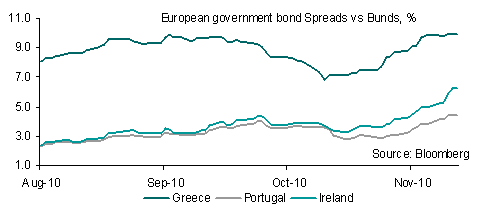
The effects of eurozone peripheral bond concerns are cascading through eurozone markets and hitting risk appetite in the process. The EUR is a clear casualty having dropped further against the USD and versus other currencies. EUR/Asian FX remains a sell in the current environment. Contagion outside Greece, Portugal and Ireland had been limited but Italy and Spain have also seen a growing impact on their bond markets. Having broke below support around 1.3734, EUR/USD will target 1.3508 support.

Speculation that Ireland will be forced to follow Greece in seeking international financial support has intensified. Although Ireland has sufficient funds to last until next spring, yields on its debt are already higher than Greek debt before it received funds a few months back. Attention is firmly fixed on the country’s budget on 7 December and the prospects of an agreement between the government and opposition in its austerity plans.

Not helping is the fact that the Irish government has a very slim majority. Even if the budget is passed there is no guarantee that sentiment will improve given the negative impact of even deeper fiscal tightening announced last week will have on economic growth. Moreover, Germany’s insistence that the cost of any Greek style bailout should be borne mostly by private investors has only added to market tension. Even the European Central Bank is unlikely to provide much support, with ECB member Stark suggesting that ECB bond purchases will remain limited.

This leaves eurozone markets in a precarious state and the EUR continues to look heavy as further downside opens up. Moreover, the problems in peripheral Europe are beginning to have a broader impact on risk appetite, with equity markets slipping, although some of this was related to a weaker sales forecast from Cisco in the US. Nonetheless, spreading risk aversion could also dampen sentiment for Asian currencies, which is why selling EUR/Asian FX looks a better bet than selling USD/Asian FX over the short term.

In contrast sentiment for the US is undergoing an improvement. Data releases over recent weeks have generally beaten forecasts and there is even growing speculation that the Fed’s calibrated asset purchases may end up being smaller than planned. Such speculation has boosted the USD but it is premature to suggest that the Fed is on the verge of scaling back asset purchases even as the program of purchases gets going. Although there are clearly some FOMC members who are opposed to significant asset purchases the probability that the Fed remains set to carry out its full $600 billion of planned purchases.

Attention today will focus squarely on day 2 of the G20 meeting and any resolution to disputes over trade imbalances and currencies. Unfortunately none is likely to be forthcoming. Despite a reported 80 minute meeting between US and Chinese leaders little agreement was reached, with plenty of finger pointing remaining in place. It appears that the mantra of moving towards “market-determined exchange rates” and efforts at “reducing excessive imbalances” as agreed at the G20 meeting of finance ministers and central bankers will be as far as any agreement reaches. As a result markets will be left with very little to chew on.