Q1 Economic Review: Elections, Recovery and Underemployment

I was recently interview by Sital Ruparelia for his website dedicated to “Career & Talent Management Solutions“, on my views on Q1 Economic Review: Elections, Recovery and Underemployment.

Sital is a regular guest on BBC Radio offering career advice and job search tips to listeners. Being a regular contributor and specialist for several leading on line resources including eFinancial Careers and Career Hub (voted number 1 blog by ‘HR World’), Sital’s career advice has also been featured in BusinessWeek online.

As you’ll see from the transcript of the interview below, I’m still cautiously optimistic about the prospects for 2010 and predicts a slow drawn out recovery with plenty of hiccups along the way.

Sital: Mitul, when we spoke in December to look at your predictions for 2010, you were cautiously optimistic about economic recovery in 2010. What’s your take on things after the first quarter?

Click here to read the rest…

Greek Saga Rumbles On – Does Anybody Care?

The debate over Greece continues to rumble on. France and Spain requested a separate summit meeting of the 16 heads of eurozone countries immediately before the full 27-member EU summit starting tomorrow but this was met with resistance. Meanwhile, Germany has called for “a substantial contribution” from the IMF towards a Greek aid package, whilst maintaining that no EU deal will be reached for Greece at the summit.

Frankly, the whole Greek saga has become extremely boring, with the lack of agreement about how to fix it doing little to inspire confidence. In particular the fractured opinion amongst EU leaders highlights the difficulties in reaching an agreement in a union made up of so many conflicting interests. At most the summit may agree on the conditions for a rescue package for Greece rather than a package itself. This will leave markets unimpressed,

US new home sales data today is likely to paint a slightly better picture with a small gain expected, albeit following the 11.2% plunge in the previous month. Sales will be helped by the extension of the home buyer tax credit. The US February durable goods orders report is also released today, with a small increase expected. A smaller gain in transport orders suggests that the 2.6% jump last month will not be repeated.

In Europe, the key release is the March German IFO business climate survey and a rebound is likely following February’s decline, helped by warmer weather and a weaker EUR. Flash readings of Eurozone March purchasing managers indices (PMIs) are also released but these are unlikely to extend gains from the previous month. Despite expectations of firmer data the EUR/USD is vulnerable to a further decline, with support around 1.3432 in sight for an imminent test.

Attention in the UK will turn to the pre-election Budget and particularly the government’s plans to cut spending and reduce the fiscal deficit. Failure to provide a credible blue print to restore fiscal credibility will damage confidence, heightening the risks of an eventual sovereign ratings downgrade and more pressure on GBP which appears destined for another drop below 1.50 versus USD.

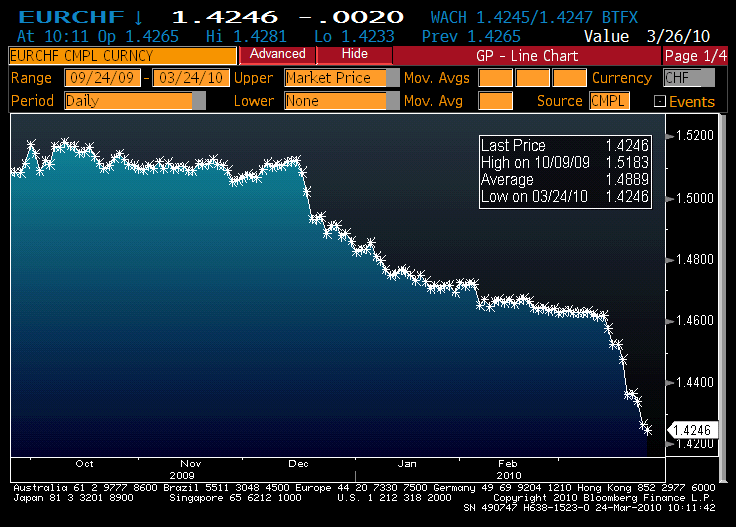
Most currencies have remained within ranges and the most interesting currency pair is EUR/CHF having failed to react to verbal warnings from the Swiss National Bank (SNB) about excessive CHF strength. EUR/CHF looks vulnerable to a further decline unless the SNB follows up rhetoric with action. Even if there is FX intervention by the SNB it may prove to be a temporary barrier to a market with an eye on the psychologically important 1.4000 level.

Despite the pressure on the Japanese government and Bank of Japan (BoJ) to engineer a weaker JPY, export performance has proven resilient, with exports jumping 45.3% on the year in February, helped by the strength of demand from Asia. Unfortunately this is doing little to end Japan’s deflation problem and even if there is less urgency for a weaker JPY to boost exports, JPY weakness will certainly help to reduce deflationary pressures in the economy. USD/JPY is stubbornly clinging to the 90.00 level, with little inclination to move in either direction.
Fed discount rate move boosts dollar

The Fed’s move to hike the discount rate by 25bps has set the cat amongst the pigeons.   Although the move was signalled in the FOMC minutes yesterday a hike in the discount rate was not expected to happen so soon.  The Fed sees the modifications which also include reducing the typical maximum maturity for primary credit loans to overnight, as technical adjustments, rather than a signal of any change in monetary policy. 

Nonetheless, the market reaction has been sharp, with the USD strengthening across the board and short term interest rate and stock futures falling.  Although the reaction looks overdone and will likely be followed by some consolidation over the short term, the move will be interpreted as the beginning of a move towards monetary policy normalisation despite the Fed’s insistence that this is not the case.  The firm USD tone is set to remain in place for now but the bulk of the strengthening has likely already occurred following the announcement.  

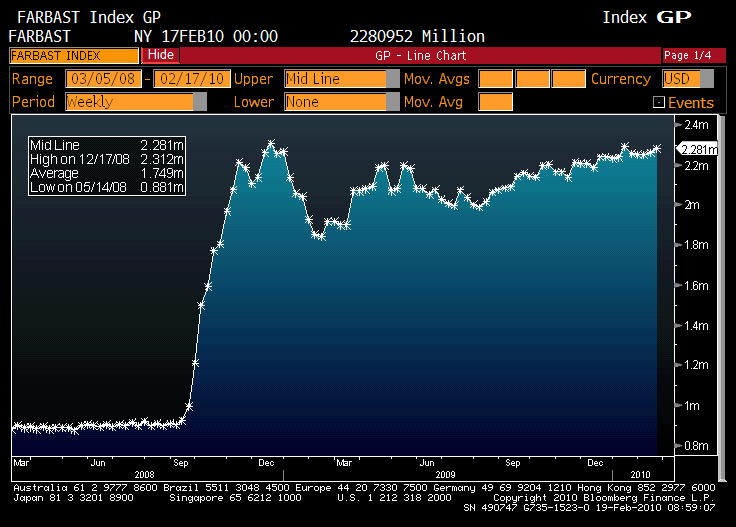
The Fed’s desire to reduce the size of its burgeoning balance sheet, which at $2.3 trillion is roughly around three times its size before the financial crisis began, will imply further measures to reduce USD liquidity over the coming months.   A withdrawal of liquidity could have positive implications for the USD but given that the Fed is still some months away from hiking the Fed Funds rate, interest rate differentials will not turn positive for the USD for a while yet. 

The move has however, changed the complexity of the FX market and likely shifted currencies into new lower ranges against the USD.  There were plenty of reasons to sell EUR even before the Fed move and the discount rate hike inflicted further damage on EUR/USD which dropped below the key psychological level of 1.35.  GBP and commodity currencies were also big losers, with GBP/USD below 1.55.  Key technical support levels to watch will be EUR/USD 1.3422, GBP/USD 1.5374 and AUD/USD 0.884.

US Federal Reserve Balance Sheet ($trillion)

High yield / commodity currencies take the lead

Although equity markets continue to tread water the appetite for risk looks untarnished. So far into the new-year the winners are commodity / high yield plays as well as emerging market assets. The AUD, NOK, NZD and CAD have been the stars on the major currency front, with only GBP registering losses against the USD so far this year. The move in these currencies has been well supported by resurgent commodity prices; the CRB commodities index is up close to 10% since its low on 9 December.

There is little reason to go against this trend and the USD index is set to continue to lose ground as risk appetite improves further. I highlighted the upside potential in high yield / commodity currencies in a post titled “FX Prospects for 2010” and stick with the view that there is much further upside. I still prefer to play long positions in these currencies versus JPY which I believe will come under growing pressure as the year progresses.

Economic data has also been supportive, especially in Australia, supporting the AUD’s yield advantage. Although comments from the central bank towards the end of last year downplayed expectations of much further tightening, data releases support the case for another rate hike at the 2 February RBA meeting, with a fourth consecutive hike of 25bps to 4.00% likely at the meeting.

There will be some important clues from next week’s jobs data in Australia but judging by the solid gain in November retail sales, which rose 1.4% versus consensus expectations of 0.3%, and 5.9% jump in building approvals, the case for a rate hike has strengthened.  AUD/USD will now set its sights on technical resistance around 0.9326. 

AUD/USD has the highest sensitivity with relative interest rate differentials – correlation of 0.85 with Australia/US interest rate futures differentials over the past month – and so unsurprisingly the AUD rallied further as markets reacted to the strong retail sales data. I believe Australian interest rates will eventually get back up to 6% – pointing to more upside for AUD/USD as this is more than is priced in by the market.

It is fortunate for the USD that the correlation between the USD index and interest rate expectations remains low but nonetheless the December 15 FOMC minutes may have provided another excuse to sell the currency. The minutes were interpreted as slightly dovish by the market, with many latching on to the comments that some members of the FOMC debated the potential to expand the scale of asset purchases and continuing them beyond the first quarter.

EUR/USD takes a crack at 1.50, where now?

It seemed inevitable and finally after flirting with the 1.50 level, EUR/USD managed to break through although there seems to be little momentum in the move, with the currency pair dipping back below 1.50 in the Asian trading session. Contrary to expectations the break above 1.50 did not lead to a sharp stop loss driven move higher. 

Even the break through 1.50 only provoked a limited reaction in the FX options market where implied EUR/USD volatility only moved slightly higher. In fact despite the warnings by ECB President Trichet about “excessive currency volatility” FX options volatility for most currency pairs has been on a downward trajectory over the past few months, implying that the move in EUR/USD and the USD itself has been quite orderly. 

Trichet’s warning is more likely a veiled threat on the level of EUR/USD rather than its volatility, unless of course the ECB chief is seeing something that the FX options market is not. Assuming that EUR/USD closes above 1.50 this week it technically has plenty of open ground on the run up to the record high of 1.6038 hit in July 2008 but there will also be plenty of official resistance to limit its appreciation. Such resistance is limited to rhetoric but it will not be long before markets begin discussing the prospects of actual FX intervention.  

Perhaps the reason that EUR/USD did not move sharply higher following the break of 1.50 was the late sell off in US stocks on Wednesday which helped to fuel some USD short covering.  The USD index is holding just above the 75.00 level but it’s not a big stretch from here to move down to the March 2008 low around 70.698, with the overall tone of broad USD weakness remaining intact and ongoing. 

GBP was helped by relief that the minutes of the BoE meeting showed no inclination to increase the level of quantitative easing despite the ongoing debate within the MPC.   The minutes even sounded slightly upbeat about economic prospects. GBP/USD hit a high of 1.6638 in the wake of these developments due in large part to more short covering whilst EUR/GBP briefly dipped below 0.90.  GBP/USD may find it tough going to make much headway above 1.66 as has been the case over recent months, with strong resistance seen around 1.6661.