All Eyes On Jackson Hole

It’s all about Jackson Hole and ahead of the Fed symposium the USD index is likely to maintain its place in towards the middle end of its recent 73.47 – 75.12 range helped by weaker equity markets. Expectations or hopes that Fed Chairman Bernanke will announce or at least hint at a fresh round of quantitative easing have receded allowing the USD to escape further pressure. Bernanke will likely keep all options open but there are still some in the FOMC who do not want to embark on QE3.

Although the USD may be saved from a further drubbing the commitment to maintain exceptionally accommodative monetary policy through Q2 2013 has contributed to a relative reduction in US bond yields and in turn is acting to restrain the US currency. A likely revision lower to US Q2 GDP will not help the USD in this respect.

One currency in particular that is reactive to yield differentials is USD/JPY, which registers an impressively high correlation with US – Japan yield differentials. Attempts this week by the Japanese authorities to encourage capital outflows and a downgrade of Japan’s credit ratings by Moody’s have done little to weaken the JPY.

Even the usually bearish JPY Japanese margin traders have been scaling back their long USD/JPY positions over recent weeks while speculative investors remain overly long (well above the three-month average) JPY according to IMM data. The risk of a shake out of long JPY positions is high but unless yield differentials reverse renewed JPY weakening looks unlikely in the short-term.

Eurozone peripheral issues will be put on the backburner ahead of the Jackson Hole meeting but that doesn’t mean they have gone away. As the continued pressure on Greek bonds shows markets continue to be fixated on the country’s problems and there may be growing nervousness ahead of the decision to distribute the next IMF loan tranche at the end of September. Nervousness also extended to Germany, with ratings agencies having to confirm the country’s AAA rating.

So far this week EUR has shown impressive resilience despite weak data in the form the German August IFO business and ZEW investor confidence surveys. However, there is a risk of EUR weakness should Bernanke not hint at QE3, with the currency already trading around the bottom of its multi-day range.

AUD has failed to recoup its end July losses and is still some 5% below its high above 1.10 versus USD. There is scope for some AUD appreciation especially as AUD speculative positioning has dropped sharply over recent weeks reducing sharply the net long overhang in the currency.

Moreover, markets have become overly aggressive in pricing in interest rate cuts in Australia and as evidenced from the AUD bounce following RBA Governor Stevens comments this morning (in which he referred to inflation data as still being concerning) there is an asymmetric risk to the AUD on the upside.

Nonetheless, AUD has experienced an increase in sensitivity to risk over recent weeks and will continue to be driven by gyrations in risk appetite. In this respect it is too early to assume the worst is over, suggesting that any further gains in AUD will be limited.
Beyond Expectations

Egypt worries continue to reverberate across markets, yet there appears to be growing resilience or at least some perspective being placed on problems there. Encouraging economic data, particularly in the US has helped to shield markets to some extent, with equity market rallying and US bond yields rising last week. The main impact of Egypt and worries about Middle East contagion continues to be felt on oil prices.

Even the mixed US January jobs report has failed to dent market sentiment; the smaller than expected 36k increase in payrolls was largely attributed to severe weather. A further surprising drop in the unemployment rate to 9.0% due mainly to a significant drop in the labor force was also well received by the market.

There will be less market moving releases on tap this week and the data are unlikely to dent recovery hopes. Michigan confidence is set to record an improvement in February whilst the December trade deficit is set to widen to around $41.0 billion. There are also plenty of Federal Reserve speakers this week including a testimony by Chairman Bernanke.

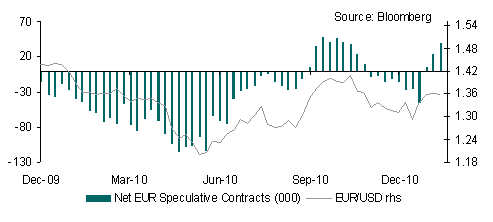
One central bank that has softened its hawkish rhetoric is the European Central Bank (ECB), with President Trichet dampening speculation of an early rate hike last week and alleviating some of the pressure on eurozone interest rate markets. Consequently the EUR fell as the interest rate differential with the USD became somewhat less attractive. The EUR was also undermined by the opposition from some member states to French and German ideas for greater fiscal policy coordination, an aim apparently not shared across euro members.

Data in Europe will be largely second tier. The EUR will look increasingly vulnerable to a further drop this week especially given the increase in net positioning over the past week to (1st February) according to the CFTC IMM data. The potential for position squaring looms large as positioning is now well above the three-month average. Stops are seen just below EUR/USD 1.3540.

In the UK the Bank of England policy meeting will take centre stage but there is unlikely to be any change in policy settings. Clues to policy thinking will be available in the monetary policy committee meeting minutes in two weeks times but it seems unlikely that any more members have joined the two voting for a hike at the last meeting.

Recent data have been a little more encouraging helping to wash off the disappointment of the surprise drop in Q4 GDP. The UK industrial production report is likely to be similarly firm on Thursday, with the annual pace accelerating. GBP/USD may however, struggle to make much headway against the background of a firmer USD and the weigh of long positioning, with GBP/USD 1.6279 seen as strong resistance.

There are plenty of releases in Australia this week to focus including the January employment data, consumer confidence, and a testimony by RBA governor Stevens in front of the House of Representatives on Friday. The data slate started off somewhat poorly this week, with December retail sales coming in softer than expected, up 0.2% MoM. AUD/USD is likely to be another currency that may struggle to sustain gains this week but much will depend on data over coming days. Resistance is seen around 1.0255.

On a final note, the weekend’s sporting events highlight how it’s not just economic data or moves in currencies that don’t always go as expected. After a solid run in the Ashes cricket England slumped to a 6-1 series loss to Australia in the one-day series, putting the Ashes win into distant memory. A similarly solid performance by Man United was dented with their unbeaten record broken by bottom of the table Wolves.

Econometer.org has been nominated in FXstreet.com’s Forex Best Awards 2011 in the “Best Fundamental Analysis” category. The survey is available at http://www.surveymonkey.com/s/fx_awards_2011

Your support in the survey is highly appreciated