Risk currencies buoyed

Positive developments helped to buoy markets. Although US durable goods orders were weaker than forecast a jump in US consumer confidence to its highest since February 2011 gave equity markets and risk assets in general a lift. Even in Europe the news was encouraging as Italy managed to auction 10-year debt at a cheaper rate than previously while Portugal passed a third review of its bailout programme and noted that unlike Greece it would need a second bailout.

There was some negative news however, with the European Central Bank (ECB) temporarily suspending the eligibility of Greek bonds as collateral for its funding operations and Ireland calling a referendum on the European fiscal compact. Nonetheless, hopes of a healthy take up at today’s ECB second 3-year Long term refinancing operation (LTRO) will keep markets in positive mood in the short term.

The USD index continues to look restrained when risk assets are rallying. Given the positive equity market mood overnight it is no surprise that the USD came under further pressure while the EUR looks firm ahead of today’s 3-year LTRO by the ECB. Fed Chairman Bernanke’s testimony will give the USD some direction but we do not expect him to deliver any big surprises. EUR/USD will continue to rally if we are correct about a strong EUR 600-700 billion take up at the LTRO but the currency pair will meet resistance around 1.3550.

JPY has lost ground against various cross including USD, EUR and AUD. Much of its weakness is related to widening yield differentials but our models reveal that USD/JPY in particular has overshot its implied value. Unless US yields widen further versus Japan, JPY could even rebound over coming days. EUR/JPY has breached its 200 day moving however, which is a bullish signal for the currency pair. A generally firm EUR tone likely to be maintained in the short term will also be exhibited versus JPY.

Warnings by Swiss National Bank head Jordan reiterating his stance of defending the EUR/CHF floor of 1.20 has done little to push the currency pair higher. EUR/CHF has enjoyed a strong relationship with movements in interest rate differentials. This implies that it will take a relative rise in German yields versus Swiss yields for EUR/CHF to move higher. This is certainly viable given the deterioration in Swiss economic data over recent months. Eventually EUR/CHF will move higher but over the short term it is unlikely to move far from the 1.20 level.
EUR/GBP upside overdone, CHF overly strong

Disappointing Eurozone service sector and manufacturing purchasing managers’ confidence indices as well as a contraction in Chinese manufacturing confidence sets the scene for a drop in risk assets. In addition in the US, existing home sales rose less than expected taking into account revisions to previous data.

Meanwhile scepticism over Greece’s ability to implement agreed upon reforms and reported resistance from Germany to increasing the firewall around peripheral Eurozone countries has delivered a further dose of negativity to markets. The market was probably looking for an excuse to sell after a strong rally and found plenty in yesterday’s news.

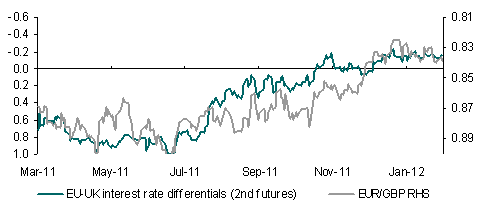
GBP has followed on the coat tails of the EUR over recent weeks, with the currency showing little independent direction. Reflecting this is the fact that EUR/GBP had until recently been trapped in a 0.83-0.84 range. As with the EUR I see downside risks to GBP over the short term against the USD.

Against the EUR, GBP will largely track the movement in yield differentials as it has done over recent months. Relatively dovish MPC minutes, with two members voting for bigger amounts of quantitative easing helped to put GBP under further pressure but the move higher in EUR/GBP look overdone.

My medium term view continues to show GBP appreciation versus EUR and current levels highlight a good opportunity to go short EUR/GBP. Markets are rewarding central banks that are proactive in their policy prescriptions. I exect this to result in some GBP resilience even if the BoE announces more QE.

EUR/CHF has continued to hug the 1.2000 line in the sand enforced by the Swiss National Bank. Ongoing Eurozone doubts even after the agreement of a second bailout for Greece mean that the CHF remains a favoured destination for European money. This is reflected by the fact that EUR/CHF has been highly correlated with Risk Aversion over the past 3-months.

It will take also take a relative rise in German yields versus Swiss yields for EUR/CHF to move higher. This is certainly viable given the deterioration in Swiss economic data over recent months. Indeed, as reflected in the KoF Swiss leading indicator and manufacturing PMI data, the economy is heading downwards. Assuming that there will be an eventual improvement in risk appetite, CHF will weaken given the strong correlation between EUR/CHF and risk aversion over the past 3-months.

Why is the Swiss franc so strong?

All eyes remain focussed on Greek developments today as the country vacillates towards acceptance of further austerity measures in order to gain the Troika’s (EU, IMF, ECB) approval for a second bailout for the country. The stakes are high with a potential disorderly default and Eurozone exit on the cards should no agreement be reached.

Against this background market nervousness is intensifying as reflected in the slippage in global equity markets and drop in risk assets in general overnight. The data and events slate today includes an RBA policy meeting and German industrial production, but neither of these will be significant enough to deflect attention and calm fraying nerves as markets await further Greek developments.

Contrary to many commentaries, the fall in EUR/CHF cannot be attributed to higher risk aversion (it has had a low correlation with my Risk Aversion Barometer over recent weeks). Instead, EUR/CHF is another currency pair that is highly correlated with interest rate differentials. Indeed, its high sensitivity provides a strong explanation for the drop in EUR/CHF since mid December 2011. This move has occurred despite an improvement in risk appetite over this period, a factor that would normally be associated with CHF weakness.

The implied interest rate futures yield advantage of the Eurozone over Switzerland has narrowed by around 47 basis points since mid December 2011. This is a problem for the Swiss National Bank, who will increasingly be forced to defend its 1.20 line in the sand for EUR/CHF. However, given that the drop in EUR/CHF has closely tracked yield differentials, any intervention is likely to have a limited impact unless there is renewed widening in the yield gap.

FX Winners and Losers

There has been a sense of mean reversion in FX markets so far this year as some of last year’s winners have become losers. Namely NZD, CHF, JPY and AUD have all lost ground whilst EUR and GBP have gained ground. The odd one out is the SEK which has strengthened over 2010 and in 2011 versus USD. I expect this pattern to change and the likely winners over the next 3- months are NZD, AUD and CAD, with CHF and JPY the likely losers.

EUR held up reasonably well in the wake of slightly disappointing growth data, with eurozone GDP rising less than expected in Q4, and a smaller than expected gain in the February German ZEW investor confidence survey (economic sentiment component). My sense is that the net long EUR speculative position has already been pared back somewhat over recent days reducing the potential selling pressure on the currency in the near term.

Given that EUR/USD is one of the only major currency pairs being influenced by interest rate differentials, its direction will hinge more on policy expectations but in the near the announcement by the German Finance Minister this morning of a restructuring plan for WestLB may give the currency some support.

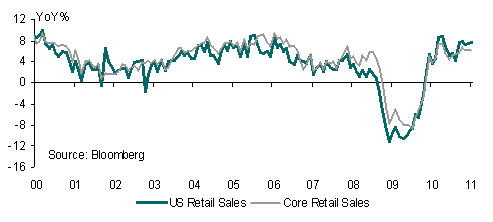
Perhaps one explanation for the stability of EUR/USD around the 1.3500 level is that US data was also disappointing yesterday. January retail sales rose less than forecast whilst revisions to back months suggest less momentum in Q4 consumer spending than previously envisaged. As with the eurozone data weather likely played a role in contributing to the outcome.

The net impact on currencies is that they are largely stuck within tight ranges. Further direction will come from the release of the Fed FOMC minutes for the January 26th meeting. The minutes may undermine the USD if a likely dovish slant continues to be expressed but given that the FOMC decision at that meeting to hold policy setting unchanged had no dissenters this should not come as a surprise.

Whilst the battle between the USD and EUR ended in a stalemate GBP outperformed in the wake of the increase in UK January CPI inflation and in particular the letter from the BoE governor to the Chancellor keeping open the door to a rate hike. The Quarterly Inflation Report (QIR) today will be particularly important to determine whether the bounce in GBP is justified.

I remain hesitant to build on long GBP positions given the net long speculative overhang in the currency. The risks following yesterday’s jump in GBP are asymmetric, with a hawkish QIR likely to have less impact on the currency than the negative impact from a more dovish than expected report.

Econometer.org has been nominated in FXstreet.com’s Forex Best Awards 2011 in the “Best Fundamental Analysis” category. The survey is available at http://www.surveymonkey.com/s/fx_awards_2011

No Let Up in USD Pressure

At the end of a momentous week for currency markets it’s worth taking stock of how things stand. Much uncertainty remains about the global growth outlook, especially with regard to the US economy, potential for a double-dip and further Fed quantitative easing. Although there is little chance of QE2 being implemented at next week’s Fed FOMC meeting speculation will likely remain rife until there is clearer direction about the path of the US economy.

In Europe, sovereign debt concerns have eased as reflected in the positive reception to debt auctions this week. Nonetheless, after a strong H1 2010 in terms of eurozone economic growth the outlook over the rest of the year is clouded. Such uncertainty means that markets will also find it difficult to find a clear direction leaving asset markets at the whim of day to day data releases and official comments.

The added element of uncertainty has been provided by Japan following its FX intervention this week. Whilst Japanese officials continue to threaten more intervention this will not only keep the JPY on the back foot but will provide a much needed prop for the USD in general. Indeed Japan’s intervention has had the inadvertent effect of slowing but not quite stopping the decline in the USD, at least for the present.

The fact that Japanese officials continue to threaten more intervention suggests that markets will be wary of selling the USD aggressively in the short term. The headwinds on the USD are likely to persist for sometime however, regardless of intervention by Japan and/or other Asian central banks across Asia, until the uncertainty over the economy and QE2 clears.

Japan’s intervention has not gone down well with the US or European authorities judging by comments made by various officials. In particular, the FX intervention comes at a rather sensitive time just as the US is piling on pressure on China to allow its currency the CNY to strengthen further. Although US Treasury Secretary Geithner didn’t go as far as proposing trade and legal measures in his appearance before Congress yesterday there is plenty of pressure from US lawmakers for the administration to take a more aggressive stance, especially ahead of mid-term Congressional elections in November. Ironically, the pressure has intensified just as China has allowed a more rapid pace of CNY nominal appreciation over recent days although it is still weaker against its basket according to our calculations.

Another country that has seen its central bank intervening over many months is Switzerland, with the SNB having been aggressively intervening to prevent the CHF climbing too rapidly. However, in contrast to Japan the SNB is gradually stepping back from its intervention policy stating yesterday that it would only intervene if the risk of deflation increased. Even so, Japan may have lent the Swiss authorities a hand, with EUR/CHF climbing over recent days following Japan’s intervention.

The move in EUR/CHF accelerated following yesterday’s SNB policy meeting in which the Bank cut its inflation forecasts through 2013, whilst stating that the current policy stance in “appropriate”. Moreover, forecasts of “marked” slowdown in growth over the rest of the year highlight the now slim chance of policy rates rising anytime soon. Markets will eye technical resistance around 1.3459 as a near term target but eventually the CHF will likely resume its appreciation trend, with a move back below EUR/CHF 1.3000 on the cards.