Pandemonium and Panic

Pandemonium and panic has spread through markets as Greek and related sovereign fears have intensified. The fears have turned a localized crisis in a small European country into a European and increasingly a global crisis.  This is reminiscent of past crises that started in one country or sector and spread to encompass a wide swathe of the global economy and financial markets such as the Asian crisis in 1997 and the recent financial crisis emanating from US sub-prime mortgages.  

The global financial crisis has morphed from a credit related catastrophe to a sovereign related crisis. The fact that many G20 countries will have to carry out substantial and unprecedented adjustments in their fiscal positions over the coming years means the risks are enormous as Greece is finding out. The IMF estimate that Japan, UK, Ireland, Spain, Greece, and the US have to adjust their primary balances from between 8.8 in the US to 13.4% in Japan. Such a dramatic adjustment never been achieved in modern history.

Equity markets went through some major gyrations on Thursday in the US, leading to a review of “unusual trading activity” by the US Securities and Exchange Commission in the wake of hundreds of billions of USDs of share value wiped off in the market decline at one point with the Dow Jones index recording its biggest ever points fall before recouping some of its losses. Safe haven assets including US Treasuries, USD and gold have jumped following the turmoil in markets whilst risk assets including high equities, high beta currencies including most emerging market currencies, have weakened. Playing safe is the way to go for now, which means long USDs, gold and Treasuries.

There is plenty of expectation that the G7 teleconference call will offer some solace to markets but this line of thought is destined for disappointment. Other than some words of comfort and support for Greece’s austerity measures approved by the Greek government yesterday, other forms of support are unlikely, including intervention to prop up the EUR. The ECB also disappointed and did not live up to market talk that the Bank could embark on buying of European debt and it is highly unlikely that the G7 will do so either. Into next week it looks like another case of sell on rallies for the EUR.   Remember the parity trade, well it’s coming back into play. 

Aside from the turmoil in the market there has been plenty of attention on UK elections. At the time of writing it looks as though the Conservatives will win most seats but fall short of a an overall majority. A hung parliament is not good news for GBP and the currency is likely to suffer after an already sharp fall over the last few days. GBP/USD may find itself back towards the 1.40 level over the short-term as concerns about the ability of the UK to cut its fiscal deficit grow. A warnings by Moody’s on Friday that the “UK can’t postpone fiscal adjustments any longer” highlights the risk to the UK’s credit ratings and to GBP.
Risk Aversion Back With A Vengeance

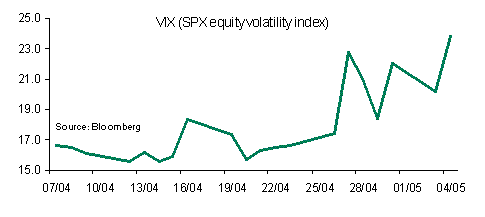
Risk aversion is back with a vengeance as reflected in the rise in equity volatility (VIX), drop in equity markets and rally in US Treasuries.  European peripheral debt markets sold off despite the EU/IMF aid package for Greece, whilst EUR/USD slid below 1.3000.  Various rumours dealt a blow to markets including talk of a sovereign ratings downgrade and a EUR 280 billion bailout for Spain.   The message is clear.  This situation is becoming increasingly dire by the day.  Europe is in big trouble and the whole euro project is under threat of unravelling.  

Concerns about parliamentary approvals, implementation/execution risk, prospects for relatively weaker growth in Europe, as well as contagion to Spain and Portugal, has tempered any enthusiasm towards the EU/IMF bailout package.  In addition, despite the large size of the EUR 110 billion loan package there are growing worries that it will be insufficient to cover Greece’s funding requirements over the next three years.  All of this implies that the EUR will remain under pressure for some time yet.  I have previously spoken about a drop to around EUR/USD 1.25 but the risk is for a much sharper decline is growing.

The USD is the clear winner, spiking to its highest level since May 2009 and is looking well set to consolidate its gains over the short-term despite the fact that net aggregate USD speculative positioning has already reached its highest level since September 2008 (according to the CFTC Commitment of Traders IMM data) in contrast to EUR positioning, which is at a record low.  This is unlikely to stand in the way of further downside for EUR/USD, with the next technical support level seen at 1.2885, which would match the previous lows see in April 2009.

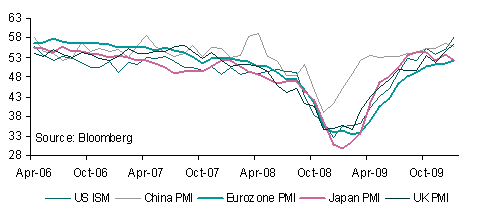
A combination of worries including contagion to Spain and Portugal, policy tightening in China, debt concerns in the UK and Japan, all threaten to undo the positive message from recent positive economic data including further strengthening in Purchasing Managers Indices globally.   The immediate attention remains on Greece and growing scepticism about the ability of Greece to carry out austerity measures in the face of rising domestic opposition, including a nationwide strike today. 

The rout in US and European markets will spill over to Asia, putting equity markets and Asian currencies under pressure.  Another risk currency to suffer is the AUD, which has dropped sharply following the Reserve Bank of Australia (RBA) meeting, in which the Bank indicated that rates were close to peaking.  Speculative positioning has dropped for the past two weeks as longs are taken off but AUD/USD weakness is set to be temporary, with buyers likely to emerge around near term support seen around 0.9001.

US/China Tensions Ratchet Higher

FX policy tension is a theme that looks to be making a come back. The potential for CNY revaluation continues to be hotly debated, with international pressure on China intensifying. For its part China continues to resist such calls, but growing speculation that the US will label China a “currency manipulator” in the semi-annual US Treasury report on 15 April suggests that the issue will remain very much on the radar screen.

Tensions have ratcheted higher in the wake of a proposed bill by US senators targeting countries with “fundamentally misaligned currencies” and those needing “priority action”. Any country that is targeted would then have a year to correct its currency or face a case at the World Trade Organisation. If China is labelled as a currency manipulator it could also result in anti dumping regulations.

Much of the increase in tension may be attributable to politicking ahead of the November mid-term Congressional elections but it is clear that the issue is not going away quickly. Chinese Premier Wen’s strong comments over the past weekend denying any need for revaluation of the CNY suggests that the stakes will get even higher over coming months.

It is looking increasingly difficult for the US administration to ignore Congress’ calls for stronger action on FX. Moreover, US President Obama’s pledge to double US exports within 5-years will require some USD weakness, but the USD will need to weaken against Asian currencies led by China and not just against the usual culprits such as the EUR.

There is little sign of this happening anytime soon as Asian central banks continue to intervene to prevent their currencies from strengthening. Nonetheless despite China’s insistence that it does not believe the CNY is undervalued China is likely to be edging closer to an eventual revaluation in the CNY sometime in Q2 2010 as it combined a stronger currency with higher interest rates and tighter lending to curb inflation. A stronger CNY will also spur other Asian central banks to allow stronger currencies.

A deterioration in the China/US relationship could have potentially significant FX implications. The latest US Treasury TIC report this week showed that China reduced its holdings of US Treasuries for the third straight month in January. Should China feel that it needs to retaliate against a more aggressive US trade or FX stance it could reduce its holdings of US Treasuries further.

An unusual dollar reaction

Although many market participants are on summer holidays this has not prevented some interesting market moves in the wake of yet more improvement in economic data and earnings.  The most noteworthy release was the July US jobs report which revealed a better than forecast 247,000 job losses and a surprise decline in the unemployment rate to 9.4%.  Moreover, past revisions added 43,000 to the tally.

Although it is difficult to get too optimistic given that job losses since December 2007 have totalled 6.7 million, the biggest drop since WW2, the direction is clearly one of improvement.  Nonetheless, markets were given a dose of reality by the drop in US consumer credit in June, which gives further reason to doubt the ability of the US consumer to contribute significantly to recovery.

The data spurred a further rally in stocks and a sell of in Treasuries.   Such a reaction was unsurprising but the more intriguing move was seen in the US dollar, which after some initial slippage managed a broad based appreciation in contrast to the usual sell off in the wake of better data and improved risk appetite.

It is too early to draw conclusions but the dollar reaction suggests that yield considerations are perhaps beginning to show renewed signs of influencing currencies following a long period where the FX/interest rate relationship was practically non-existent.  Indeed, the strengthening in the dollar corresponded with a hawkish move in interest rate futures as the market probability of a rate hike by the beginning of next year increased.

Since the crisis began the biggest driver of currencies has been risk aversion, a factor that relegated most other influences including the historically strong driver, interest rate differentials, to the background.  More specifically, much of the strengthening in the dollar during the crisis was driven by US investor repatriation from foreign asset markets as deleveraging intensified.   This repatriation far outweighed foreign selling of US assets and in turn boosted the dollar.

Over the past few months this reversed as risk appetite improved and the pace of deleveraging lessened.  Ultra easy US monetary policy also put the dollar in the unfamiliar position of becoming a funding currencies for higher yielding assets and currencies though admittedly this was all relative as yields globally dropped.   The dollar also suffered from concerns about its role as a reserve currency but failed to weaken dramatically as much of the concern expressed by central banks was mere rhetoric.

Where does this leave the dollar now?  Risk will remain a key driver of the dollar but already its influence is waning as reflected in the fact that the dollar has remained range bound over recent weeks despite an improvement in risk appetite.   As for interest rates their influence is set to grow as markets price in rate hikes and as in the past, more aggressive expectations of relative interest rate hikes will play the most positive for the respective currency.

It is still premature for interest rates to overtake risk as the principal FX driver.   Even if rates increase in importance I still believe interest rate markets are overly hawkish in the timing of rate hikes. A reversal in tightening expectations could yet push the dollar lower.  This is highly possible given the benign inflationary environment and massive excess capacity in the US economy.

Eventually the dollar will benefit from the shift in interest rate expectations as markets look for the Fed to be more aggressive than other central banks in reversing policy but this could take some time. Until then the dollar is a long way from a real recovery and will remain vulnerable for several months to come as risk appetite improves further.

Are foreign investors really turning away from US debt?

The press has been full of stories about the dangers to US credit ratings and growing concerns by foreign official investors about the value of their holdings of US Treasury bonds.   A combination of concerns about the rising US fiscal deficit, Fed quantitative easing and potential monetization of US debt, have accumulated to fuel such fears. Given the symbiotic relationship between China and the US it is perhaps unsurprising that China has been one of the most vocal critics. I have highlighted this in past posts, especially related to the risks to the US dollar. Please refer to US dolllar beaten by the bears and US dolllar under pressure. However, my concerns that foreign investors have been shunning US Treasuries recently may have proved somewhat premature.

Should China or other large reserves holders pull out of US asset markets, it would imply a sharp rise in US bond yields and a much weaker dollar.  However, it is not easy for China or any other central bank to act on such concerns.  China is faced with a “dollar trap” in that any decline in their buying of US Treasuries would undoubtedly reduce the value of their existing Treasury holdings as well as drive up the value of the Chinese yuan as the dollar weakens.  Such a self defeating policy would clearly be unwelcome. 

One solution that China has proposed to reduce the global reliance on the dollar and in turn US assets was to make greater use of Special Drawing Rights (SDRs) which I discussed in a previous post, but in reality this would be fraught with technical difficulties and would in any case take years to achieve.  Nor will it be quick or easy for China to persuade other countries to make more use of the yuan in the place of the dollar.  The first problem in doing so is that fact that the yuan is not a convertible currency and therefore foreign holders would have difficulties in doing much with the currency.  

Foreign official concerns are understandable but whether this translates into a major drop in buying of US Treasuries is another issue all together.  Foreign countries have been gradually reducing their share of dollars in foreign exchange reserves over a period of years.  This is supported by IMF data which shows that dollar holdings in the composition of foreign exchange reserves have fallen from over 70% in 1999 to around 64% at the end of last year.

In contrast the share of euro in global foreign exchange reserves has increased to 27% from 18% over the same period.  This process of diversification likely reflects the growing importance of other major currencies in terms of trade and capital flows, especially the euro, but the pace of diversification can hardly be labeled as rapid. 

Importantly, there is no sign that there has been an acceleration of diversification over recent weeks or months.  Fed custody holdings for foreign official investors have held up well.  In fact, these holdings have actually increased over recent weeks.  Moreover, the share of indirect bids (foreign official participation) in US Treasury auctions have been strong over recent weeks.  Taken together it provides yet more evidence that foreign official investors haven’t shifted away from US bonds despite all the rhetoric.