Bernanke Boost

Last week ended with a downward revision to US Q2 GDP. The data clarified that growth momentum going into Q3 was indeed quite weak though it probably didn’t take the GDP revision to tell us this nugget of information, something that has been evident from the run of weak data over recent months.

Softer growth in Q2 placed particular attention on the Jackson Hole speech by Fed Chairman Bernanke in which he acknowledged the slowing in the pace of growth, but also forecast a moderate economic recovery in H2 2010. Importantly if the Fed is proven wrong he noted the FOMC would undertake unconventional (quantitative easing) QE II measures if needed.

The net impact on Bernanke’s speech and the smaller than expected downward revision to US Q2 GDP was to provide a boost to risk appetite. Sentiment will at least begin this week on a positive note in the knowledge that the Fed stands ready to act although double dip fears are far from over.

One trigger for Fed action will be a further deterioration in job market conditions and markets will pay close attention to the August US jobs report at the end of the week. Bloomberg consensus estimates forecast a 100 drop in payrolls, with private payrolls up 47k and the unemployment rate edging higher to 9.6%. Such an outcome would do little to boost confidence in a jobs market recovery.

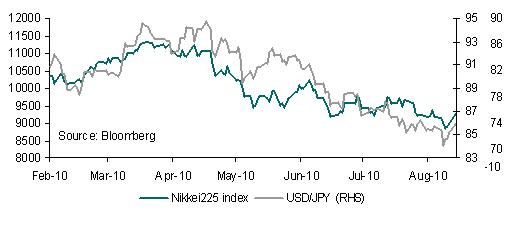
The week begins with all eyes on Japan however, with an emergency Bank of Japan (BoJ) meeting in focus. USD/JPY has already jumped higher on the belief that concrete action will emerge to weaken the JPY. The risk of disappointment is high and at most the BoJ will announce measures to extend loans to banks. A lack of other action especially in the form of FX intervention alongside a likely increase in risk aversion once the Bernanke bounce wares off, will result in a renewed USD/JPY move lower, with a breach of 85.00 likely. As seen in the chart below a decisive turn in the Japanese stocks will be a key factor in helping to eventually drive USD/JPY higher.
Two other central bank meetings of note this week are the European Central Bank (ECB) and Sweden’s Riksbank meetings on Thursday. No change in policy by the ECB will be of little surprise but the release of new staff projections, with growth likely to be revised up in 2010 but left unchanged for 2011, will be of interest. Developments regarding open market operations will also be of attention. In contrast, the Riksbank is widely expected to hike rates by 25bps on the back of a firming economy and house price inflation.

A UK holiday today will likely keep liquidity thin and as noted above risk currencies including AUD, NZD and CAD as well as Asian currencies will start the week firmer but will struggle to hold gains as the week progresses. EUR/USD has benefited little from improved risk appetite and will have a hard time this week making much any headway although potential EUR/CHF buying from the SNB may give some, albeit limited support.

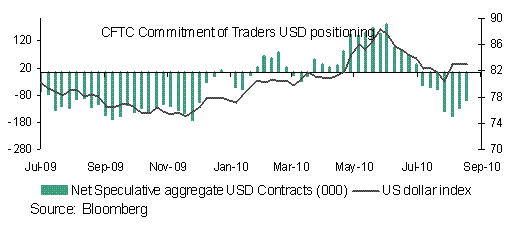
A renewed downside move to support around EUR/USD 1.2455 remains on the cards in the short term. Overall USD sentiment has become less negative as reflected in the CFTC IMM positioning data in contrast to a renewed deterioration in EUR speculative sentiment. We look for more of the same.
Q2 Economic Review: Double-Dip Recession or Prolonged Recovery?

I was recently interviewed by Sital Ruparelia for his website dedicated to “Career & Talent Management Solutions“, on my views on my view on the Q2 Economic Review: Double-Dip Recession or Prolonged Recovery?

Sital is a regular guest on BBC Radio offering career advice and job search tips to listeners. Being a regular contributor and specialist for several leading on line resources including eFinancial Careers and Career Hub (voted number 1 blog by ‘HR World’), Sital’s career advice has also been featured in BusinessWeek online.

Please see below to read my article

Since we last discussed the economic outlook at the end of quarter 1, much has happened and unfortunately there has not been a great deal of positive news. I retained a cautiously optimistic outlook for economic recovery for the Q1 Economic Review: elections, recovery and underemployment discussion article, but highlighted that recovery would be a long and drawn-out process, with western economies underperforming Asian economies.

The obstacles to recovery discussed then continue to apply now, including consumers paying down debt, high unemployment, tight credit conditions and weak confidence.

Click here to read the rest…

The Pain Of A Stronger Swiss Franc

Volatility and increasingly large market swings are characterizing current market conditions. A warning by Fitch on the UK’s “formidable” fiscal challenge, concerns about Bulgaria’s public finance statistics and a massive public sector strike in Spain, combined to fuel another bout of risk aversion.

Hungary’s government attempted to diffuse worries about its finances, with the country’s Prime Minister listing measures including cutting public pay and prohibiting mortgages denominated in foreign currencies, in order to hit the 3.8% of GDP budget deficit target. There was also some good news in the US, with small business confidence (NFIB) rising to its highest level since September 2008 whilst ABC consumer confidence edged higher.

The US Beige Book and Fed Chairman Bernanke’s testimony on the US economy to Congress, mark the highlights today. The Beige Book is set to reveal further signs of economic recovery but with limited inflation pressures. Bernanke is likely to maintain a similar tone to comments he made yesterday, highlighting a “moderate” economic recovery, with unemployment likely to stay “high for a while”. His testimony will be scrutinized for the timing of rate hikes, and any elaboration on his comments about rates rising before the economy is at full employment.

Against the background of the many and varied uncertainties still afflicting markets maintain a sell on rallies view on risk trades is still the best option. EUR/USD will struggle to breach resistance around 1.2010 and remains susceptible to test support around 1.1826. GBP/USD could target fresh lows in a “negative reversal”, with potential to head back down to 1.3996.

Confidence has plummeted to extreme lows and it will be several months before appetite for risk trades returns. The AUD and NZD as well as many Asian currencies will struggle over the interim period before their appreciation trend finally resumes.

In contrast to the weakening of risk currencies, CHF strength is showing little sign of letting up. Switzerland recorded a massive 50% jump in FX reserves in May to CHF 232 billion from CHF 153 billion in April. This is not usually market moving data but the scale of the jump in reserves is huge and it is not just due to valuation changes. The Swiss National Bank (SNB’s) effective abandonment of defending a particular level in EUR/CHF turned into more a smoothing operation but this did not stop the bank from massive FX interventions. Despite the interventions EUR/CHF dropped by 0.8% over the month.

Aside from alleviating upward pressure on the CHF the interventions had an indirect effect of reducing the pain of holders of CHF mortgages. E.g. around 30% of Hungary’s bank loans and 60% of mortgages are denominated in CHF but countries across Europe have plenty of CHF denominated loans, especially Austria. Although Hungary announced steps to meet its deficit targets its woes are far from over.

The CHF has appreciated by around 3% since the beginning of May versus HUF, exacerbating the pain for CHF borrowers in the country. The fact that CHF strength shows no sign of letting up on the back of strong data and safe haven flows, the pain for these borrowers will only add to the problems for banks and borrowers alike in Europe.

What A Disappointment!

Ok so after talking up US data releases over recent weeks the big one namely the May jobs report, came as a disappointment. To recap, payrolls rose 431k, which was less than market consensus. Hiring due to the census which by its nature will be transitory was however, in line with expectations, at 411k, leaving ex-census hiring at a measly +20k.

Believe it or not, the trend in payrolls is one of improvement but the May outcome came as a blow to a market with bullish expectations, especially following earlier comments from the US administration hinting at a robust outcome. The disappointment was compounded by talk of a +700k payrolls outcome, which proved widely off the mark. The unemployment rate did drop more than expected, by two ticks to 9.7%, but this was due to disaffected workers dropping out of the labor force rather than an inherent pick up in job conditions.

Combined with worries about a new target in the sovereign debt crisis in Europe, this time Hungary, markets quickly tanked and risk aversion jumped. So much for relative stability! The concerns were sparked by Hungarian officials themselves, with a spokesman for the Prime Minister warning about the fiscal mess inherited from the previous government. The real blow came when the spokesman compared Hungary to Greece and reportedly said that talk of a default was “not an exaggeration”.

Suffice to say, markets are set up for tense and nervous week in which risk trades are set to suffer further. EUR/USD once again proved to be the weak link dropping below the psychologically important level of 1.20 and the EUR introduction rate around 1.1830 has moved sharply into focus.

Renewed concerns

Despite some positive US data, with both the May ISM manufacturing index and April construction spending coming in stronger than forecast, market sentiment soured. The relative calm that was exhibited at the end of May is giving way to renewed fears as equity markets weaken, volatility increases and risk aversion intensifies. Risk trades are set to remain on the back foot, with the EUR likely to remain the weakest link. After testing support close to 1.2110 EUR/USD bounced but remains vulnerable to a fresh test of this level in the short-term.

A combination of concerns including rumours of ratings downgrades, with France the new target, Middle East tensions, weaker Chinese manufacturing activity and worries about increasing bank writedowns in Europe, have conspired to drag markets lower. The failure to stem the hue oil-leak in the US contributed to the malaise as the US government announced a criminal probe.

For the most part, data releases were unhelpful to risk appetite as the majority of global purchasing managers indices (PMIs) slipped in May, led by China. Only a few increased, including India and notably Ireland, whilst the Spanish and Greek PMIs fell. Although the US ISM index slipped the components looked positive, especially the employment component which moved higher, suggesting some upside potential for Friday’s May payrolls data for which we look for a 500k increase.

A picture of divergence appears to be growing in the eurozone, which will act as another source of pressure on the EUR. Germany’s outperformance is widening as reflected by the fact the German unemployment dropped to 7.7% in May in contrast to a rise in eurozone unemployment, to 10.1%. Moreover, Germany was the only country where its PMI was actually revised higher relative to the flash reading. There are also growing divisions within the European Central Bank (ECB), in particular towards the purchase of government bonds, with German ECB members particularly critical.