EUR to struggle to extend gains

Once again the USD index failed to break above its 100-day moving average, its third failure to do so over recent weeks. The USD is now trading below its 20- and 50- day moving averages and looks vulnerable to further weakness. However, much will depend on the travails of the EUR and how quickly the boost to this currency fades following last week’s Greek austerity plan approval.

The USD was helped last week by the relative move higher in US bond yields, which saw 2-year yield differentials between the Eurozone and US drop below 100bps for the first time since the beginning of April. Given that the six-month correlation between 2-year bond yield differentials and EUR/USD is at a very high level, it is reasonable to assume that this will remain an important factor driving the currency pair going forward.

The yield differential narrowing seen last week has reversed as German yields have moved sharply higher this week, however. This is in large part attributed to more positive developments in Greece but nonetheless, it has helped to push the EUR higher.

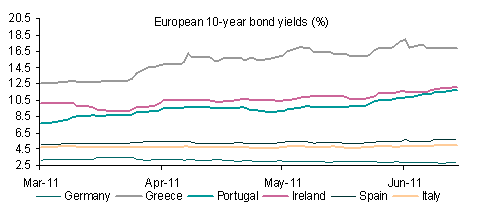
Ratings agencies may yet spoil the party for the EUR, with S&P’s warning that Greece’s debt rollover plans may put the country’s ratings into select default, fuelling some caution. Should ratings agencies downgrade Greek debt to junk it will not only be international investors that will re-think their exposure to the country but the European Central Bank (ECB) could also stop holding Greek debt as collateral for loans although an official from the Bank noted that this would happen only if all the major ratings agencies downgrade Greek debt to default.

Attention is now turning to the implementation risks of austerity measures and asset sales. While Greece’s contribution to eurozone GDP is small, the pain of implanting more budget cuts will push the economy deeper into recession and reveal the stark divergences in growth in the eurozone at a time when the ECB is hiking interest rates.

In reaction to such concerns there is likely to be a series of measures announced over coming days and weeks to boost growth according to Greece’s finance minister. As the S&P comments and implementation/growth concerns suggest, the EUR may struggle to extend gains, especially as the currency is looking increasingly stretched at current levels, with this week’s ECB rate hike largely in the price. Top side resistance for EUR/USD is seen around 1.4598.
EUR higher but resistance looms

EUR and risk currencies in general were buoyed by the passage of the austerity bill in the Greek parliament. The implementation bill is also likely to be passed later today opening the door for the disbursement of EUR 12 billion from the European Union / IMF from the EUR 110 bailout agreed for the country. Combined with news that German banks are progressing towards agreeing on a mechanism to roll over Greek debt alongside French banks as well as likelihood of an European Central Bank (ECB) rate hike next week, the EUR is set to remain supported over the short term.

Nonetheless, it once again looks as though a lot of good news is priced in and it would be surprising if EUR/USD could extend to above strong resistance around 1.4557 given the many uncertainties ahead, not the least of which includes the stance of ratings agencies on any Greek debt rollover.

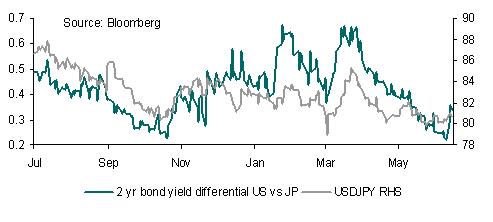
USD/JPY is the only major currency pair that is correlated with bond yield differentials at present (2-year yields) and therefore it should not come as a surprise that USD/JPY has moved higher as the yield differential between the US and Japan has widened by around 10bps over the past week. Indeed, yesterday’s move above 81.00 was spurred by the move in yield differentials although once again the currency pair failed to build sufficient momentum to close above this level.

Further gains will require US bond yields to move even higher relative to Japan but perhaps the end of QE2 today may mark a turning point for US bond markets and currencies. The end of QE2 taken together with a jump in bond supply over coming months, will see US Treasury yields will move sharply higher, implying much more upside for USD/JPY.

AUD has bounced back smartly over recent days, with the currency eyeing resistance around 1.0775 versus USD. A general improvement in risk appetite has given the currency some support but markets will be unwilling to push the currency much higher ahead of the Reserve Bank of Australia (RBA) meeting next week. On the plus side, there are no rate hikes priced in for Australia over the remainder of the year, suggesting an asymmetric risk to next week’s meeting.

In other words, unless the RBA openly discusses rate cuts in the statement, the AUD will likely remain supported. Conversely any indication that a rate hike may be in prospect will be AUD supportive. In any case we continue to believe the AUD offers better value especially relative to NZD and maintain our trade idea to buy AUD/NZD.

Euro unimpressed by Greek confidence vote

News that the Greek government won a confidence vote has left the EUR unimpressed and gains will be limited ahead of the June 28 vote on the country’s 5-year austerity plan. The EUR was in any case rallying ahead of the vote, which the government won by 155-143 votes, and has actually lost a little ground following the vote.

EUR sentiment is likely to remain somewhat fragile given the ongoing uncertainties, but now that the first hurdle has been passed markets there is at least a better prospect of Greece receiving the next EUR 12 billion aid tranche before the July 15 “do or default” deadline. Over the near term EUR/USD upside is likely to remain capped around the 1.4451 resistance level (15 June high).

The next key event for markets is the Fed FOMC meeting outcome and press conference. This is unlikely to bode particularly well for the USD given that the Fed is set to downgrade its growth forecasts, with the comments on the economy likely to sound a little more downbeat given the loss of momentum recently as reflected in a string of disappointing data releases.

Nonetheless, monetary settings are unlikely to be changed, with the Fed committed to ending QE2 by the end of June. I remain positive on the USD’s prospects but its recovery is fragile due to the fact that US bond yields remain at ultra low levels.

Whilst only AUD/USD and USD/JPY have maintained significant correlations with bond yield differentials over the past three months, it will eventually require US bond yields to move higher in relative terms for the USD to find its legs again on a more sustainable basis.

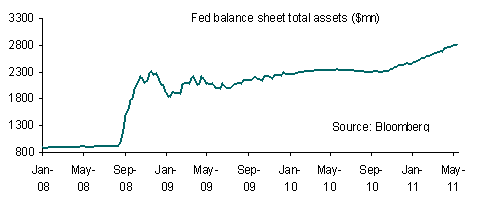
In the meantime the approach of the end of QE2 by the end of June will on balance play positively for the USD as at least the Fed’s balance sheet will no longer be expanding even if the reinvestment of principle from its holdings of US Treasuries suggest that there will not be a quick or immediate reduction in the size of the balance sheet anytime soon.

There is little appetite to intervene to weaken the JPY at present, with the Japanese authorities blaming the strengthening in the JPY versus USD on the latter’s weakness rather than the former’s strength. Until yield differentials widen, USD/JPY will continue to languish at current levels or even lower.

GBP will garner direction from the release of the Bank of England Monetary Policy Committee meeting minutes. Whilst GBP has edged higher against the USD it has remained vulnerable against EUR. A likely dovish set of minutes reflecting some weak activity data, easing core inflation and soft wage growth, suggests little support for GBP over the short term.

US Dollar Finding Support

The US dollar is finding growing relief from the fact that the Fed is putting up a high hurdle before more quantitative easing (QE3) is even considered. As highlighted by Federal Reserve Chairman Bernanke last week he is not considering QE3 despite a spate of weak US data. Of course until US bond yields move higher the USD will fail to make much of a recovery and in turn this will need some improvement in US economic data.


The May retail sales release is unlikely to provide this with headline sales likely to undergo an autos related drop while core CPI released on Wednesday is set to remain benign in May. There will be better news on the US manufacturing front, with surveys and hard data likely to bounce back.

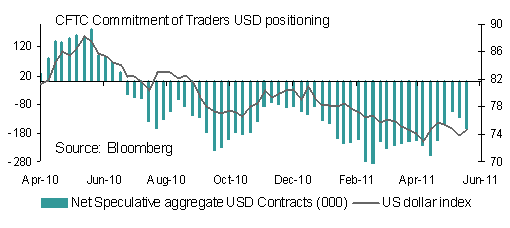
There is still plenty of scope for USD short covering as reflected in the fact that IMM USD positions fell further as of the 7th June, with the market still heavily short USDs. The USD index has likely found a short term bottom, with a break above the 50-day moving average level around 74.6874 in focus.

EUR has lost momentum , with the European Central Bank’s (ECB) confirmation of a July policy rate hike prompting a major sell off in the currency, even with interest rate markets barely flinching. The EUR is susceptible to developments regarding Greece and the news on this front is not good. Divisions between policy makers including the ECB about the extent of private sector involvement in a second bailout package threaten to prolong the pain.

Similarly divisions within the Greek parliament about further austerity measures needed to secure a second bail could also derail the process. Further negotiations this week will be closely scrutinised, likely taking more importance than data releases, with only the final reading of May inflation and industrial production of note this week.

As revealed by the CFTC IMM data, EUR long positions jumped early last week leaving plenty of scope for unwinding, something that is likely to take place this week. Nonetheless, support around the 30 May low of EUR/USD 1.4256 is likely to prove difficult to break on the downside this week.

GBP took a hit in the wake of yet more weak activity data in the form of May industrial and manufacturing production data. The economic news will be no better this week, with retail sales set to drop in May and CPI inflation set to rise further in April. The data will only add further to the confusion about UK monetary policy as the dichotomy between weak data and persistently high inflation continues.

Admittedly the weak data releases can at least partially be explained away by the Royal wedding and Easter holidays but this will provide little solace to GBP bulls. GBP will likely struggle against a firmer USD this week although its worth noting that GBP speculative position has been negative for 3-straight weeks, suggesting that at least there is less room for GBP position unwinding. GBP/USD is likely to hold above support around 1.6055 this week.

Euro weaker despite hawkish ECB

The bounce in EUR/USD following the European Central Bank (ECB) press statement following its unchanged rate decision proved short-lived with the currency dropping sharply as longs were quickly unwound, with EUR/USD hitting a low around 1.4478. The sell off occurred despite the fact that the ECB delivered on expectations that it would flag a July rate hike, with the insertion of “strong vigilance” in the press statement.

The reaction was a classic ‘buy on rumour, sell on fact’ outcome and highlights just how long EUR the market was ahead of the ECB meeting. Interestingly the interest rate differential (2nd futures contract) has not widened versus the USD despite the hawkish ECB message and in any case interest rate differentials are not driving EUR/USD at present as reflected in low correlations.

This leaves the EUR susceptible to Greek developments and the news on this front is less positive. ECB President Trichet ruled out any direct participation (ie no rollover of ECB Greek debt holdings) in a second Greek bailout whilst potentially accepting a plan of voluntary private participation in any debt rollover. The ECB’s stance is at odds with that put forward by German Finance Minister Schaeuble pressuring investors to accept longer maturities on their Greek debt holdings.

In contrast the USD appears to be finding growing relief from the fact that the Federal Reserve is putting up a high hurdle before QE3 is considered. As highlighted by Fed Chairman Bernanke earlier this week the Fed is not considering QE3 despite a spate of weak US data. This was echoed overnight by the Fed’s Lockhart and Plosser, with the former noting that there would need to be a substantially weaker economy and the latter noting that there would have to be a “pretty extraordinary” deterioration in the economy to support QE3.