JPY retracement, CHF pressure

Risk assets rallied overnight, the USD weakened and US Treasury yields rose. There was little new in terms of economic news, with only NAHB March homebuilders confidence of note, which came in slightly weaker than expected. The bigger driver for markets was the news that Apple Inc. will pay around USD 45 billion in dividends and share buybacks over the next 3-years.

Today sees a crop of second tier releases including housing starts and building permits in the US and inflation data in the UK while there will also be attention on a speech by Fed Chairman Bernanke. Risk assets will remain supported but I continue to see consolidation for markets in the near term.

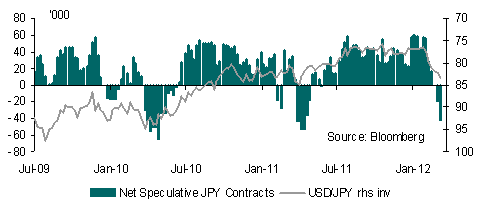
USD/JPY has retraced lower as warned last week. My quantitative models suggest scope for even more of a correction lower, with a drop below 83.00 on the cards in the short term. While the upward move in the currency pair was built on a widening in the US yield advantage over Japan, the move looks overdone. Nonetheless, any pullback will offer better levels to initiate long USD/JPY medium term positions.

Clearly the market believes that the JPY will weaken further given the build up in JPY short positions over recent weeks, with shorts at their highest since April 2011. February trade data to be released on Thursday will provide further fuel for JPY bears given the persistence of a trade deficit and weakness in exports.
Following the bounce in EUR/CHF last week the currency pair has dropped back into its recent tight range around the 1.2050-1.2070 area. Strong warnings by the Swiss National Bank at its policy meeting did not lead to any follow through on the CHF. I expect a gradual drift higher in EUR/CHF over coming weeks in line with the incremental change in sentiment for the Eurozone as Greece slips from the radar.

Official pressure for CHF weakness will remain intense given the deterioration in economic data as likely to be revealed in today’s release of Q4 industrial production. Nonetheless, the SNB will be wary of confronting the market in terms of FX intervention to weaken the CHF despite its verbal warnings. Meanwhile USD/CHF remains highly sensitive to gyrations in the USD index given its strong correlation, suggesting some consolidation in the short term as the USD pulls back.

Q4 earnings and Chinese data

Since the start of the year the market has gyrated from “risk on” to “risk off” and back again. On balance the overall tone has been just about positive, with firmer economic data, most notably in China outweighing sovereign debt concerns in Greece and elsewhere. Although debt concerns are unlikely to dissipate quickly, especially given Greece’s inability to convince markets of its plans to cut its burgeoning budget deficit, the “risk on” tone is likely to win.

“Risk off” may be the tone at the start of the week however, as US equities ended the week on a negative note ahead of the Martin Luther King holidays. The holidays will likely keep trading slow. Data wise the main US events housing starts on Wednesday and the Philly Fed on Thursday. Q4 US earnings are likely to take a bigger share of market attention as the earnings season rolls on. Bank earnings will be a key focus, with Citigroup, Morgan Stanley, BoA, Wells Fargo and Goldman Sachs set to report this week.

Given the growing influence of Chinese data on markets the monthly data pack from China will capture more attention than usual on Thursday. In particular, GDP and inflation data will be of most interest. GDP data is likely to reveal an acceleration in growth in Q4 YoY to above 10% but given worries about over heating and following last week’s tightening in China’s monetary policy CPI data will be closely scrutinized. Inflation is likely to pick up further maintaining the pressure for further monetary tightening as well as a stronger CNY.

Elsewhere, in the eurozone the main event is the German ZEW survey tomorrow, which is likely to show further signs of flagging, due to Greek concerns. There is also an interest rate decision to contend with; the Bank of Canada is unlikely to surprise markets as it keeps policy unchanged tomorrow. The UK has a relatively heavier data slate, with CPI tomorrow, Bank of England minutes on Wednesday and retail sales at the end of the week.

The UK data kicked off on a positive note this week, with house prices rising 0.4% MoM in January and 4.1% YoY according to UK property website Rightmove, the biggest annual gain in over a year. Moreover, activity on Rightmove’s website reached a record high in the first full week of the year. The data as well as expectations that Kraft will raise its bid for Cadbury will likely help GBP in addition to other GBP positive M&A news. GBP/USD will look to test resistance around 1.6365 this week.

After a slightly firmer start helped by the weak close to US equity markets on Friday the USD is likely to generally trade on the back foot over the week. Speculative sentiment for the USD has definitely soured into the new-year as reflected in the CFTC IMM data which revealed a big jump in net short positions in the week ending 12 January 2010. Net aggregate USD positions shifted from +1.6k to -51.9k over the week, with the main beneficiaries being the EUR, and risk trades including AUD, NZD and CAD.

US rates “low for long”

Risk appetite is failing to show much improvement this week and sharply weaker than forecast US housing data dampened sentiment further following other soft data over recent days including the Empire manufacturing survey, industrial production and retail sales less autos. The data will add to concerns about the pace and magnitude of growth in the months ahead.

A sub-par recovery and benign inflation outlook are the two main reasons why the Fed will not hike rates for a long while yet. This was echoed by St. Louis Fed President Bullard – a voting member of the FOMC – who gave a little more colour on the Fed’s “extended period” statement. He highlighted the probability that US interest rates will not be raised until the first half of 2012.

Bullard noted that following the past two recessions the Fed did not raise rates until two and half to three years after recession ended. This is accurate given that in 2001 the Fed did not begin to hike rates until around 2 ½ years after the end of the recession whilst in 1990-91 rates did not go up until close to 3 years after recession ended. This recession just passed was arguably worse than both of the past two, so why should rates rise any earlier?

One factor that could trigger an earlier rate hike is the risks from the massive global liquidity fuelled carry trade fuelled by Fed policy. Bullard highlighted that the risks of creating an asset bubble from keeping rates “too low for too long” may prompt an earlier tightening. What will be important is that the Fed gets the exit strategy right and the risk that delaying any reduction in the Fed’s balance sheet and asset purchases could turn out to be inflationary which in turn would be negative for the USD and hit confidence in US assets.

The Fed is very likely to adjust the level of quantitative easing well before contemplating raising interest rates. The market is pricing in around 50bps of rate hikes in the next 12 months but even this looks to aggressive and as has been the case of recent months the market is likely to push back the timing of expected rate hikes. The consequences for the USD are negative at least until the market becomes more aggressive in pricing in US interest rate hikes or believes the Fed is serious about its exit strategy.

All eyes on Chinese stocks

Equity markets extended their declines overnight as European and US stocks were smacked across the board.  One of the biggest pull backs has occurred in the Chinese stock market where stocks are down by around 17% since early (3rd) August although stocks are still up close to 73% on the year.  Some of this could be on fears of monetary tightening in China as well as missed profit estimates. 

Risk trades were sold and the dollar and yen strengthened whilst bond markets continued to rally.  News that contributed to the move could have included a sharp 35.7% YoY decline in FDI flows to China in July as well as a broad tightening of lending standards in Q2 according to the latest Senior Loan Officer survey by the Fed.  In contrast there was some positive news on the manufacturing front as the US Empire manufacturing survey jumped 13 points to its highest reading since November 2007. 

The Fed announced that the TALF with a capacity of as much as $1 trillion will expire on June 30 rather than December 31 but for other asset backed securities and CMBS sold before January the plan was extended by three months.   This extension failed to prevent a drop in financial shares overnight with the S&P financials index down 4.2%. 

Commodity prices also extended their drop, with the CRB index now down by around 5.6% since 5 August.   This will continue to play negatively for commodity currencies including the Australian, NZ and Canadian dollars, with the currencies looking vulnerable to more downside today.   Expectations of rising oil inventories and a firmer dollar tone are also playing negatively for commodities. 

Some relief may come today from firmer economic data expected in the US and Eurozone.   US housing starts and building permits are set to reveal further signs of stabilisation in the US housing market whilst the German ZEW survey will rise in August on the back of better economic data and past stronger equity market performance.  It is debatable how much economic data can help counter the worsening in equity sentiment but it may at least provide a semblance of relief.  

The dollar index is trading around the top of its recent range and sentiment for the currency has clearly become less negative as reflected in the latest CFTC Commitments of Traders Report which showed a sharp pull back in net aggregate dollar short positions in the latest week.  

Nonetheless, the dollar is likely to show little inclination to break out of its recent ranges against most currencies.  Overall FX market attention will focus on the Shanghai composite to lead the way in terms of risk appetite and overall direction. Thin holiday trading will leave the markets prone to exaggerated moves over the near term.