Consolidation

The overall tone to markets remains a positive one. Core bonds (Treasuries, bunds) have taken on a bearish tone in the wake of strengthening economic data and have established the usual bullish equities / bearish bonds relationship. Meanwhile volatility measures both in equity and currency markets have dropped to historically low levels.

The USD has been propelled by higher US bond yields but looks vulnerable as US Treasuries consolidate in the short term. Data this week is fairly light, suggesting that direction will be limited as only housing data in the US and purchasing managers’ indices in Europe will be of interest. Overall, the start to the week will see markets in consolidation mood.

The USD index had made up plenty of ground since hitting its lows around 78.095 at the end of February. Higher US bond yields in the wake of strengthening economic data and receding expectations of more Fed money printing have boosted the USD. Nonetheless, US Treasuries appear to be consolidating their losses (ie yields have failed to push higher recently), limiting the ability of the USD to strengthen further.

Data releases in the US this week will be mainly centred on the housing market and are unlikely to be strong enough to warrant a further strengthening in the currency. Much will also depend on gyrations in risk. My Risk Barometer has moved into ‘risk loving’ territory, which plays negatively for the USD versus many high beta currencies. The USD will struggle to make further gains in the short term.

The agreement to furnish Greece with a second bailout gave the EUR no help whatsoever. Instead, higher US Treasury yields relative to bunds dealt the EUR a strong blow and the currency came dangerously close to dropping below the 1.3000 psychologically important level versus USD. Even a narrowing in peripheral bond spreads against the core has failed to give the EUR a lift. Further EUR losses will be limited over coming days but only because US yields have not pushed higher.

Nonetheless, the technical picture has turned bearish and any relief could prove temporary. A mixed batch of data releases including ‘flash’ purchasing managers’ indices which overall will reveal the composite PMI below the 50 boom/bust level for a second month in a row, will not be particularly helpful for the EUR. EUR/USD is likely to be stuck in a 1.2974 – 1.3291 range over coming sessions.
Euro Resilience To Fade

There will at least be a little more liquidity in FX markets today following yesterday’s public holidays in the US and UK. Whether this means that there will be a break out of recent ranges is another matter. Clearly global growth worries as well as eurozone peripheral debt concerns are having an important impact on market dynamics but are also providing conflicting signals.

On the one hand the USD ought to garner support from Europe’s problems but on the other, safe haven demand and growth concerns is bolstering demand for US Treasuries keeping US bond yields at very low levels despite the lack of progress on increasing the US debt ceiling and agreeing on medium to long term deficit reduction.

In the wake of a run of US data disappointments including April durable goods orders, Q1 GDP and weekly jobless claims last week, fears of a loss of momentum in the US economy have intensified. Manufacturing and consumer confidence surveys in the form of the May Chicago PMI and Conference Board consumer confidence survey today will be closely scrutinised to determine whether the ‘soft patch’ in the US economy will persist.

This will have important implications for the USD as worries about growth may feed into expectations that the Fed’s ultra loose monetary policy will be sustained for longer. As it is US 2-year bond yields have dropped to their lowest level this year.

Fortunately for the USD only USD/JPY and USD/CHF have maintained a statistically strong correlation with bond yield differentials although we expect the break in relationship for other currencies to prove temporary. In the case of USD/JPY, yield differentials have narrowed between the US and Japan, a factor playing for JPY appreciation.

Perhaps the fact that unlike the US Japanese data has on balance been beating expectations notwithstanding disappointing April household spending and industrial output data has helped to narrow the yield gap with the US. One explanation is that that worst fears of post earthquake weakness have not been borne out, suggesting that economic expectations have been overly pessimistic. In any case, USD/JPY 80 is still a major line in the sand for the currency pair.

The EUR continues to show impressive resistance, with EUR/USD breaking technical resistance around 1.4345, which opens up a test of 1.4423. Reports that Greece had failed to meet any of its fiscal targets and of harsh conditions set by European officials for further aid have failed to dent the EUR. Whether the market is simply becoming fatigued or complacent will be important to determine if the EUR can gain further.

A report in the WSJ that Germany is considering dropping its push for early rescheduling of Greek debt has given some support to the EUR too. Ongoing discussions this week are unlikely to prove conclusive however, with attention turning to meetings of European officials on 20th and 24th June. I still believe EUR gains will limited, with the break above 1.4345 likely to prove shortlived.

Capital Flowing Out of Europe

When investors’ concerns shift from how low will the EUR go to whether the currency will even exist in its current form, it is blatantly evident that there is a very long way to go to solve the eurozone’s many and varied problems. As many analysts scramble to revise forecasts to catch up with the declining EUR, the question of the long term future of the single currency has become the bigger issue. Although the EUR 750 billion support package was hailed by EU leaders as the means to prevent further damage to the credibility of the EUR, it has failed to prevent a further decline, but instead revealed even deeper splits amongst eurozone countries.

Although the European Central Bank (ECB) confirmed that it bought EUR 16.5 billion in eurozone government bonds in just over a week, with the buying providing major prop to the market, private buyers remain reluctant to renter the market. As a result of the ECB’s sterilised interventions bond markets have stabilised but the EUR is now taking the brunt of the pressure, a reversal of the situation at the beginning of the Greek crisis, when the EUR proved to be far more resilient. Reports that some large institutional investors have exited from Greek and Portuguese debt markets whilst others are positioning for a eurozone without Greece, Portugal and Spain, suggest that the ECB may have taken on more than it has bargained for in its attempts to prop up peripheral eurozone bond markets.

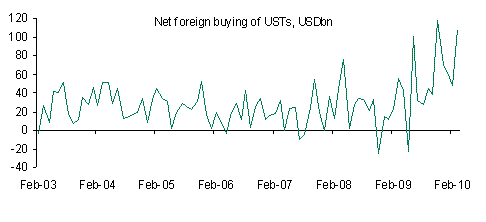
As was evident in the US March Treasury TICS report it appears that a lot of the outflows from Europe are finding their way into US markets. The data revealed that net long-term TIC flows (net US securities purchases by foreign investors) surged to $140.5 billion in March. The bulk of this flow consisted of safe haven buying of US Treasuries ($108.5 billion), although it was notable that securities flows into other asset classes were also strong especially agencies and corporate bonds, which recorded their biggest capital inflow since May 2008. Asian central banks also reversed their net selling of US Treasuries, with China investing the most into Treasuries since September 2009. Anecdotal evidence corroborates this, with central banks in Asia diversifying far less than they were just a few months ago.

This reversal of flows is unlikely to stop anytime soon. It is clear that enhanced austerity measures in the eurozone will result in weaker growth and earnings potential. This will play negatively on the EUR especially given expectations of a superior growth and earnings profile in the US. Evidence of implementation, action and a measure of success on the fiscal front will be necessary to begin the likely long process of turning confidence in the EUR around. This will likely take a long time to be forthcoming. EUR/USD has managed to recover after hitting a low of around 1.2235 but remains vulnerable to further weakness. The big psychological barrier of 1.20 looms followed by the EUR launch rate of around 1.1830.

The best funding currency

The dollar was beaten up over the past week, finally breaking through some key levels against many major currencies; the dollar index touched 76.457, the lowest since September 25, 2008.  The usual explanation for dollar weakness over recent months has been an improvement in risk appetite.  However, this explanation fails to adequately explain the drop in the currency over recent days.   

Although we have seen a multi month trend of improving risk appetite it is not clear that there was any further improvement last week.  On the one hand the ongoing rise in equity markets points to a continued improvement in risk appetite; the S&P 500 recorded its biggest weekly gain since July.  Equity volatility has also declined, reflected by the decline in the VIX index.   

On the other hand, other indicators reveal a different picture.  The ultimate safe haven and inflation hedge, namely gold, registered further gains above $1000 per troy ounce. That other safe haven, US Treasuries underwent the strongest demand in almost 2 years (bid-cover ratio 2.92) for the $12 billion 30-year note auction, whilst the earlier 10 year note auction also saw solid demand (bid-cover ratio 2.77) as well as strong interest from foreign investors.  

The massive increase in bond issuance to fund the burgeoning fiscal deficit continues to be well absorbed by the market for now, whilst the drop in the dollar does not appear to be putting foreign investors off US assets.  The strong demand for Treasuries could reflect a lack of inflation concerns but may also reflect worries about recovery, quite a contrast to the move in equities.

The fact that the Japanese yen and Swiss franc strengthened against the dollar also contrasts with the view that risk appetite is improving.  The yen was the biggest beneficiary currency during the economic and financial crisis but has continued to strengthen even as risk appetite improves.  USD/JPY dropped close to the psychologically important level of 90 last week which actually indicates a drop in risk appetite.  Perhaps the move is more of an indication of general dollar pressure rather than yen strength.  

A likely explanation for the drop in the dollar is that it is increasingly becoming a favoured funding currency, taking over the mantle from the Japanese yen; investors borrow dollars and then use it to take short positions against higher yielding currencies.  US dollar 3-month libor rates fell below those of the yen and Swiss franc for the first time since November, effectively making the dollar the cheapest funding currency and fuelling broad based weakness in the currency.

Although the historically strong relationship between currencies and interest rates has yet to establish itself to a significant degree, ultra low interest rates suggests that the dollar will remain under pressure for a while yet, especially as the Fed continues to highlight that US interest rates are not going to go up in a hurry.

Contrasting messages from bonds, gold and equities

There is an interesting divergence developing between bond yields, gold prices and the trend in equity markets.  Whilst equities continue to go up, bond yields are falling and gold prices are rising.  Indeed the usually strong relationship between the S&P 500 and US 10 year yields has collapsed to an insignificant correlation around -0.09 over the past month compared to a high correlation of 0.84 in the month to 8 August.  

Rising equities appear to signify an improvement in risk appetite whilst bonds (US 10-year yield around 3.4%) and gold (around $1000 per troy ounce) are giving the opposite message.  So which indicator is correct and why the breakdown in the usually solid relationship?  

Growing optimism about economic recovery and the run of better than forecast data releases suggest that equities are correct but there is growing risk that so much good news is now priced in that we should pay attention to what bond yields and gold prices are telling us.  

Some of the move lower in bond yields can probably be attributed to the wall of liquidity sloshing around due to central banks’ unconventional policy measures.  However, it is still remarkable that despite the plethora of better than expected data releases, bond yields have actually declined.  This may reflect the success of quantitative easing but could also be associated with sustained economic and market fears.    

The commitment by G20 officials last weekend not to reverse stimulus policies prematurely may also have given more confidence in the view that interest rates will not be raised quickly.  Reflecting this 2 year German bund yields dropped to a record low level at the beginning of the week although longer term bond yield have pushed higher in the 30 year area.  The G20 commitment could turn out to be a double edged sword, however.  If there is no commitment to reduce burgeoning deficits, bonds could ultimately take fright.  

If bonds and gold prices are really reflecting safe haven demand then it will pose a risk to the sustainability of any equity rally over coming months.  As equity valuations begin to look increasingly stretched – the P/E ratio on the S&P 500 has reached 18.76 (according to Bloomberg calculations) compared to a low of around 10.00 at the beginning of March 2009 – it will need more to keep the rally going and high amongst the factors needed is some clarity about the pace and shape of growth once stimulus is reversed. 

For currency markets I think it will be difficult to see a trend until there is more clarity about the economic outlook and in the meantime currency markets will continue to stock watch for direction even if the influence of risk appetite is declining.  Even so, the dollar appears to be reacting more to equities than bond movements and is coming under growing pressure as equities rise.  

Many currencies are poised to break out of recent ranges to the topside versus the dollar led by risk currencies such as the AUD, NZD and CAD.  If it turns out that the equity story rather than the bond message is the correct one then the real message is a bullish one for risk appetite and given the dollar’s usually negative reaction to improved risk appetite, it could face further pressure over coming weeks.