Edging Towards A European Deal For Greece

The momentum towards some form of agreement at the Special EU Summit today is growing, with French and German leaders reaching a “joint position on Greece’s debt situation”. Details of this position are still unknown, however. EUR has found support as expectations of a positive outcome intensify.

However, given that positive news is increasingly being priced in, and the market is becoming increasingly long, upside EUR potential will be limited even in the wake of a comprehensive agreement. A break above EUR/USD resistance around 1.4282 would bring in sight the next key resistance level around 1.4375 but this where the rally in EUR/USD is set to be capped.

Prospects of a major US debt default or at the least a government shutdown appear to be receding as the US administration has indicated some willingness to opt for a short term increase in the US borrowing limit to give more time for a bigger deficit reduction deal to be passed by Congress. Meanwhile, there will be further news on the deficit reduction plans put forward by the “gang of six” US senators, with a press conference scheduled for later today.

Debt ceiling negotiations are likely to be the main focus of market attention, with the Philly Fed manufacturing survey and weekly jobless claims relegated to the background. A speech by Fed Chairman Bernanke is unlikely to deliver anything new today. The USD is likely to be on the back foot given expectations of a deal in Europe and improved risk appetite but we expect losses to be limited.

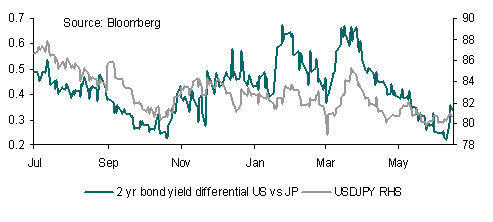
The JPY continues to defy my bearish expectations. Over recent days the US yield advantage over Japan in terms of 2Y bonds dropped to multi-year lows below 20bps. Given the high correlation between USD/JPY and yield differentials, this has corresponded with the fall below 80.00.

Expectations of JPY weakness versus USD is highly dependent on the US – Japan yield gap widening over coming months. For this to happen it will need concerns about the US economy and expectations of more Fed asset purchases to dissipate, something that may not happen quickly given the rash of disappointing US data releases lately.

GBP found itself on the front foot following the release of the Bank of England Monetary Policy Committee minutes, which were less dovish than anticipated. They also revealed that the BoE expects inflation to peak higher and sooner than previously expected. However, the fact that the overall tone was similar to the last set of minutes meant there was little follow through in terms of GBP.

Further direction will come from June retail sales data today and forecasts of a bounce in sales will likely help allay concerns about a downturn in consumer spending. Nonetheless, GBP is still likely to struggle to break through resistance around 1.6230 versus USD.
EUR to struggle to extend gains

Once again the USD index failed to break above its 100-day moving average, its third failure to do so over recent weeks. The USD is now trading below its 20- and 50- day moving averages and looks vulnerable to further weakness. However, much will depend on the travails of the EUR and how quickly the boost to this currency fades following last week’s Greek austerity plan approval.

The USD was helped last week by the relative move higher in US bond yields, which saw 2-year yield differentials between the Eurozone and US drop below 100bps for the first time since the beginning of April. Given that the six-month correlation between 2-year bond yield differentials and EUR/USD is at a very high level, it is reasonable to assume that this will remain an important factor driving the currency pair going forward.

The yield differential narrowing seen last week has reversed as German yields have moved sharply higher this week, however. This is in large part attributed to more positive developments in Greece but nonetheless, it has helped to push the EUR higher.

Ratings agencies may yet spoil the party for the EUR, with S&P’s warning that Greece’s debt rollover plans may put the country’s ratings into select default, fuelling some caution. Should ratings agencies downgrade Greek debt to junk it will not only be international investors that will re-think their exposure to the country but the European Central Bank (ECB) could also stop holding Greek debt as collateral for loans although an official from the Bank noted that this would happen only if all the major ratings agencies downgrade Greek debt to default.

Attention is now turning to the implementation risks of austerity measures and asset sales. While Greece’s contribution to eurozone GDP is small, the pain of implanting more budget cuts will push the economy deeper into recession and reveal the stark divergences in growth in the eurozone at a time when the ECB is hiking interest rates.

In reaction to such concerns there is likely to be a series of measures announced over coming days and weeks to boost growth according to Greece’s finance minister. As the S&P comments and implementation/growth concerns suggest, the EUR may struggle to extend gains, especially as the currency is looking increasingly stretched at current levels, with this week’s ECB rate hike largely in the price. Top side resistance for EUR/USD is seen around 1.4598.

EUR higher but resistance looms

EUR and risk currencies in general were buoyed by the passage of the austerity bill in the Greek parliament. The implementation bill is also likely to be passed later today opening the door for the disbursement of EUR 12 billion from the European Union / IMF from the EUR 110 bailout agreed for the country. Combined with news that German banks are progressing towards agreeing on a mechanism to roll over Greek debt alongside French banks as well as likelihood of an European Central Bank (ECB) rate hike next week, the EUR is set to remain supported over the short term.

Nonetheless, it once again looks as though a lot of good news is priced in and it would be surprising if EUR/USD could extend to above strong resistance around 1.4557 given the many uncertainties ahead, not the least of which includes the stance of ratings agencies on any Greek debt rollover.

USD/JPY is the only major currency pair that is correlated with bond yield differentials at present (2-year yields) and therefore it should not come as a surprise that USD/JPY has moved higher as the yield differential between the US and Japan has widened by around 10bps over the past week. Indeed, yesterday’s move above 81.00 was spurred by the move in yield differentials although once again the currency pair failed to build sufficient momentum to close above this level.

Further gains will require US bond yields to move even higher relative to Japan but perhaps the end of QE2 today may mark a turning point for US bond markets and currencies. The end of QE2 taken together with a jump in bond supply over coming months, will see US Treasury yields will move sharply higher, implying much more upside for USD/JPY.

AUD has bounced back smartly over recent days, with the currency eyeing resistance around 1.0775 versus USD. A general improvement in risk appetite has given the currency some support but markets will be unwilling to push the currency much higher ahead of the Reserve Bank of Australia (RBA) meeting next week. On the plus side, there are no rate hikes priced in for Australia over the remainder of the year, suggesting an asymmetric risk to next week’s meeting.

In other words, unless the RBA openly discusses rate cuts in the statement, the AUD will likely remain supported. Conversely any indication that a rate hike may be in prospect will be AUD supportive. In any case we continue to believe the AUD offers better value especially relative to NZD and maintain our trade idea to buy AUD/NZD.

Euro weaker despite hawkish ECB

The bounce in EUR/USD following the European Central Bank (ECB) press statement following its unchanged rate decision proved short-lived with the currency dropping sharply as longs were quickly unwound, with EUR/USD hitting a low around 1.4478. The sell off occurred despite the fact that the ECB delivered on expectations that it would flag a July rate hike, with the insertion of “strong vigilance” in the press statement.

The reaction was a classic ‘buy on rumour, sell on fact’ outcome and highlights just how long EUR the market was ahead of the ECB meeting. Interestingly the interest rate differential (2nd futures contract) has not widened versus the USD despite the hawkish ECB message and in any case interest rate differentials are not driving EUR/USD at present as reflected in low correlations.

This leaves the EUR susceptible to Greek developments and the news on this front is less positive. ECB President Trichet ruled out any direct participation (ie no rollover of ECB Greek debt holdings) in a second Greek bailout whilst potentially accepting a plan of voluntary private participation in any debt rollover. The ECB’s stance is at odds with that put forward by German Finance Minister Schaeuble pressuring investors to accept longer maturities on their Greek debt holdings.

In contrast the USD appears to be finding growing relief from the fact that the Federal Reserve is putting up a high hurdle before QE3 is considered. As highlighted by Fed Chairman Bernanke earlier this week the Fed is not considering QE3 despite a spate of weak US data. This was echoed overnight by the Fed’s Lockhart and Plosser, with the former noting that there would need to be a substantially weaker economy and the latter noting that there would have to be a “pretty extraordinary” deterioration in the economy to support QE3.

Greece’s trials and tribulations

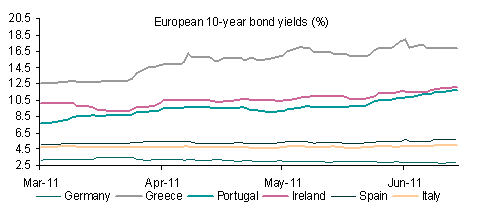
Two main influences on markets continue to weigh on sentiment. Firstly the trials and tribulations of the eurozone periphery remain centre of attention. The failure of Greek Prime Minister Papandreou to win cross party support for austerity measures at the end of last week highlights the problems Greece is facing both domestically and externally.

Reports that European officials are negotiating tough bailout conditions including major external intervention in terms of tax collection and privatisation suggest that gaining further aid will not be easy. The second weight on market sentiment is global growth concerns, with a string of disappointing data releases over recent weeks leading to an intensification of concerns about the pace of recovery.

Markets will likely remain nervous in this environment and it is difficult to see risk appetite improving to any major degree. This has proven bullish for bond markets, with the tone set to continue this week. Currencies remain in ranges and holidays today in the US and UK will likely result in thin trading. The resilience of the EUR to peripheral concerns has been impressive but at the same time Greek concerns will limit any gains. Meanwhile, gold and precious metals look to remain well supported, with gold’s safe haven bid remaining solid.

USD sentiment has improved sharply according to the latest CFTC IMM report which reveals that net USD short positions have been cut in half over the last two weeks with positioning well above the 3-month average. Conversely net EUR longs continue to shrink as speculative investors off load the currency. The fact that the EUR is not weaker than it is points to the influence of official demand for the currency, especially from Asia.

This week will likely be dominated by ongoing discussions about Greece and given the opposition to austerity measures and potentially strict bailout terms, forging an agreement will not be easy. Reports suggest that around half of Greece’s financing needs until the end of 2013 could be accounted for without new loans via privatisation and changes in terms for private bondholders, with Europe and the IMF needed to lend an additional EUR 30-35 billion on top of the EUR 110 already slated.

Data releases are likely to take a back seat but there will still be plenty of attention on the key release of the week, namely the May US jobs report. The market looks for a 185k increase in payrolls, with the unemployment rate edging lower to 8.9%. This would mark the lowest payrolls reading in 4 months. Clues to the jobs data will be garnered from the May ADP jobs report, ISM manufacturing survey and consumer confidence data earlier in the week.