Euro rallies on Greek election outcome but gains to be short lived

The Greek election outcome will be met with a sigh of relief across markets. However, there is still likely to be plenty of horse trading before a new government is formed and even then Greece’s fiscal/debt/growth problems will not just miraculously go away. Market pressure will resume after a brief delay.

At least for the early part of this week markets will likely find some support however, and with events including the FOMC meeting, G20 meeting and EU Summit coming up, hopes that some solutions may be forthcoming may at least prevent sentiment for risk assets from deteriorating too significantly.

The EUR garnered support following news that pro-bailout parties have gained sufficient votes to form a government in Greece. Negotiations will begin to form a coalition government between the first placed party New Democracy and third placed Pasok but the risk remains that prolonged discussions could quickly result in the EUR erasing its gains. Indeed, Pasok leaders are talking about the need to form a ‘government of national unity’, suggesting the process of forming a government will not be straightforward.
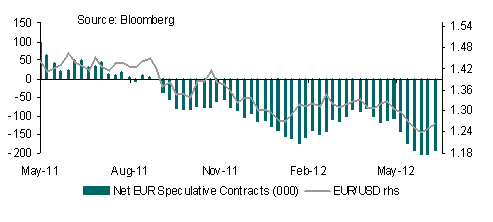
A slightly less negative shift in EUR sentiment has been apparent from the CFTC IMM data which revealed that net short positions dropped (ie there has been some short covering) even before the election outcome. The election result will encourage more short covering although data releases this week including the June German ZEW investor confidence and IFO business confidence surveys, both of which are set to decline, will caution against becoming overly bullish EUR. Short term EUR/USD resistance is seen around 1.2750 but a move back down to around 1.2515 is more likely as the week progresses.
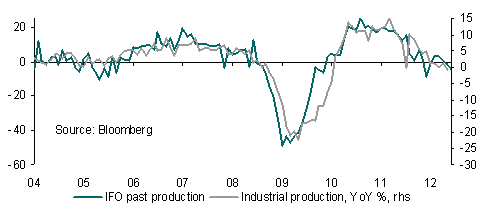
a href=”https://econometer.org/wp-content/uploads/2012/06/gerifo.gif”>
One of the reasons the EUR has managed to garner support over recent days has been growing speculation of Fed action to boost the economy in the wake of a rash of softer data releases. Such expectations have put the USD under pressure, with last week’s data revealing disappointing retail sales, industrial production and consumer confidence. On Wednesday the markets will find an answer to speculation of more Fed action, with the Fed FOMC policy decision.

Expectations of more quantitative easing will be disappointed but the Fed will likely increase Operation Twist buying time to evaluate incoming data releases. A combination of a relatively positive Greek election outcome together with speculation of more QE will keep the USD under pressure ahead of Wednesday’s outcome but weakness ought to prove short lived, with USD gains expected following the Fed decision not to expand its balance sheet further.
Is gold losing its lustre?

Hopes and expectations of more Fed quantitative easing in the wake of a run of weak US data, including the US May jobs report, has been attributable to the bounce in gold prices over recent weeks. However, Fed Chairman Bernanke dampened such hopes in his speech to Congress, in which he did not indicate a desire to move towards more QE. The Fed is unlikely in my view to embark on more QE any time soon.

Clearly, should the Fed implement more QE it will help to renew the attraction of gold. Once again markets will see the consequences of Fed QE as a means to debase the USD. A shift in Fed stance cannot be ruled out if US economic conditions worsen further and/or the Eurozone crisis escalates. Assuming no more QE and no more USD debasement, gold prices ought to decline over coming months.

One of the biggest factors putting downward pressure on gold prices has been the strength of the USD. While I do not expect the USD to continue to strengthen at the same pace as it has done recently, further gradual gains in the currency are likely. My FX forecasts predict a further small gain for the USD index by the end of the year but I also believe that the recent run up in the USD may have been too rapid. Assuming that the USD continues on a gradual upward trajectory I expect it to exert a negative influence on gold prices.

Gold appears to have lost its sensitivity to risk aversion. Indeed, gold’s relationship with risk has actually inverted over recent months, with a negative but significant relationship registered over the past 3 months between gold prices and my Risk Aversion Barometer. In other words as risk aversion goes up, gold prices actually drop.

The lack of reaction to higher risk aversion shows that the lustre of gold as a safe haven has faded as investors pull capital out of this as well as many other asset classes. However, gold’s drop is not unusual when compared to other commodity prices, with oil and copper prices falling too and gold maintaining a strong correlation with these commodities.

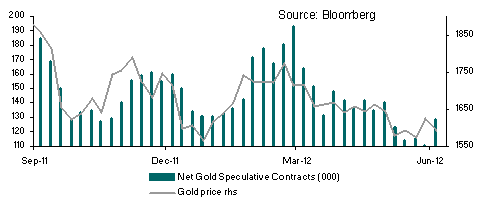
Some deterioration in sentiment towards gold prices has been reflected in the drop in speculative appetite for the commodity. Speculative demand for gold hit a cyclical high in August 2011 but since then there has been a steady reduction in appetite for gold from these investors. Indeed, CFTC IMM data reveals that speculative gold positioning dropped well below its three-month average. However, positioning is still well above its all time lows reached in February 2005, suggesting if anything, there is scope for more declines.

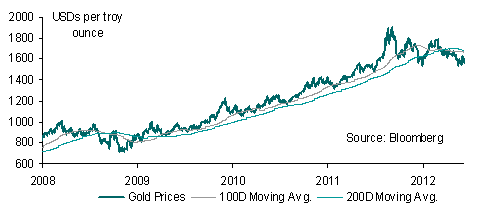
On top of the drop in speculative appetite for gold the technical picture has turned bearish. Since March 2009 at the height of the financial crisis the 100 day moving average price of gold had been trading above the 200 day moving average. On 27 March 2012 the 100 day moving average crossed below the 200 day moving average. Moreover, gold is now trading below both the 100 and 200 day moving average prices which sends a bearish technical message. Over the near term some key levels to look for are the 100 day moving average around 1658 on the topside and trendline support around the 1530 level on the bottom.

Another determinant of gold prices is demand from India and China. Growth in both countries is slowing, suggesting that gold demand is also weakening. While I certainly do not expect a collapse in demand from either country I have no doubt that compared to last year the strength of demand will be softer over coming months. Although I still look for a soft landing in China the Indian economic picture has clearly deteriorated while the Indian rupee has weakened. A weaker INR means that has become increasingly more expensive to import gold to India for domestic purchasers.

Overall, a weaker real demand picture taken together with reduced speculative appetite implies little support for gold prices. Moreover, a firmer USD in general will continue to weigh on prices. Perhaps a dose of inflation would help gold prices but there is little risk of this given the still sizeable amount of excess capacity in major economies.

Uncertainty about QE will help to limit any downside pressure on gold prices but elevated risk aversion will provide little assistance to gold. If however, the Eurozone and global picture deteriorates further gold will find itself with a lifeline but only if this means more currency debasement and a Fed engineered lower USD. If not, a further decline is on the cards and I forecast a drop in gold prices to around USD 1475 by the end of the year.

Central banks ready to act

Markets are in wait and see mode ahead of Greek elections with range trading likely to dominate market action, albeit with a slightly risk on bias. US data disappointed once again, with jobless claims coming in worse than expected, compounding the growing fears about deterioration in US job market conditions. Perversely the poor jobs data coming against the background of soft May CPI inflation data have fuelled expectations of Fed action at next week’s Federal Reserve FOMC meeting.

It is not only the Fed that markets believe may act, with reports overnight suggesting that there may be some form of coordinated action by central banks should the Greek election outcome prove to be unfavourable. On this front, the news appears to be a little more encouraging as expectations that pro bailout parties will garner relatively more votes has grown as reflected in the 10% rally in Greek shares overnight.

If it takes weak economic data for markets to rally nowadays then there will be plenty available today, with declines expected for the May Empire manufacturing survey and June Michigan confidence, while industrial production is only likely to register a marginal gain in May. While the data may add more fuel to the fire, I suspect it will still be insufficient to result in more Fed balance sheet expansion.

European Central Bank (ECB) President Draghi is scheduled to speak today but I doubt he will suggest a move towards another LTRO or Securities Market Purchases. On the subject of central banks the Bank of Japan will announce its policy decision today but I expect no change in stance despite the fact that the 1% inflation goal remains a long way off. Currencies will remain in ranges but hopes of central bank action and a favourable outcome to the Greek elections will provide support for risk currencies and keep the USD under pressure.

EUR jumps on Spanish news, but Greek risks ahead

Spain’s request for a EUR 100 billion bailout for its banks has significantly shifted the bias for markets this week, with risk assets buoyed and safe haven assets pressured. The fact that Spain will receive a bailout ‘light’ in terms of the conditions of the loan, will also have come as good news as the stringent measures associated with bailouts of Greece, Portugal and Ireland, will be avoided. Taken together with mixed (but less bad than feared) Chinese data over the weekend, the scene is set for markets to rally early in the week.

However, plenty of event risk remains, not least of which is the outcome of Greek elections at the weekend and results of French parliamentary elections today, which could easily reverse the positive mood of markets.

The USD has continued to head lower a trend that has been established since the end of May, with its drop set to accelerate at the start of the week following news of Spain’s banking bailout and the subsequent bounce in risk assets.

Although Fed Chairman Bernanke provided some relief for the USD last week by not indicating a desire to embark on fresh quantitative easing, the reality is that US data has been disappointing of late, keeping the door open to such action, restaining the USD.

More damaging to the USD is the bounce in risk appetite even before the Spanish news. Softer US data this expected week including likely sluggish May retail sales, a small increase in industrial production and lower manufacturing and consumer confidence surveys, will keep the debate on QE firmly open, leaving the USD struggling in the days ahead.

EUR/USD lurched higher following Spain banking bailout request. However, the sum of EUR 100 billion is far higher than the EUR 40 billion anticipated and could add around 20% to Spain’s sovereign debt. While the size of the package is significant it is also worrying, a fact that could come back and haunt the EUR.

Undoubtedly the upside in EUR is being helped by the fact that speculative positioning reached a fresh record low last week (according to the CFTC IMM data) leaving plenty of scope for short covering. In the near term EUR/USD will remain buoyed but any gains will be restricted to technical resistance around the EUR/USD 1.2690 level where sellers will emerge, especially given uncertainty surrounding the outcome of Greek elections.

US dollar could stall as QE hopes rise

Growth concerns are increasingly accompanying Eurozone tensions as major weights on market sentiment. US jobs data at the end of last week which revealed a disappointing 69k increase May payrolls added to other data including weaker than expected Chinese purchasing managers index (PMI) and even more disappointing Eurozone data highlighting intensifying downside risks to economic activity.

Combined with the lack of traction towards solutions to the Eurozone crisis it has led to an acceleration in the demand for safe haven assets. The weak US data has also reopened the debate about more US quantitative easing, with Fed Chairman Bernanke’s congressional testimony on the economic outlook on Thursday likely to garner plenty of attention.

Another central bank under pressure to act is the European Central Bank (ECB) but action such as restarting its Securities Market Purchases program and/or a third Long Term LTRO are unlikely to take place at least until after the Greek election on June 17 if at all. Until then investors will have to put up with more procrastination, prevarication and inaction from policy makers in Europe as the ECB continues its game of chess with European politicians.

Other central banks in focus this week include the Reserve Bank of India (RBA) and Bank of England (BoE) but while the ECB may still cut policy interest rates this week it is not obvious that the other central banks will follow suit despite growing pressure for easier policy. Against this background risk measures will remain highly elevated while core bond yields will remain suppressed and the USD will remain on the front foot.

The weaker than forecast US May jobs report has really set the cat among the pigeons. The prospects of more Fed quantitative easing is firmly back on the table and while Fed Chairman Bernanke is unlikely to countenance such action in his testimony this week, the market will still speculate on this option. Consequently the USDs one way bet is not longer so clear cut despite the elevated level of risk aversion providing some support for the currency.

Ahead of Bernanke’s testimony on Thursday the USD will struggle to make too much headway leaving the currency to consolidate its gains in the short term. Other US data releases this week are inconsequential for FX markets although the Fed’s Beige Book will be watched for clues ahead of the Fed’s 19-20 June FOMC meeting.

EUR/USD is well off its lows and will consolidate ahead of Thursday’s ECB meeting. Event risk is high and various rumours have resulted in a cautious tone for EUR bears. Talk of a ‘secret master plan’ consisting of structural reforms, banking union, fiscal union and political union to save the EUR as well as of the ECB buying sovereign bonds will keep markets wary of aggressively selling EUR from current levels. Attention is centred on Spain and its banking sector and debate about the country is next in line for a bailout.

Worries about Spain and of course the outcome of Greek elections on June 17 will limit any bounce in the EUR. Nonetheless, speculative positioning in EUR/USD reached another all time low in the latest week according to the CFTC IMM data, suggesting that scope for short covering is growing. EUR/USD will find technical support around its 2012 low around 1.2287 while upside potential will be restricted to resistance around 1.2505.