USD/CHF and EUR/CHF enjoyed a bounce as risk aversion eased but continued uncertainty over the situation in the Ukraine suggests that any upward momentum will be limited. The fact that the largest economic impact from any worsening in tensions with Russia will be felt in the Eurozone highlights that life may become difficult once again for the Swiss National Bank as renewed safe haven inflows move into the country. Indeed the EUR/CHF floor at 1.20 may be tested over coming weeks. Data tomorrow will likely give further reason for the SNB to oppose CHF strength, with the annual rate of CPI inflation set to remain very low.
 MarketWatch.com – MarketPulse
- Jobless claims fall to lowest level since mid-May
- Jobless claims stay low in latest week
- Consumer credit growth soars in December
- U.S. productivity slows down in fourth quarter while unit labor costs accelerate
- Beyond to buy rights to Buy Buy Baby brand and reunite it with Bed Bath & Beyond
- Trump asks Supreme Court to pause TikTok ban
- Amazon says it had best-ever Thanksgiving Holiday week with record sales and number of items sold
- U.S. stock futures and bond yields drop on reports Putin has updated nuclear doctrine
- Charter Communications announces buyout deal for Liberty Broadband at terms above its previous proposal
- General Motors unveils new all-electric Cadillac called the Vistiq with 300-mile range
Euro and Swiss franc under pressure
March 15, 2012 — Mitul KotechaPositive momentum in risk assets slowed, with higher core bond yields in the US and Europe weighing on sentiment. The USD in particular has been buoyed by higher US bond yields, with the move in line with my long held medium term view of a firmer yield led gain in the USD. Commodity prices in contrast have come under growing pressure, with gold and copper prices sliding in particular. Risk measures continue to improve including my risk barometer, suggesting that the overall tone to risk assets will remain positive.
The main focus today will be on a plethora of US data releases including industrial production, Philly Fed and Empire manufacturing confidence while in Europe attention will be on Spanish and French bond auctions. US data will likely remain upbeat, while the auctions should be well received.
EUR has pulled back sharply over recent not just against the USD but also on the crosses, with EUR/GBP finally playing some catch up yesterday. It’s interesting that the drop in the EUR has occurred despite generally improving conditions for peripheral Eurozone as reflected in narrowing yield spreads between peripheral countries and Germany.
The bottom line is that the EUR is suffering from a widening in the US / Europe (Germany) bond yield differential as it is becoming increasingly clear that the US economy will strongly outperform the Eurozone economy this year. As noted at the beginning of the week EUR/USD was set to drop to below support around 1.3055. Having hit this level, strong support around the 1.2974 level moves into sight.
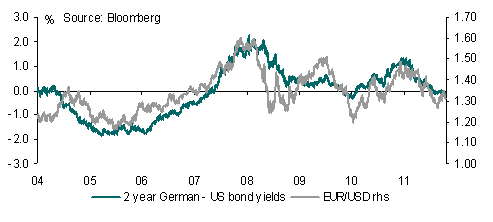
Ahead of today’s quarterly Swiss National Bank meeting at which no change in policy is widely expected, EUR/CHF has taken a sharp lurch higher, finally moving away from around the 1.2050 level it has been trading at over recent weeks. While I am bearish on the CHF over the medium term further upside in EUR/CHF will be limited over the short term given that the move in the currency is at odds with interest rate differentials which have actually narrowed between the Eurozone and Switzerland. Technical resistance around 1.2298 will cap gains over coming sessions.
As for USD/CHF the picture remains a bullish one, with general USD strength driven by higher yields, pushing the currency pair higher. I look for a test of resistance around 0.9393 over coming sessions.
Euro Resilience To Fade
May 31, 2011 — Mitul KotechaThere will at least be a little more liquidity in FX markets today following yesterday’s public holidays in the US and UK. Whether this means that there will be a break out of recent ranges is another matter. Clearly global growth worries as well as eurozone peripheral debt concerns are having an important impact on market dynamics but are also providing conflicting signals.
On the one hand the USD ought to garner support from Europe’s problems but on the other, safe haven demand and growth concerns is bolstering demand for US Treasuries keeping US bond yields at very low levels despite the lack of progress on increasing the US debt ceiling and agreeing on medium to long term deficit reduction.
In the wake of a run of US data disappointments including April durable goods orders, Q1 GDP and weekly jobless claims last week, fears of a loss of momentum in the US economy have intensified. Manufacturing and consumer confidence surveys in the form of the May Chicago PMI and Conference Board consumer confidence survey today will be closely scrutinised to determine whether the ‘soft patch’ in the US economy will persist.
This will have important implications for the USD as worries about growth may feed into expectations that the Fed’s ultra loose monetary policy will be sustained for longer. As it is US 2-year bond yields have dropped to their lowest level this year.
Fortunately for the USD only USD/JPY and USD/CHF have maintained a statistically strong correlation with bond yield differentials although we expect the break in relationship for other currencies to prove temporary. In the case of USD/JPY, yield differentials have narrowed between the US and Japan, a factor playing for JPY appreciation.
Perhaps the fact that unlike the US Japanese data has on balance been beating expectations notwithstanding disappointing April household spending and industrial output data has helped to narrow the yield gap with the US. One explanation is that that worst fears of post earthquake weakness have not been borne out, suggesting that economic expectations have been overly pessimistic. In any case, USD/JPY 80 is still a major line in the sand for the currency pair.
The EUR continues to show impressive resistance, with EUR/USD breaking technical resistance around 1.4345, which opens up a test of 1.4423. Reports that Greece had failed to meet any of its fiscal targets and of harsh conditions set by European officials for further aid have failed to dent the EUR. Whether the market is simply becoming fatigued or complacent will be important to determine if the EUR can gain further.
A report in the WSJ that Germany is considering dropping its push for early rescheduling of Greek debt has given some support to the EUR too. Ongoing discussions this week are unlikely to prove conclusive however, with attention turning to meetings of European officials on 20th and 24th June. I still believe EUR gains will limited, with the break above 1.4345 likely to prove shortlived.
Risk Aversion Creeps Higher
May 4, 2011 — Mitul KotechaThe USD index has dropped by around 17% since June 2010 high and despite a slight bounce this week it is unlikely to mark the beginning of a sustained turnaround. Nonetheless, I would caution about getting carried away with positioning for USD weakness. Whilst an imminent recovery looks unlikely the risk/reward of shorting the USD is becoming increasingly unfavourable.
Until then Federal Reserve comments will be watched closely for clues on policy and there are plenty of Fed speakers this week including a speech by Boston Fed’s Rosengren today and Fed Chairman Bernanke tomorrow. The USD will also gain some direction from jobs data and markets will be able to gauge more clues for Friday’s non-farm payrolls data , with the release of the April ADP employment report today.
The EUR is one currency that has suffered this week. News that Portugal’s caretaker government has reached an agreement with the European Union / International Monetary Fund on a bailout of as much as EUR 78 billion has so far been greeted with a muted response. EUR attention is still very much focussed on the ECB meeting tomorrow and prospects of a hawkish press statement suggest that EUR/USD downside will be limited, with support seen around 1.4755.
The JPY has strengthened by around 5% versus USD since its 6th April USD/JPY high around 85.53, confounding expectations that Japan’s FX intervention following the county’s devastating earthquake marked a major turning point in the currency. A combination of narrowing interest rate differentials with the US (2 year US/Japan yield differentials have narrowed by around 20bps in the past month), strong capital inflows to Japan (net bond and equity flows in the last four weeks have increased to their highest this year), and rising risk aversion have all played their part in driving the JPY higher.
As a result USD/JPY is fast approaching the psychologically important level of 80, a level that if breached will likely lead to FX intervention. Although Golden Week holidays in Japan this week suggest that JPY liquidity may be quite thin, Japanese authorities are likely to remain resistant to further gains in the JPY, likely using thinning liquidity to their advantage.
Despite the JPY’s recent strength speculative positioning over the past four weeks has remained net short JPY, whilst Japanese margin traders have also increased their long USD/JPY bets, suggesting that these classes of investors are not to blame for the JPY’s appreciation. This suggests that FX intervention may not be as successful given that the market is already short JPY.
Given the risk of intervention on USD/JPY, the CHF appears to be an easier choice for safe haven demand against the background of rising risk aversion. The currency has risen to a record high against the USD, gaining around 8.3% so far this year. Given the hints of higher interest rates by the Swiss National Bank (SNB) and resilience economic performance, downside risks for CHF are limited at present unless risk appetite improves sharply. Further gains are likely with USD/CHF likely to test the 0.8570 support level over the short-term.
Japanese yen spikes higher
March 17, 2011 — Mitul KotechaEvents in Japan continue to dominate market action in this respect the situation is highly fluid. Markets will continue to gyrate on various pieces of news concerning the nuclear situation in Japan. As a result, risk aversion remains highly elevated and safe haven assets including US Treasuries, German bunds and the CHF are the main beneficiaries. In contrast, risk assets including global equity markets and risk currencies have come under growing pressure.
Prior to Japan’s earthquake risk aversion was already elevated amidst renewed eurozone peripheral bond tensions but the aftermath of the earthquake has seen our risk barometer rise to its highest level since the end of August last year. Any decline in risk aversion will depend on the nuclear situation coming under some form of control but until then the general “risk off” market tone will continue. Similarly currency and equity volatility will also remain relatively high.
Risk had been losing its influence on currencies over recent months but the spike in risk aversion over recent weeks has seen short-term correlations increase. The most highly impacted (highest correlations over the past month) currencies from higher risk aversion USD/JPY, USD/CHF, NZD/USD, NOK/SEK, EUR/CHF, EUR/HUF, EUR/PLN, USD/KRW. Over a three-month period all of the correlations are much lower and insignificant for the most part. JPY and CHF will likely remain the key beneficiaries in the current environment.
USD/JPY hit a low of 76.25 amidst volatile trading conditions but Japanese authorities noted that rumours of Japanese life and non life insurance companies repatriating funds back to Japan are “groundless”. USD/JPY bounced from its lows but there appears to be no sign of intervention although there may have been Bank of Japan rate checking, which helped to provoke some fears about imminent intervention. There is a high risk of FX intervention as long as USD/JPY remains below the 80.00 level.
Share this blog

 ECONOMETER