The loss of a great forecaster

Forecasters around the world will mourn the loss of one of their finest following the death of Paul the Octopus at the age of 2 ½ (apparently an average age for Octopi). Although Paul had various threats to his life and insults to his mother’s honour he passed away from natural causes. Many forecasters envious of Paul’s record will look now a successor being groomed to take his place. Markets could do with Paul’s abilities in trying to ascertain the magnitude of Fed quantitative easing (QE) to be announced on 3 November. Conflicting comments from the Fed’s Hoenig (hawkish) and Dudley (dovish) yesterday will keep the market’s guessing.

Interestingly US bond yields are backing up and although yields elsewhere are also rising US yields are beginning to move relatively higher. The FX impact is evident in the growing resilience of the USD. Major Currencies with the highest correlations with bond yield differentials are EUR/USD, AUD/USD, EUR/CAD and USD/CHF although USD/JPY correlations have also been pushing higher. These currencies will ultimately suffer the most if US yields back up further.

Part of the reason for the shift higher in US bond yields is growing speculation that the Fed will take a more measured approach to asset purchases whilst recent data, particularly in the US housing market is showing some stabilisation as revealed in existing home sales data on Monday and a surprise gain in the August US FHFA home price index overnight. September new homes sales will be closely watched today to determine whether this stability is becoming broader based.

US consumer confidence continued this pattern, with the Conference Board index rising to 50.2 in October. Perhaps more interesting was the outcome of the US 5-year TIPS auction at a negative yield (-0.55%). The increased demand for inflation protection hints at QE2 working even before it has been carried out but there is a long way to go on this road and it would be premature to read too much into the auction outcome.

It’s worth noting that UK bond yields bucked the trend versus US bond yields following the release of stronger than expected UK GDP. The data alongside persistently above target inflation will likely dampen expectations that the Bank of England (BoE) will follow the path of the Fed into more QE. Consequently GBP has been a key outperformer. EUR/GBP in particular underwent a sharp reversal and technically the currency pair is showing a negative divergence from the 9-day RSI and the MACD is turning lower from overbought levels. The cross needs to drop below 0.8696 to confirm the technical signals.

Closer to home Australian CPI data this morning played into the hands of those looking for the Reserve Bank of Australia (RBA) to remain on hold next week. Although CPI was slightly softer than expected at 0.6% QoQ in Q3, the AUD took the news badly. The RBA has kept the cash rate on hold at 4.5% since May and at the last meeting there was little indication of an urgency to hike. Nonetheless, recent data plays towards a rate hike next week though the outcome is now a much closer call
G20 Leaves The US Dollar Under Pressure

The G20 meeting of Finance Ministers and Central bankers failed to establish any agreement on clear targets or guidelines. Perhaps the problem of trying to achieve consensus amongst a variety of sometimes conflicting views always pointed to an outcome of watered down compromise but in the event the G20 summit appears to pass the buck to November’s summit of G20 leaders in Seoul where more concrete targets may be outlined.

Officials pledged to “move towards more market determined exchange rate systems” and to “refrain from competitive devaluation of currencies”. What does this actually mean? The answer is not a great deal in terms of practical implications. The first part of the statement is the usual mantra from such meetings and the addition of the latter part will do little to stop central banks, especially in Asia from continuing to intervene given that no central bank is actually devaluing their currency but rather preventing their currencies from strengthening too rapidly.

The communiqué highlighted the need for advanced economies being “vigilant against excess volatility and disorderly movements in exchange rates”, but once again this is the mantra found in the repertoire of central bankers over past years and is unlikely to have the desired effect of reducing the “excessive volatility in capital flows facing some emerging countries”. In other words many emerging countries will continue to have an open door to impose limited restrictions on “hot money” flows.

Although the language on currencies was stronger than in previous summits it arguably changes very little in terms of the behaviour of central banks and governments with respect to currencies. The communiqué is wide open to varying interpretations by countries and is unlikely to prevent the ongoing trend of USD depreciation and emerging market country FX appreciation and interventions from continuing over coming weeks.

The onus has clearly shifted to the November summit of G20 leaders but once again it seems unlikely that substantial agreements will be found. In the interim the November 3 Fed FOMC meeting will be the next major focus and if the Fed embarks on renewed asset purchases as widely expected FX tensions will remain in place for some time yet.

So whilst a “currency war” was always unlikely “skirmishes” will continue. In the meantime the USD is set to remain under pressure although it’s worth noting that speculative positioning has recorded a reduction in net aggregate USD short positions over the last couple of weeks, suggesting that some of the USD selling pressure may have abated. Whether this reflected caution ahead of the G20 meeting (as the data predates the G20 meeting) or indicated the USD having priced in a lot of quantitative easing (QE2) expectations already, is debatable.

The path of least resistance to USD weakness remains via major currencies including AUD, CAD and NZD. Officials in Europe are also showing little resistance to EUR strength despite the premature tightening in financial conditions and negative impact on growth that it entails. Scandinavian currencies such as SEK and NOK have also posted strong gains against the USD and will likely continue to show further outperformance.

The JPY has been the best performing major currency this year followed not far behind by the CHF despite the FX interventions of the authorities in Japan and Switzerland. Although USD/JPY is fast approaching the 80.00 line in the sand level expected to result in fresh FX intervention by the Japanese authorities, the path of the JPY remains upwards. Japan is unlikely to go away from the G20 meeting with any change in policy path as indicated by officials following the weekend deliberations.

Speculators bail out of USDs

Risk appetite held up reasonably well last week, with markets failing to be derailed by concerns over Ireland’s banking sector and growing opposition to austerity measures across Europe. The main loser remained the USD, with the USD index hitting a low marginally above 78.00 and speculative positioning as reflected in the CFTC IMM data revealing a further sharp drop in sentiment to its lowest since Dec 2007.

This week is an important one for central bank meetings, with four major central banks deliberating on monetary policy including Bank of Japan (BoJ), Reserve Bank of Australia (RBA), European Central Bank (ECB) and Bank of England (BoE). The major event of the week however, is Friday’s release of the September US employment report. The RBA is set to hike its cash rate by 25bps, the BoJ may announced more easing measures whilst in contrast both the ECB and BoE are unlikely to alter their policy settings.

Whilst the BoJ is widely expected to leave its policy rate unchanged at 0.1%, it may announce further measures against the background of persistent JPY strength, a worsening economic outlook as reflected in last week’s Tankan survey and decline in exports. Japanese press indicate that the BoJ may increase lending of fixed rate 3 to 6 month loans to financial institutions as well as buy more short-term government debt.

The measures alongside risks of further JPY intervention may prevent USD/JPY slipping further but as reflected in the increase in speculative net long JPY positions last week, the market is increasingly testing the resolve of the Japanese authorities. Strong support is seen around USD/JPY 82.80, with the authorities unlikely to allow a break below this technical level in the short-term.

Although we will only see details of the voting in two weeks in the release of the UK BoE Monetary Policy Commitee (MPC) minutes it is likely that there was a three-way split within the MPC as reflected in recent comments, with MPC member Posen appearing to favour more quantitative easing whilst the MPC’s Sentance is set to retain his preference for higher rates. As has been the case over recent months the majority of the MPC are likely to have opted for the status quo.

GBP was a laggard over September as markets continued to fret over potential QE from the BoE. This uncertainty is unlikely to fade quickly suggesting limited gains against the USD and potentially more downside against the EUR. GBP speculative sentiment has improved but notably positioning remains short. EUR/GBP will likely target resistance around 0.8810.

In contrast to GBP the EUR has taken full advantage of USD weakness and looks set to extend its gains. Although there is a risk that speculative positioning will soon become overly stretched it is worth noting that positioning is well below its past highs according to the IMM data. EUR may have received some support from Chinese Premier Wen’s pledge to support Greece, and a stable EUR. Whilst there continues to be risks to the EUR from ongoing peripheral debt concerns such comments likely to be repeated at the EU-Asia summit today and tomorrow, will keep the EUR underpinned for a test of 1.3840.

FX Tension

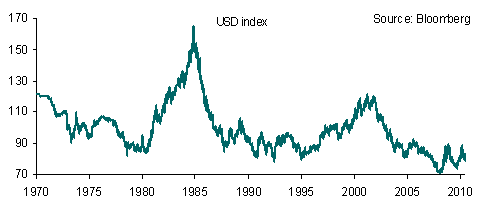
On September 22 1985 the governments of France, West Germany, Japan, US and UK signed the Plaza Accord which agreed to sharply weaken the USD. At this time it was widely agreed that the USD was overly strong and needed to fall sharply and consequently these countries engineered a significant depreciation of the USD.

It is ironic that 25 years later governments are once again intervening in various ways and that the USD is once again facing a precipitous decline as the Fed moves towards implementing further quantitative easing. This time central banks are acting unilaterally, however, and there is little agreement between countries. For instance Japan’s authorities found no help from the Fed or any other central bank in its recent actions to buy USD/JPY.

So far Japan’s FX interventions have been discreet after the initial USD/JPY buying on 15 September. The fact that Japan is less inclined to advertise its FX intervention comes as little surprise given the intensifying pressure from the US Congress on China for not allowing its currency, the CNY to strengthen. Tensions have deepened over recent weeks and the backing of a bill last week by an important Congressional committee to allow US companies to seek tariffs on Chinese imports suggests that the situation has taken a turn for the worse.

The softly softly approach to Japan’s FX intervention and US/China friction reflects the fact that unlike in 1985 we may be entering a period in which currency and in turn trade tensions are on the verge of intensifying sharply against the background of subdued global economic recovery.

The Fed’s revelation that it is moving closer to implementing further quantitative easing has shifted the debate to when QE2 occurs rather than if, with a November move moving into focus. Clearly the USD took the news negatively and will likely remain under pressure for a prolonged period as the simple fact of more USD supply weighs heavily on the currency. Markets will be able to garner more clues to the timing of QE2, with a plethora of Fed speakers on tap over coming days.

This week the US economic news will be downbeat, with September consumer and manufacturing confidence surveys likely to register declines, with consumer sentiment weighed down by the weakness in job market conditions. Personal income and spending will also be of interest and gains are expected for both. There will be plenty of attention on the core PCE deflator given that further declines could give clues to the timing of QE2.

Attention in Europe will centre on Wednesday’s recommendations for legislation on “economic governance” from the European Commission. Proposed penalties for fiscal indiscipline may include withholding of funding and/or voting restrictions but such measures would be politically contentious. Measures to enforce fiscal discipline ought to be positive for markets given the renewed tensions in peripheral bond markets in the eurozone.

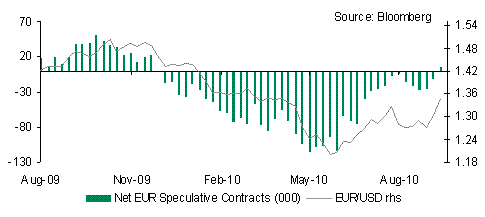
The EUR was a major outperformer last week benefiting from intensifying US QE speculation and will set its sights on technical resistance (20 April high) around 1.3523 in the short-term. Notably EUR speculative positioning has turned positive for the first time this year according to the CFTC IMM data, reflecting the sharp shift in speculative appetite for the currency over recent weeks. The EUR has been surprisingly resilient to renewed sovereign debt concerns and similarly softer data will not inflict much damage to the currency this week.

Ready for Fed QE2

The USD was already under pressure ahead of the Fed FOMC decision last night, with the EUR benefiting in particular from successful debt auctions in Ireland and Spain. The Fed statement resulted in a further lurch lower for the USD index as it fell through the 81.00 level on its way to testing the August low of 80.09. EUR/USD broke important technical resistance levels moving above its 200-day moving average (1.3215). In contrast, gold prices continued to surge hitting a new record high whilst 2-year Treasury yields fell to an all-time low.

The US Federal Reserve confirmed that it was ready to ease if needed. Although the decision to leave the Fed funds target rate at 0% to 0.25% unchanged and commitment to maintain exceptionally low levels of the rate for an “extended period” came as no surprise there was a subtle change in the language of the statement regarding further easing. The Fed noted that it was “prepared to provide additional accommodation if needed” a shift from the previous wording that it “will employ its tools as necessary”.

It appears to be a case of not if but when the Fed embarks on further quantitative easing and/or other policy accommodation. Once again the Fed offered no guideposts to determine the timing of easing and the decision will ultimately be data dependent. Nonetheless, the bias has clearly shifted towards more balance sheet expansion.

We expect core inflation to decline further over the coming months although we do not forecast a drop to as low as 0.5%. Nonetheless, declining core CPI could lead to the Fed’s disinflation concerns intensifying. Indeed, providing further rationale for the Fed’s conditional easing bias was the particularly dovish stance on inflation in the FOMC statement.

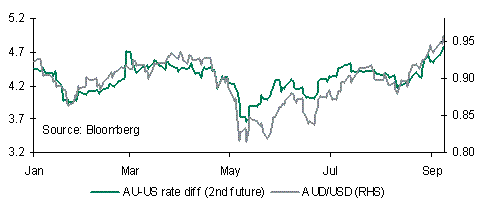
If it wasn’t obvious before it has become increasingly clear now that the USD will not relinquish its role as the ultimate funding currency for a long time to come. Although interest rate differentials are not yet the main driver for most currency pairs, with risk aversion retaining this role for now, there is a very high correlation between certain high yielding currencies and their respective interest rate differentials against the USD.

For instance, there is a high and significant correlation between interest rate differentials between Japan, Australia, Canada and the US and their respective currency pairs. AUD/USD is one to watch as the currency hit a fresh 25 month high overnight. Although the AUD looks rich at current levels, the shift in relative yield with the US overnight provides a further underpinning to the currency, with parity being talked about once again.

Even USD/JPY moved lower in the wake of the Fed statement dropping just below 85.00 although the threat of further official Japanese FX intervention will likely prevent a sharp drop in the currency pair. It will be interesting to see how far the market is prepared to go, with further threats of FX intervention by Prime Minister Kan overnight. Despite the threats the narrowing in US / Japan bond yields overnight suggests more downside pressure on USD/JPY and a fresh challenge for the Japanese authorities.