What To Watch This Week

A “crisis over” mode is being adopted across markets as worries about Greece wane and economic data provides support to recovery hopes, whilst importantly allaying fears of a “double-dip”. Equities, bonds and currencies are reacting accordingly; equities are close to year highs, bond yields have risen and spreads have narrowed, whilst the USD and JPY are weaker, and conversely risk currencies are stronger. Even EUR/USD pushed higher on its way to 1.3800 as a number of stops were cleared and shorts were squeezed.

The coming weeks will be important to determine whether there is any staying power in the upward move in risk assets. A lot of the February data in the US will likely be obscured by bad weather however, including industrial production figures this week, leaving markets with little to go on. In Europe, the key release is the March German ZEW investor confidence survey, and better news in Greece, will likely prevent a sharper decline in confidence.

After both the Swish National Bank (SNB) and Reserve Bank of New Zealand (RBNZ) unsurprisingly left policy unchanged last week this week sees the turn of the US Federal Reserve and Bank of Japan (BoJ). Neither central bank is likely to shift policy but the Fed statement will be looked upon for guidance on the timing of rate hikes. The comment in the FOMC statement that the Fed Funds rate is expected to remain low for an “extended period” is set to be retained, even if some FOMC members are itching to remove it soon.

The BoJ meeting will be particularly interesting. I have just returned from a week long trip in Japan and on the ground there is plenty of speculation that the BoJ will take extra action to combat deflation and weaken the JPY. Additionally comments by Japan’s Prime Minister and Deputy PM have highlighted the potential for action to weaken the JPY although the usual market hesitation to sell JPY into fiscal year end and repatriation talk may mean a weaker JPY path is not straightforward.

Greece will not move too far from the spotlight, with EU officials likely to give the official stamp of approval on Greece’s deficit cutting measures and plenty of discussion at the Eurogroup Finance Minister’s meeting and Ecofin meeting early in the week. Moreover, weekend press reports suggest that a bailout up to EUR 25 billion is close to being agreed. Other topics of conversation will include the possible formation of a European Monetary Fund, though this looks like it will be a non-starter given the many objections to it.

Overall, risk appetite is set to continue its upward trajectory, likely keeping the USD on the back foot. Some deterioration in USD sentiment was reflected in the fact that net long aggregate USD speculation positioning has turned negative again according to the latest CFTC Commitment of Traders (IMM) report. Much in terms of FX direction will depend on what the FOMC says rather than does tomorrow.

EUR/USD may take a crack at resistance around 1.3840 on improving Greek news but it is difficult to see much upside from current levels. The one to watch will be the JPY, especially if the BoJ embarks on aggressive actions at this week’s meeting, leaving USD/JPY plenty of scope to test resistance around 92.16.
Risk Appetite Puts Dollar On The Back Foot

Markets look somewhat calmer going into this week helped by comments by Fed members who noted that the discount rate hike did not signal a shift in monetary policy, something which is likely to be repeated by Fed Chairman Bernanke in his testimony to Congress on Wednesday and Thursday.  A tame US January CPI report last Friday helped too, giving further support to the view that the Fed will not hike the Fed Funds rate for some time yet; a rate hike this year seems highly unlikely in my view.  

Data this week will be conducive to a further improvement in risk appetite and despite the lingering concerns about Greece the EUR may find itself in a position to extend gains.  In Europe all eyes will be on the February German IFO survey and eurozone sentiment indicators, which following the surprising strength in the manufacturing Purchasing Managers Indices (PMIs), are likely to reveal solid gains. 

The main highlights in Japan this week includes January trade data and industrial production. The trade numbers will be particularly important to determine whether the rebound in exports due in large part to robust Asian demand, has continued whilst the bounce back in exports will be a key factor in fuelling a further gain in industrial output. 

In the US aside from the testimonies by Fed Chairman Bernanke there are plenty of releases on tap including consumer confidence, new and existing home sales, durable goods orders and a likely upward revision to Q4 GDP.  For the most part the data will show improvement and play for a further improvement in risk appetite. 

FX direction will depend on whether markets focus on the potentially positive USD impact of a reduction in USD liquidity or on the likely firmer tone to risk appetite this week.  Given expectations of firmer data and the soothing tone of the Fed, risk currencies will likely perform better, with crosses such as AUD/JPY favoured.  The USD will likely be placed on the back foot, especially given the very long market positioning in the currency.

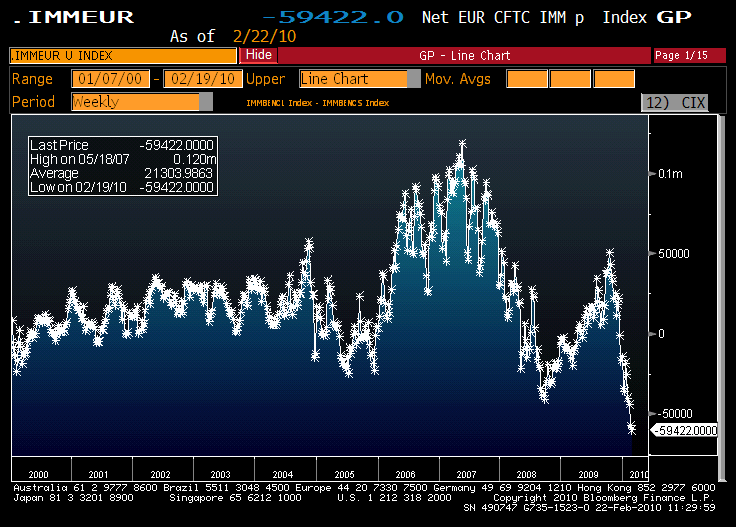
The EUR will be helped by the fact that speculative market, according to the CFTC IMM data, holds record short positions in the EUR (as of the week ended 16 February) giving plenty of potential for short-covering.   The more timely Tokyo Financial Exchange (TFX) data also reveals that positioning in EUR/JPY has continued to be scaled back.  

CFTC Commitment of Traders (IMM) data – Net EUR speculative positioning

EUR/USD bounced smartly from its lows around 1.3444 on Friday, partly reflecting some short covering and the drop in FX volatility suggests the market is more comfortable with EUR/USD around these levels.  A positive IFO survey and improved risk appetite could see EUR/USD test resistance around 1.3774, its 20 day moving average, over coming days.  Ongoing Greek concerns suggest that any EUR bounce will be limited, however. 

USD/JPY looks well supported and although data this week will suggest that exports are improving despite JPY strength, the relatively more aggressive stance of the Fed compared to the BoJ, long JPY positioning, and improved risk appetite, give plenty of scope for the JPY to extend losses, with technical USD/JPY support seen around 91.28.

Optimism dissipates

Markets have been highly fickle so far this year. Optimism about strong recovery led by China – recall the fact that disappointment from the surprisingly weak US non-farm payrolls report in December was outweighed by strong Chinese trade data – has dissipated. Instead of rejoicing at China’s robust GDP report last week, which revealed a 10.7% rise in the fourth quarter of 2009, investors began to fret about whether China would have to move more aggressively to tighten monetary policy. Fuelling these fears was the release of Consumer price data which showed inflation rising above expectations to 1.9% YoY in China.

If such fears were not sufficient to hit risk appetite, US President Obama’s plan to limit the size and trading activities of financial institutions dealt another blow to financial stocks. The plan followed quickly after the Democrats lost the state of Massachusetts to the Republicans and managed to shake confidence in bank stocks whilst fuelling increased risk aversion. Meanwhile, rumblings about Greece continue to weigh on markets and Greek debt spreads continued to widen even as global bond markets rallied.

Following the US administration’s plans to restrict banks’ activities the fact that the rise in risk aversion was US led rather than broad based led to an eventual pull back in the dollar which helped EUR/USD to avoid a break below 1.40. Risk trades including the AUD came under pressure as risk appetite pulled back. A drop in commodity prices did not help. The AUD was also hit by news that Australia’s Henry Tax Review would look to tax miners in the country. As a result AUD/USD dropped below 0.90 though this level is likely to provide good buying levels for those wanted to take medium term AUD long positions. The one currency that did benefit was the JPY which managed to drop below sub 90 levels.

The aftermath of the “Volker Plan” will reverberate around markets this week keeping a lid on equity sentiment. Meanwhile Greece will be in the spotlight especially its bond syndication. A bad outcome could be the trigger for EUR/USD to sustain a move below 1.40 though it looks as though it may find a bottom around current levels, with strong support seen around 1.4029. The German IFO business survey for January will be important to provide some direction for EUR and could be a factor that weighs on the currency if as expected it reveals some loss of momentum in the economy.

Aside from the Fed the other G3 central bank to meet this week is the Bank of Japan but unless the Bank is seen to be serious about fighting deflation, USD/JPY may remain under downward pressure against the background of elevated risk aversion. Below 90.0 there does appear to be plenty of USD/JPY buyers however, suggesting that further upside for the JPY will be limited. USD/JPY will find strong support around 88.84.

Much will depend on the key events in the US this week including the Fed FOMC meeting and the President’s State of the Union speech. USD bulls will look for some indication that the US government is serious about cutting the burgeoning budget deficit. Also watch out for the confirmation vote on the renomination of Bernanke as Fed Chairman which could end up being close. There is a heavy slate of data to contend with including new and existing home sales, consumer confidence, durable goods orders, the first glance at Q4 GDP and Chicago PMI.

All eyes on US payrolls

Happy New Year.  Markets are likely to struggle for direction ahead of the key US December non-farm payrolls data though the end of the year ended on a softer note for equity markets in the US, whilst Asian stocks were somewhat firmer.  The USD has taken a firmer tone at the start of this week but is likely to face renewed pressure into the new-year.  The fact that USD/Asian FX has failed to build any momentum on the upside also highlights risks to the USD from current levels. 

Ahead of payrolls look for EUR/USD technical support around 1.4177, with strong resistance around 1.4459 whilst USD/JPY will find support at 91.00 and resistance around 94.08.   I favour a firmer bias for the USD at the beginning of the week but this may not last too long and would look to take profits on long USD / short risk currency positions into next week. 

2010 is set to be a year of two halves for currency markets and whilst the USD is to eventually recover, the rally seen at the end of last year is likely to prove unsustainable, especially now that a lot of short USD positions have been covered.   If anything the pull back in various risk currencies provide better levels to take long positions, especially in the AUD and NZD as well as many Asian currencies where renewed appreciation in the months ahead is likely.  I particularly like the IDR and KRW, two of last year’s winners. 

The US jobs report will provide some evidence of a normalisation in economic conditions, with December likely to have marked the best month in two years for payrolls (Bloomberg consensus forecasts a 1k drop in payrolls). Although hiring is unlikely to pick up quickly and wage pressures are set to remain subdued, the data will mark an encouraging shift in job market conditions following the loss of 7.2 million jobs since the US recession began.  The unemployment rate is likely to remain stubbornly high, however.

Ahead of the jobs data markets will be able to garner some clues to the data from the jobs component in today’s release of the December ISM data.  The ISM is likely to remain in expansion territory though is unlikely to register much of a gain from last month’s 53.6 reading.   The eurozone and UK also release their manufacturing PMIs today and although both will remain above the 50 boom/bust mark, neither are set to register much improvement from November’s reading. 

There will also be some attention on central bank thinking this week, with the release of the December 16 meeting FOMC minutes as well as the BoE rate decision to digest.  The minutes will likely acknowledge some signs of improvement in the economy but there will be no indication that the Fed is shifting its “extended period” thinking even if the Fed wants to reassure markets that it has an exit strategy in place.   The BoE meeting will be a non-event for markets, with more interest on the outcome of the February meeting.

FX Prospects for 2010

There can be no doubt that for the most part 2009 has been a year for risk trades, not withstanding the sell off into year end. The policy successes in preventing a systemic crisis and the massive flood of USD liquidity injected globally kept the USD under pressure for most of the year and the currency became a victim of this success. Risk appetite is likely to improve only gradually over coming months given the still significant obstacles to recovery in the months ahead.  This will coincide with the declining influence of risk on FX markets. 

2010 will not be as straightforward and whilst risk will dominate early in the year interest rate differentials will gain influence in driving currencies as the year progresses. The problem for the USD is that market expectations for the timing of the beginning of US interest rate hikes is likely to prove premature as the Fed is set to hold off until at least late 2010/early 2011 before raising interest rates. The liquidity tap will stay open for some time, and risk trades will still find further support at least in the early part of 2010, whilst the USD will come under renewed pressure.    

The ECB will be much quicker in closing its liquidity tap than the Fed and arguably an earlier reduction in credit easing and interest rate hikes compared to the Fed would favour a stronger EUR.  However, the EUR is already very overvalued and a relatively aggressive ECB policy is unwarranted. Consequently rather than benefiting from more favourable relative interest rate expectations, the EUR could be punished and the EUR is set to decline over much of 2010 following a brief rally in Q1 2010, with EUR/USD set to fall over the year. 

Japan is moving in the opposite direction to the ECB.  FX intervention is firmly on the table though the risk is limited unless USD/JPY drops back to around 85.00. Even at current levels the JPY is overvalued but for it to resume weakness it will need to regain the role of funding currency of choice, a title that the USD has assumed. Efforts by the BoJ to combat deflation will likely help result in fuelling some depreciation of the JPY and it is likely to be the worst performing major currency over 2010, with a move back up to around USD/JPY in prospect.

The issue of global rebalancing will need to involve currencies but the currency adjustments necessary will not be forthcoming in 2010.  USD weakness early in the year will be mostly exhibited against freely floating major currencies which will bear the brunt of USD weakness.  However, the bulk of adjustment is needed in Asian currencies and there is little sign that central banks in the region will allow a rapid appreciation.  China holds the key and a gradual appreciation in the CNY over 2010 suggests little incentive to allow other Asian currencies to appreciate strongly. 

So in many ways 2010 will be one of two halves for currency markets and this has the potential to reignite some volatility in FX markets.  High beta risk trades including the AUD, NZD, NOK and many emerging currencies will see further upside in H1 as the USD falls further.  Gains in risk currencies will look even more impressive when played against the JPY and/or CHF than vs. USD given that they will succumb to growing pressure in the months ahead as their usage as funding currencies increases.

Ongoing rate hikes in Australia and Norway and the likely beginning of the process to raise rates in New Zealand early next year will mean that these currencies will also have the additional support of yield to drive them higher unlike the JPY.  There is a limit to most things however, and eventually the USD will recover some of its lost ground against risk currencies, as it undergoes a cyclical recovery over H2 2010.