RBA on hold, RBI hikes rates

News of the death of Osama Bin Laden gave the USD a lift and its gains have extended for a second day. Extreme short market positioning as well as increasing risk aversion (perhaps due to worries about retaliation following Bin Laden’s death) have helped the USD.

However, the boost to the USD could be short-lived in the current environment in which it remains the preferred global funding currency. Indeed, the fact that US bond yields have dropped sharply over recent weeks continues to undermine the USD against various currencies.

The USD firmed despite the US ISM manufacturing index dropping slightly, albeit from a high level. The survey provided some useful clues to Friday’s US jobs report, with the slight decline in the employment component of the ISM survey to 62.7 consistent with a 200k forecast for April payrolls.

Ahead of the European Central Bank (ECB) meeting on Thursday hawkish rhetoric from new Council member and Bundesbank chief Weidmann (replacing Weber) and more reassurances from Greek and EU officials that there will be no debt restructuring or haircut on the country’s debt has helped the EUR although it is notable that it could not sustain a foot hold above 1.49. Eurozone bond yields have risen by around 20bps compared to US yields over the past month, a fact that suggests that the EUR may not fall far in the short-term.

USD/JPY is trading dangerously close to levels that may provoke FX intervention by the Japanese authorities. General USD weakness fuelled a drop in USD/JPY which has been exacerbated by a rise in risk aversion over recent days (higher risk aversion usually plays in favour of a stronger JPY). The biggest determinant of the drop in USD/JPY appears to a narrowing in bond yields (2-year bond yields have narrowed by around 20bps over the past month) largely due to a rally in US bonds.

Unsurprisingly the Reserve Bank of Australia (RBA) left its cash rate on hold at 4.75%. The accompanying statement showed little inclination to hike rates anytime soon, with credit growth noted as modest, pressure from a stronger exchange rate on the traded sector and temporary prices shocks which are expected to dissipate. The only indication that rates will eventually increase is the view that longer term inflation is expected to move higher.
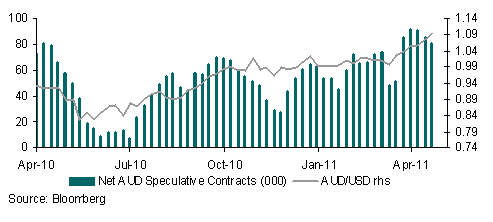
I look for further rate hikes over coming months even with the AUD at such a high level. AUD has lost a bit of ground after hitting a high just above 1.10 against the USD and on the margin the statement is slightly negative for AUD. A slightly firmer USD overall and stretched speculative positioning, with IMM AUD positions close to their all time high, points to some downside risks in the short-term.

In contrast India’s central bank the RBI hiked interest rates by more than many expected. Both the repo and reverse repo rates were raised by 50bps, with the central bank governor highlighting renewed inflation risks in his statement. The decision reveals a shift in RBI rhetoric to an even more hawkish bias in the wake of rising inflation pressures, which should be beneficial to the rupee.

Contrasting Stance

Despite some recent Fed speakers putting doubts into the minds of the many now looking for the Fed to embark on QE2 in November, the minutes of the 21 September FOMC meeting gave the green light to the commencement of asset purchases next month. Although there is clearly no unanimity within the FOMC the majority favour further easing. Incremental data dependent asset purchases will be the most likely path.

The minutes leave the USD vulnerable to further declines but extreme short USD positioning suggest that there is plenty of risk of short covering and more likely we are probably set for a period of consolidation over coming weeks before the USD resumes its decline.

Unlike the Fed, BoJ and BoE, which remain in easing mode the ECB is already veering towards an exit strategy, albeit one that is unlikely to take effect for some time. Hawkish comments by the ECB’s Weber overnight managed to give a lift to the EUR in the wake of a further widening in interest rate differentials between the eurozone and US. Indeed, interest rate differentials (2nd contract futures) are at the widest since Feb 2009, a factor that is providing plenty of underlying support for the EUR.

Further out the follow through on the EUR will depend on whether markets believe Weber’s stance is credible. Germany’s economy is doing well but it is highly likely that Southern European officials would oppose any premature tightening in policy given the parlous state of their economies. The stronger EUR will also do some damage to growth, with its recent appreciation acting as a de facto monetary tightening.

Despite the positive influence of Weber’s comments short-term technical indicators show that the trend in EUR is vulnerable, with clear signs of negative divergence as the spot rate is still trending higher whilst the relative strength indices (RSI) are trending lower. Moreover, EUR speculative positioning is at its highest in a year, albeit still well of its all time highs. Speculators may be reluctant to build on longs in the near term. A clean and sustained break above EUR/USD 1.4000 level still looks like a stretch too far though any downside is likely to be limited to strong support around 1.3895.

Unlike the perception that the ECB is highly unlikely to follow the Fed in a path of QE2 the policy stance of the BoE is far more uncertain, a fact that continues to weigh on GBP, especially against the EUR. Recent data in the UK has played into the hands of the doves, with housing market activity and prices coming under renewed pressure, retail sales surveys revealing some deterioration and consumer confidence as revealed in the Nationwide survey overnight, weakening further.

BoE MPC member Miles summarized the situation by highlighting that the UK faces “some big risks” and even hinted that the BoE may “come to use QE”. UK jobs data today is unlikely to give any support to sentiment for GBP although as per its recent trend GBP is likely to remain resilient against the USD whilst remaining under pressure against the EUR, with a move to resistance around EUR/GBP 0.8946 on the cards in the short-term