Which is the ugliest currency?

The contest of the uglies has once again been set in motion in FX markets as last Friday’s weak US jobs report, which revealed a paltry 18k increase in June payrolls, downward revisions to past months and a rise in the unemployment rate, actually left the USD unperturbed. Europe’s problems outweighed the negative impact of more signs of a weak US economy, leaving the EUR as a bigger loser.

The USD’s resilience was even more impressive considering the drop in US bond yields in the wake of the data. However, news over the weekend that talks over the US budget deficit and debt ceiling broke down as Republicans pulled out of discussions, will leave USD bulls with a sour taste in their mouth.

Should weak jobs recovery dent enthusiasm for the USD? To the extent that it may raise expectations of the need for more Fed asset purchases, it may prove to be an obstacle for the USD. However, there is sufficient reason to look for a rebound in growth in H2 2011 while in any case the Fed has set the hurdle at a high level for more quantitative easing (QE).

Fed Chairman Bernanke’s reaction and outlook will be gleaned from his semi-annual testimony before the House (Wed) although he will likely stick to the script in terms of US recovery hopes for H2. This ought to leave the USD with little to worry about. There will be plenty of other data releases this week to chew on including trade data, retail sales, CPI and PPI inflation and consumer confidence as well as the kick off to the Q2 earnings season.

Fresh concerns in Europe, this time with contagion spreading to Italy left the EUR in bad shape and unable to capitalise on the soft US jobs report. In Italy high debt levels, weak growth, political friction and banking concerns are acting in unison. The fact that there is unlikely to be a final agreement on second Greek bailout package at today’s Eurogroup meeting will act as a further weight on the EUR.

Discussions over debt roll over plans, the role of the private sector and the stance of ratings agencies will likely drag on, suggesting that the EUR will not find any support over coming days and will more likely lose more ground as the week progresses. If these issues were not sufficiently worrisome, the release of EU wide bank stress tests on Friday will fuel more nervousness. Against this background EUR/USD looks vulnerable to a drop to technical support around 1.4102.
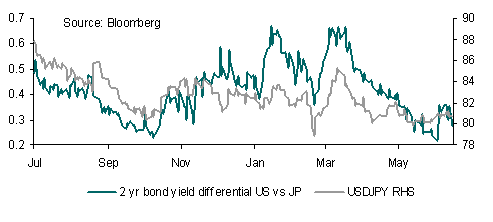
The Bank of Japan is the only major central bank to decide on interest rates this week but an expected unchanged policy decision tomorrow is unlikely to lead to any JPY reaction. In fact there appears to be little to move the JPY out of its current tight range at present. USD/JPY continues to be the most correlated currency pair with 2-year bond yield differentials and the fact that the US yield advantage has dropped relative to Japan has led to USD/JPY once again losing the 81.0 handle.
However, as reflected in the CFTC IMM data the speculative market is still holding a sizeable long position in JPY, which could result in a sharp drop in the currency should US yields shift relatively higher, as we expect over coming months. In the short-term USD/JPY is likely to be well supported around 80.01.
G7 Intervention Hits Japanese Yen

One could imagine that it was not difficult for Japan to garner G7 support for joint intervention in currency markets given the terrible disaster that has hit the country. Given expectations of huge repatriation flows into Japan and a possible surge in the JPY Japanese and G7 officials want to ensure currency stability and lower volatility. Moreover, as noted in the G7 statement today officials wanted to show their solidarity with Japan, with intervention just one means of showing such support.

Although Japanese Finance Minister Noda stated that officials are not targeting specific levels, the psychologically important level of 80.00 will likely stick out as a key level to defend. Note that the last intervention took place on 15 September 2010 around 83.00 and USD/JPY was trading below this level even before the earthquake struck. The amount of intervention then was around JPY 2.1 trillion and at least this amount was utilised today. The last joint G7 intervention took place in September 2000.

Unlike the one off FX intervention in September 2010, further intervention is likely over coming days and weeks by Japan and the Federal Reserve, Bank of France, Bundesbank, Bank of England, Bank of Canada and other G7 nations. The timing of the move today clearly was aimed at avoiding a further dramatic drop in USD/JPY, with Thursday’s illiquid and stop loss driven drop to around 76.25 adding to the urgency for intervention. USD/JPY will find some resistance around the March high of 83.30, with a break above this level likely to help maintain the upside momentum.

The JPY has become increasingly overvalued over recent years as reflected in a variety of valuation measures. Prior to today’s intervention the JPY was over 40% overvalued against the USD according to the Purchasing Power Parity measure, a much bigger overvaluation than any other Asian and many major currencies. The trade weighted JPY exchange rate has appreciated by around 56% since June 2007. In other words there was plenty of justification for intervention even before the recent post earthquake surge in JPY

Although Japanese exporters had become comfortable with USD/JPY just above the 80 level over recent months, whilst many have significant overseas operations, the reality is that a sustained drop in USD/JPY inflicts significant pain on an economy and many Japanese exporters at a time when export momentum is slowing. Japan’s Cabinet office’s annual survey in March revealed that Japanese companies would remain profitable if USD/JPY is above 86.30. Even at current levels it implies many Japanese companies profits are suffering.

Upward pressure on the JPY will remain in place, suggesting a battle in prospect for the authorities to weaken the currency going forward. Round 1 has gone to the Japanese Ministry of Finance and G7, but there is still a long way to go, with prospects of huge repatriation flows likely to make the task of weakening the JPY a difficult one. The fact that there is joint intervention will ensure some success, however and expect more follow up by other G7 countries today to push the JPY even weaker over the short-term.

EUR boosted, USD under pressure

Market attention remains fully focussed on events in Japan especially related to the country’s nuclear facilities. Risk aversion has spiked higher as a result, with ongoing Middle East tensions adding to the risk off tone. CHF is a key beneficiary of safe haven demand but the picture for JPY is obscured by repatriation expectations on one hand and FX intervention risks/Bank of Japan liquidity injections on the other, keeping USD/JPY clsoe to the 82.00 level. In contrast the AUD is vulnerable to a drop below parity with the USD on Japan worries, especially as Australia is a key destination for Japanese investment and therefore potential for reversal of such flows if Japanese institutions repatriate funds.

The EUR recovered over recent days as worries about the eurozone periphery ease and peripheral bonds spreads narrow. It is only a matter of time before overly long market positioning catches up with the EUR especially as the prospects of further interest rate support to the currency looked limited; markets have already priced in 75bps of policy rate hikes in the eurozone this year, which looks appropriate. It is difficult to see markets pricing in any more tightening than this over coming weeks. Despite its bounce back EUR/USD will struggle to break resistance around 1.4036.

Markets will digest the fallout from the informal EU leaders meeting last Friday which prepared the groundwork for the official meeting on 24/25 March. The initial reaction of the EUR appears to be positive but there is a significant risk of disappointment if the outcome of the meeting on 24/25 March does not live up to expectations. Indeed although Friday’s meeting resulted in an agreement in principle of a new “pact for the Euro” much will depend on the eventual details later this month.

Leaders also agreed on lowering interest rates to Greece by 100bps, and in principle enlarging the scope of the European Financial Stability Facility (EFSF) bailout fund to EUR 440 billion. The main positive surprise was opening the door for the fund to purchase eurozone debt. Data releases will offer little support to the EUR this week, with limited gains in the March German ZEW investor confidence survey today likely to leave markets unperturbed.

The USD’s gains last week proved short-lived and the currency will be tested by another relatively dovish Fed FOMC statement today and a benign reading for core CPI inflation in February. The Fed FOMC meeting is unlikely to deliver any changes to the Fed’s stance and whilst there has recently been some speculation that the Fed will soon remove its “extended period” comment, this is unlikely to happen any time soon. The statement will remind markets that the Fed is in no rush to alter its policy settings, an outcome that may limit the ability of the USD to strengthen this week even if data releases continue to remain on the positive side, including manufacturing survey and industrial production over coming days.

Japan’s Earthquake Aftermath

The aftermath of the devastating earthquake and Tsunami in Japan will largely drive markets this week outweighing the ongoing tensions in the Middle East. Having been in Tokyo as the earthquake struck I can testify to the severity and shock impact of the earthquake. Aside from the terrible human cost the economic cost will be severe at least for the next few months before reconstruction efforts boost growth. An early estimate suggests around a 1% negative impact on GDP this year.

The government is expected to announce a spending package over coming weeks to help fund relief efforts but this will likely put additional strain on Japan’s precarious debt situation at a time when worries about the country’s fiscal health were already high. Nonetheless, there is around JPY 550 billion available from the Fiscal Year 2010 and FY 2011 budgets even before a supplementary budget is needed.

The initial negative JPY impact of the natural disaster gave way to strength in anticipation of expected repatriation flows by Japanese life insurance companies and other institutions as they liquidate assets abroad in order to pay for insurance payments in Japan. The bias to the JPY will likely continue to be upwards but trading will be choppy.

Many of the margin traders holding extreme long USD/JPY positions will likely reduce these positions in the weeks following the earthquake in order to fulfil JPY demand. This may be countered by some foreign selling of Japanese assets especially given that foreigners have accelerated Japanese asset purchases over recent weeks. Therefore, it’s not a straight forward bet to look for JPY strength.

If however, the JPY strengthens rapidly and threatens to drop well below the psychologically important level of 80 the spectre of FX intervention will loom large. Indeed, following the Kobe earthquake in 1995 the JPY strengthened sharply by around 18% but the USD was already in decline prior to the earthquake and USD/JPY was also being pressured lower by Barings Bank related liquidation.

Therefore, comparisons to 1995 should be taken with a pinch of salt. Nonetheless, Japanese authorities will be on guard for further upward JPY pressure. The immediate market focus will be on the Bank of Japan (BoJ) meeting today, with the BoJ announcing the addition of JPY 7 trillion in emergency liquidity support to help stabilise markets.

FX Winners and Losers

There has been a sense of mean reversion in FX markets so far this year as some of last year’s winners have become losers. Namely NZD, CHF, JPY and AUD have all lost ground whilst EUR and GBP have gained ground. The odd one out is the SEK which has strengthened over 2010 and in 2011 versus USD. I expect this pattern to change and the likely winners over the next 3- months are NZD, AUD and CAD, with CHF and JPY the likely losers.

EUR held up reasonably well in the wake of slightly disappointing growth data, with eurozone GDP rising less than expected in Q4, and a smaller than expected gain in the February German ZEW investor confidence survey (economic sentiment component). My sense is that the net long EUR speculative position has already been pared back somewhat over recent days reducing the potential selling pressure on the currency in the near term.

Given that EUR/USD is one of the only major currency pairs being influenced by interest rate differentials, its direction will hinge more on policy expectations but in the near the announcement by the German Finance Minister this morning of a restructuring plan for WestLB may give the currency some support.

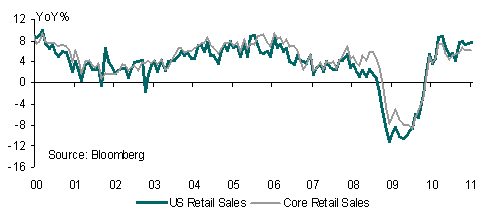
Perhaps one explanation for the stability of EUR/USD around the 1.3500 level is that US data was also disappointing yesterday. January retail sales rose less than forecast whilst revisions to back months suggest less momentum in Q4 consumer spending than previously envisaged. As with the eurozone data weather likely played a role in contributing to the outcome.

The net impact on currencies is that they are largely stuck within tight ranges. Further direction will come from the release of the Fed FOMC minutes for the January 26th meeting. The minutes may undermine the USD if a likely dovish slant continues to be expressed but given that the FOMC decision at that meeting to hold policy setting unchanged had no dissenters this should not come as a surprise.

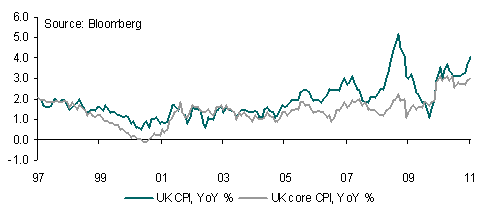
Whilst the battle between the USD and EUR ended in a stalemate GBP outperformed in the wake of the increase in UK January CPI inflation and in particular the letter from the BoE governor to the Chancellor keeping open the door to a rate hike. The Quarterly Inflation Report (QIR) today will be particularly important to determine whether the bounce in GBP is justified.

I remain hesitant to build on long GBP positions given the net long speculative overhang in the currency. The risks following yesterday’s jump in GBP are asymmetric, with a hawkish QIR likely to have less impact on the currency than the negative impact from a more dovish than expected report.

Econometer.org has been nominated in FXstreet.com’s Forex Best Awards 2011 in the “Best Fundamental Analysis” category. The survey is available at http://www.surveymonkey.com/s/fx_awards_2011