Japanese FX Intervention

The Bank of Japan acting on the behest of the Ministry of Finance intervened to weaken the JPY, the first such action since 2004. The intervention came as the USD was under broad based pressure, with the USD index dropping below its 200-day moving average. USD/JPY dropped to a low of around 82.88 before Japan intervened to weaken the JPY. The move follows weeks of verbal intervention by the Japanese authorities and came on the heels of the DPJ leadership election in which Prime Minister Kan retained his leadership.

One thing is for certain that Japanese exporters had become increasingly concerned, pained and vocal about JPY strength at a time when export momentum was waning. However, the move in USD/JPY may simply provide many local corporates with better levels to hedge their exposures.

Time will tell whether the intervention succeeds in engineering a sustainable weakening in the JPY but more likely it will only result in smoothing the drop in USD/JPY over coming months along the lines of what has happened with the SNB interventions in EUR/CHF. As many central banks have seen in the past successful intervention is usually helped if the market is turning and in this case USD/JPY remains on a downward trajectory.

Although the BoJ Governor Shirakawa said that the action should “contribute to a stable foreign exchange-rate formation” it is far from clear that the BoJ favoured FX intervention. Indeed, the view from the BoJ is that the move in USD/JPY is related less to Japanese fundamentals but more to US problems.

Now that the door is open, further intervention is likely over coming days and weeks but for it to be effective it will require 1) doubts about US growth to recede, 2) speculation of Fed QE 2 to dissipate, 3) and consequently interest rate differentials, in particular bond yields between the US and Japan to widen in favour of the USD. This is unlikely to happen quickly, especially given continued speculation of further US quantitative easing. A final prerequisite to a higher USD/JPY which is related to the easing of some of the above concerns is for there to be an improvement in risk appetite as any increase in risk aversion continues to result in JPY buying.

When viewed from the perspective of Asian currencies the Japanese intervention has put Japan in line with other Asian central banks which have been intervening to weaken their currencies. However, Asian central bank intervention has merely slowed the appreciation in regional currencies, and Japan may have to be satisfied with a similar result. Japan’s intervention may however, give impetus to Asian central banks to intervene more aggressively but the result will be the same, i.e. slowing rather then stemming appreciation.

As for the JPY a further strengthening, with a move to around 80.00 is likely by year end despite the more aggressive intervention stance. Over the short term there will at least be much greater two-way risk, which will keep market nervous, especially if as is likely Japan follows up with further interventions. USD/JPY could test resistance around 85.23, and then 85.92 soon but eventually markets may call Japan’s bluff and the intervention may just end up putting a red flag in front of currency markets to challenge.
High yield / commodity currencies take the lead

Although equity markets continue to tread water the appetite for risk looks untarnished. So far into the new-year the winners are commodity / high yield plays as well as emerging market assets. The AUD, NOK, NZD and CAD have been the stars on the major currency front, with only GBP registering losses against the USD so far this year. The move in these currencies has been well supported by resurgent commodity prices; the CRB commodities index is up close to 10% since its low on 9 December.

There is little reason to go against this trend and the USD index is set to continue to lose ground as risk appetite improves further. I highlighted the upside potential in high yield / commodity currencies in a post titled “FX Prospects for 2010” and stick with the view that there is much further upside. I still prefer to play long positions in these currencies versus JPY which I believe will come under growing pressure as the year progresses.

Economic data has also been supportive, especially in Australia, supporting the AUD’s yield advantage. Although comments from the central bank towards the end of last year downplayed expectations of much further tightening, data releases support the case for another rate hike at the 2 February RBA meeting, with a fourth consecutive hike of 25bps to 4.00% likely at the meeting.

There will be some important clues from next week’s jobs data in Australia but judging by the solid gain in November retail sales, which rose 1.4% versus consensus expectations of 0.3%, and 5.9% jump in building approvals, the case for a rate hike has strengthened.  AUD/USD will now set its sights on technical resistance around 0.9326. 

AUD/USD has the highest sensitivity with relative interest rate differentials – correlation of 0.85 with Australia/US interest rate futures differentials over the past month – and so unsurprisingly the AUD rallied further as markets reacted to the strong retail sales data. I believe Australian interest rates will eventually get back up to 6% – pointing to more upside for AUD/USD as this is more than is priced in by the market.

It is fortunate for the USD that the correlation between the USD index and interest rate expectations remains low but nonetheless the December 15 FOMC minutes may have provided another excuse to sell the currency. The minutes were interpreted as slightly dovish by the market, with many latching on to the comments that some members of the FOMC debated the potential to expand the scale of asset purchases and continuing them beyond the first quarter.

FX Prospects for 2010

There can be no doubt that for the most part 2009 has been a year for risk trades, not withstanding the sell off into year end. The policy successes in preventing a systemic crisis and the massive flood of USD liquidity injected globally kept the USD under pressure for most of the year and the currency became a victim of this success. Risk appetite is likely to improve only gradually over coming months given the still significant obstacles to recovery in the months ahead.  This will coincide with the declining influence of risk on FX markets. 

2010 will not be as straightforward and whilst risk will dominate early in the year interest rate differentials will gain influence in driving currencies as the year progresses. The problem for the USD is that market expectations for the timing of the beginning of US interest rate hikes is likely to prove premature as the Fed is set to hold off until at least late 2010/early 2011 before raising interest rates. The liquidity tap will stay open for some time, and risk trades will still find further support at least in the early part of 2010, whilst the USD will come under renewed pressure.    

The ECB will be much quicker in closing its liquidity tap than the Fed and arguably an earlier reduction in credit easing and interest rate hikes compared to the Fed would favour a stronger EUR.  However, the EUR is already very overvalued and a relatively aggressive ECB policy is unwarranted. Consequently rather than benefiting from more favourable relative interest rate expectations, the EUR could be punished and the EUR is set to decline over much of 2010 following a brief rally in Q1 2010, with EUR/USD set to fall over the year. 

Japan is moving in the opposite direction to the ECB.  FX intervention is firmly on the table though the risk is limited unless USD/JPY drops back to around 85.00. Even at current levels the JPY is overvalued but for it to resume weakness it will need to regain the role of funding currency of choice, a title that the USD has assumed. Efforts by the BoJ to combat deflation will likely help result in fuelling some depreciation of the JPY and it is likely to be the worst performing major currency over 2010, with a move back up to around USD/JPY in prospect.

The issue of global rebalancing will need to involve currencies but the currency adjustments necessary will not be forthcoming in 2010.  USD weakness early in the year will be mostly exhibited against freely floating major currencies which will bear the brunt of USD weakness.  However, the bulk of adjustment is needed in Asian currencies and there is little sign that central banks in the region will allow a rapid appreciation.  China holds the key and a gradual appreciation in the CNY over 2010 suggests little incentive to allow other Asian currencies to appreciate strongly. 

So in many ways 2010 will be one of two halves for currency markets and this has the potential to reignite some volatility in FX markets.  High beta risk trades including the AUD, NZD, NOK and many emerging currencies will see further upside in H1 as the USD falls further.  Gains in risk currencies will look even more impressive when played against the JPY and/or CHF than vs. USD given that they will succumb to growing pressure in the months ahead as their usage as funding currencies increases.

Ongoing rate hikes in Australia and Norway and the likely beginning of the process to raise rates in New Zealand early next year will mean that these currencies will also have the additional support of yield to drive them higher unlike the JPY.  There is a limit to most things however, and eventually the USD will recover some of its lost ground against risk currencies, as it undergoes a cyclical recovery over H2 2010.

Gold / FX correlations

There is no shortage of cash rich investors in Asia even amidst the current troubles in Dubai. Indeed, sentiment in the gemstones market is particularly upbeat, with a rare five-carat pink diamond selling for a record HK$84.24 million in Hong Kong. Perhaps this is a good reflection of abundant liquidity and of course wealth in Asia and in particular China, with talk that mainland Chinese investors were strong participants in the diamond auction.

It’s not just diamonds that are selling for record prices; gold hit a fresh high above $1,200 and once again at least part of this is attributable to the appetite of Asian central banks as well as demand from China as the country tries to increase its gold reserves. The rise in gold prices has coincided with a bullish announcement from the world’s top gold producer that it has completely eliminated its market hedges earlier than forecast due to the positive outlook on prices and waning supply.

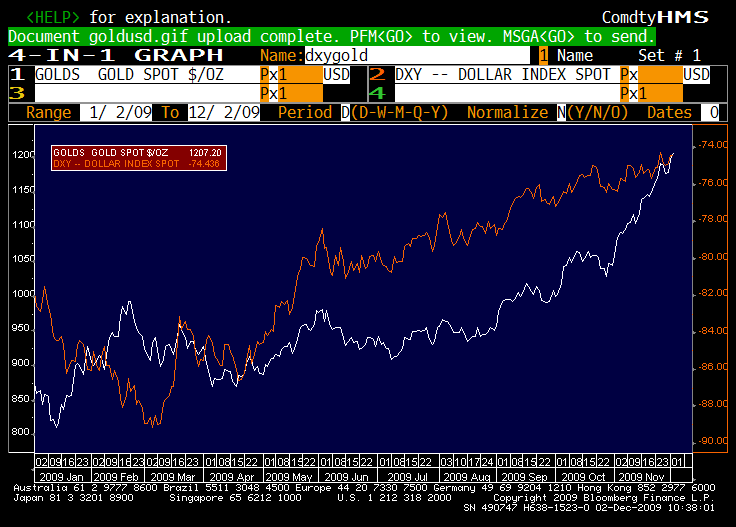
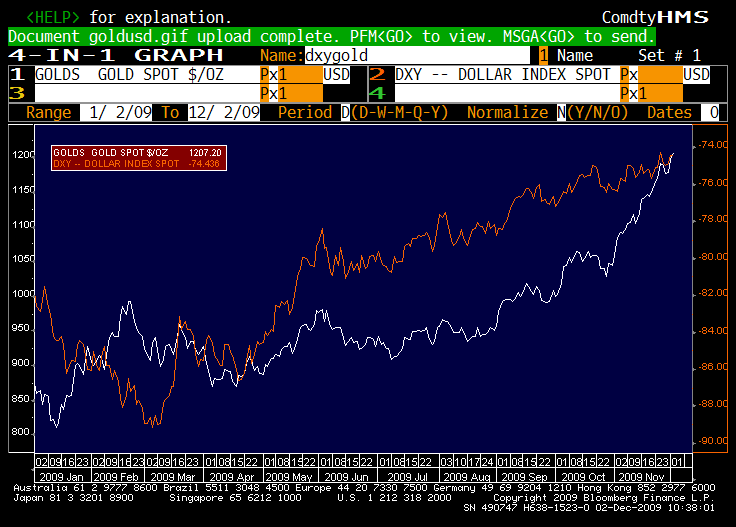
The correlation between gold prices and the USD remains very strong at -0.88 over the last 3-months, with firmer gold prices, implying further USD weakness. In fact, the gold / USD correlation has been consistently strong over the past few months and is showing little sign of diminishing.

Over the past 6-months the correlation has been -0.91 and over the past 1-month it was -0.75.  Assuming that anything above 0.70 can be considered statistically significant, the relationship shows that USD weakness has been well correlated with gold strength and that despite talk of a breakdown in the relationship it appears to remain solid. 

As long as the bullish trend in gold continues, the pressure on the USD will remain in place.  Adding to this pressure is the fact that risk is back on for now. Markets took the news of a fall in the ISM manufacturing index and in particular the drop in the employment component in its stride even though it supports the view of a weaker than consensus drop in payrolls in November when it is published on Friday.

There are still plenty of reasons to be cautious in the weeks ahead and although we appear to be back in a “risk on” environment markets are likely to gyrate between “risk on” and “risk off” over coming weeks. At least for now, the USD looks to remain under pressure but if risk aversion creeps back up as I suspect it may then the USD will see a bit more resilience into year end. 

Moreover, central banks globally are reaching the limits of their tolerance of USD weakness and will be tested once again, with EUR/USD back above 1.5000, EUR/CHF moving back below 1.5100 and the USD/JPY set to re-test 85.00 following the relatively benign measures announced by the BoJ in which the Bank did little to stem deflationary pressure or weaken the JPY.

Buffer for risk trades

Firmer data, most recently in the form of the stronger than expected US consumer confidence and dovish Fed comments as reiterated in the Fed FOMC minutes will provide a buffer for risk trades, supporting the USDs role as the prime funding currency over coming weeks.  Nonetheless, any improvement in sentiment will have to push against the weight of position adjustment into year-end as investors book profits on risk trades.  The net effect could be an increase in volatility especially in thinning liquidity expected in the wake of holidays in Japan and the Thanksgiving holiday in the US.

This could make it difficult for many asset markets to sustain key psychological and technical levels.  Whether the S&P 500 can hold gains above 1100 could prove significant as could EUR/USD’s ability to hold onto gains above 1.50.  The expiry of last week’s EUR/USD 1.48/1.51 option may provoke a move out of its range but there seems to be little appetite for a sustained break above the 23rd October high around 1.5061.  Even so, an upside bias is more likely given the likely softer tone to the USD. EUR/USD looks well supported around 1.4865.

Position adjustment towards the end of the year has been particularly evident in FX markets.  For instance, the latest CFTC Commitment of Traders’ data revealed that speculative investors have sharply reduced net long EUR positions into last week whilst there was a significant degree of short covering of GBP positions.  It is worth noting however, that aggregate USD net short speculative positions actually increased, largely due to a sharp jump in net JPY positioning, suggesting that overall sentiment for the USD remains very negative.

It is difficult to see a strong reversal in USD sentiment into year-end and the Fed’s commitment to maintaining interest rates at a low-level for an “extended period” taken together with hints of extending asset purchase programmes suggests little support to the USD over the short-term unless there is a more significant increase in risk aversion and or profit taking/book closing into year-end.  It seems that the impact of improved risk appetite is winning for now, giving no respite to the USD.