Dollar, euro and yen view

Pressure on the US dollar was maintained last week but there were definite signs that selling momentum is slowing. The lack of major US data releases meant that the key focus for the USD was events in Europe. This week there will be some return of attention back to the domestic front, with heavyweight releases such January retail sales, manufacturing surveys, industrial production and inflation data.

On balance the data will provide more evidence of US recovery but as we have noted previously this is not necessarily positive for the USD. Firmer US data helps to boost risk appetite, which in turn plays negatively for the USD. This could be counterbalanced if US interest rate expectations turn more hawkish but the Fed has effectively ruled out such a prospect, with its commitment to maintain easy policy.

Europe has some important data releases over coming days including the German February ZEW survey and GDP data across the Eurozone. The data will be less encouraging, especially the Eurozone GDP data, compared to the US and is unlikely to give any support to the EUR. Instead events surrounding Greece will be crucial for EUR sentiment. EUR/USD appeared to lose some traction at the end of the week but the EUR remained firm against other currencies.

Greece’s approval of austerity measures overnight will bode well for markets but the tough stance of EU officials towards Greek austerity implementation means that focus will turn to yet another extraordinary meeting of European officials on Wednesday. Even assuming that some form debt deal and second bailout package is ironed out it is questionable how much the EUR will rally as so much good news is already in the price.

The JPY for a change managed to register relatively big moves, with USD/JPY pushing higher over the past week. The revelation that ‘stealth’ FX intervention was carried out by the authorities in Japan taken together with verbal warnings threatening more intervention helped to exacerbate JPY moves.

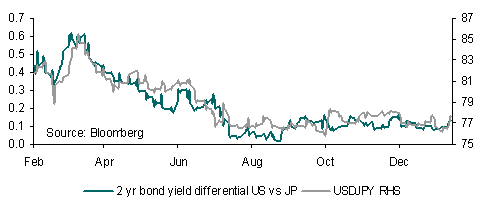
Speculation that the Bank of Japan is pondering further easing steps at its policy meeting on Tuesday may also be contributing to the softer tone in the JPY. Such hopes may be disappointed however, as we expect the BoJ to retain its current policy settings. The biggest factor explaining the move in USD/JPY is the fact that US bond yields moved higher relative to Japan, with the yield differential ending the week at its highest so far this year.
Data releases in focus

For a change the markets may actually concentrate on data releases today rather than political events in the eurozone. The October US retail sales report and November Empire manufacturing survey are likely to paint a less negative economic picture of the US. The data will help to dampen expectations of more quantitative easing in the US but we will be able to hear more on the subject from the Fed’s Bullard and Williams in speeches today.

Overnight the Fed’s Fisher poured more cold water on the prospects of further QE by highlighting that the economy is “poised for growth”. While speculative data in the form of the CTFC IMM data shows a drop in USD sentiment to its lowest in several weeks we do not expect this to persist. The USD will likely benefit from the data today and we see the currency retaining a firmer tone over the short term especially as eurozone concerns creep back in.

The vote by German Chancellor Merkel’s party to approve a measure for a troubled country to leave the EUR opens up a can of worms and will hit EUR sentiment. But rather than politics there are several data releases on tap today that will provide some short term influence on the EUR, including Q3 GDP and the November German ZEW survey. FX markets will likely ignore a positive reading for GDP given that the outlook for Q4 is going to be much worse. The forward looking ZEW survey will record a further drop highlighting the risks to Europe’s biggest economy.

T-bill auctions in Spain and Greece may garner even more attention. Following on from yesterday’s Italian debt sale in which the yield on 5-year bond came in higher than the previous auction but with a stronger bid/cover ratio, markets will look for some encouragement from today’s auctions. Even if the auctions go well, on balance, relatively downbeat data releases will play negatively for the EUR.

When viewing the EUR against what is implied by interest rate differentials it is very evident that the currency is much stronger than it should be at least on this measure. Both short term (interest rate futures) and long term (2 year bond) yield differentials between the eurozone and the US reveal that EUR/USD is destined for a fall.

Europe’s yield advantage has narrowed sharply over recent months yet the EUR has not weakened. Some of this has been due to underlying demand for European portfolio assets and official buying of EUR from central banks but the reality is that the EUR is looking increasingly susceptible to a fall. EUR/USD is poised for a drop below the psychologically important level of 1.35, with support seen around 1.3484 (10 November low).

Risk Aversion to remain elevated

It remains a tumultuous time for markets, gripped by a cacophony of concerns ranging from the lack of resolution to the Eurozone debt crisis to the failure to reach agreement on raising the US debt ceiling and associated deficit reduction plans. Mingled among these is the growing evidence that economic growth is turning out weaker than expected. Meanwhile Europe’s crisis appears to be shifting from bad to worse, as reflected in a shift in attention towards the hitherto untouched Italy although Italian concerns have eased lately.

The release of the EU bank stress test results at the end of last week have not helped, with plenty of criticism about their severity and rigour following the failure of only 8 banks out of the 90 tested. Expectations centred on several more banks failing, with much more capital required than the EUR 2.5 billion shortfall revealed in the tests. Answering to this criticism officials note that there has already been a significant amount of capital raised over recent months by banks, but this will be insufficient to stem the growing disbelief over the results.

Attention is still very much focussed on Greece and reaching agreement on a second bailout for the country, with further discussions at the special EU summit on July 21. The contentious issue remains the extent of private sector participation in any debt restructuring. The decision to enhance the flexibility of the EFSF bailout fund to embark on debt buybacks has not helped. Consequently contagion risks to other countries in the Eurozone periphery are at a heightened state. Despite all of this the EUR has shown a degree of resilience, having failed to sustain its recent drop below 1.40 versus USD.

One explanation for the EUR’s ability to avoid a steeper decline is that the situation on the other side of the pond does not look much better. Hints of QE3 in the US and the impasse between Republicans and Democrats on budget deficit cutting measures tied to any increase in the debt ceiling are limiting the USD’s ability to benefit from Europe’s woes. Moreover, more weak data including a drop in the Empire manufacturing survey and a drop in the Michigan consumer sentiment index to a two-year low, have added to the worries about US recovery prospects.

Against this background risk aversion will remain elevated, supporting the likes of the CHF and JPY while the EUR and USD will continue to fight it out for the winner of the ugliest currency contest. Assuming that a deal will eventually be cobbled together to raise the US debt ceiling (albeit with less ambitious deficit cutting measures than initially hoped for) and that the Fed does not embark on QE3, the EUR will emerge as the most ugly currency, but there will be plenty of volatility in the meantime.

Data and events this week include more US Q2 earnings, June housing starts and existing home sales. While housing data are set to increase, the overall shape of the housing market remains very weak. In Europe, July business and investor surveys will be in focus, with a sharp fall in the German ZEW investor confidence survey likely and a further softening in July purchasing managers indices across the eurozone. The German IFO business confidence survey is also likely to decline in July but will still point to healthy growth in the country. In the UK Bank of England MPC minutes will confirm no bias for policy rate changes with a 7-2 vote likely, while June retail sales are likely to bounce back.