Italy downgrade adds to EUR woes

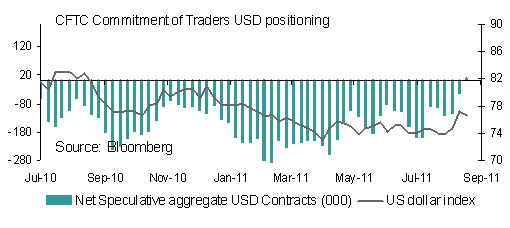
The USD index remains firm but it remains unlikely that the USD is being bought on its own merits but rather on disappointments in the eurozone. Nonetheless, speculative USD sentiment has turned positive for the first time since June 2010 according to the CFTC IMM data, reflecting a major shift in appetite for the currency. Clearly there are risks to the USD including the potential for more QE3 being announced at this week’s FOMC meeting but this risk is likely to be small.

In contrast, the reversal in speculative sentiment for the EUR has been just as dramatic but in the opposite direction as the net short EUR position has increased over recent weeks, with positioning now at its lowest since June 2010. Sentiment is likely to have soured further overnight following news that Italy’s credit rating was cut by S&P to A from A+ despite the recent passage of an austerity package.

This outweighed any boost to sentiment from what was noted by the Greek Finance Minister as “productive” talks yesterday. Another conference call today is scheduled but the longer markets wait for approval of the next loan tranche the bigger the risk to the EUR. In addition Greek and Spanish T-bill auctions and European Central Bank (ECB) cash operations will be in focus. The EUR remains vulnerable to a test of support around 1.3500.

GBP has continued to slide over recent weeks, having fallen by around 5% since its high just above 1.66 a month ago. However, it has managed to hold its own against the EUR which looks in even more of a sorry state than the pound. The fact that GBP has been unable to capitalise on the EUR’s woes is largely attributable to growing expectations of further UK quantitative easing.

The minutes of the last Bank of England meeting on September 8 to be released on Wednesday will give more clues as to the support within the Monetary Policy Committee for further QE but its likely that the MPC will want to see the next Quarterly Inflation Report in November before committing itself to any further easing. In the meantime, GBP will find it difficult to sustain any recovery, with its drop against the USD likely to extend to around 1.5583 in the short term.

Japan returns from its Respect for the Aged holiday today but local market participants will have missed little action on the JPY, with the currency remaining confined to a very tight range. The inability of USD/JPY to move higher despite the general bounce in the USD index reflects 1) the fact that USD/JPY is very highly correlated with 2 year bond yield differentials and 2) the fact that US yields continue to be compressed relative to Japan. Additionally, risk aversion continues to favour the JPY and combined, these factors suggest little prospect of any drop in the JPY versus USD soon.
Euro fails too hold on to gains

Any improvement in sentiment following the USD liquidity support announcement by various central banks last week is already filtering away against the background of European Union (EU) officials’ failure to make any headway at the Ecofin meeting over the weekend, a delay in the approval of the next bailout tranche for Greece and ongoing collateral dispute between Greece and Finland. On top of all of this German Chancellor Merkel suffered a further setback in regional elections over the weekend.

Greece will remain in focus this week and markets will look for signs that the country is back on track on its austerity plans and its next loan tranche. Prime Minister Papandreou cancelled a trip to the US while the Greek cabinet are apparently deciding on new fiscal measures. Attention will turn to a teleconference today from the Greek Finance Minister with EU and IMF officials.

Speculative sentiment for the EUR has already soured further and according to the latest CFTC IMM report, positioning in EUR is at its lowest since the end of June 2010. EUR/USD will continue to look very vulnerable having already dropped sharply from a high of around 1.3899 in Asian morning trading as the bad weekend news hit the currency. EUR/USD will find some technical support just below 1.3500 this week but any upside is set to prove limited unless some concrete announcements are delivered relating to Greece over coming days.

In contrast to the EUR, USD speculative appetite has turned net long for the first time since July 2010. The extended Fed FOMC meeting will help to dictate USD sentiment as markets wait for further measures to stimulate the economy. The Federal Reserve has already committed to hold rates steady until at least mid 2013 and the extended two day meeting this week will likely discuss further options. However, more quantitative easing (QE3) appears unlikely at this stage while an ‘Operation Twist’ type approach is more probable. The USD will benefit from a lack of further quantitative easing but this is largely already priced in.

Euro slides as Greek worries intensify

The USD ended last week on high a note having overcome speeches by Fed Chairman Bernanke and President Obama. Bernanke’s lack of detail on potential further Fed stimulus offered the USD a lifeline as there was no mention of QE3 but nervousness may mount ahead of the September 21 FOMC meeting.

This week’s data releases (including retail sales, inflation, industrial production and regional manufacturing surveys may offer some direction to the USD and it is likely that the data over coming days will look less negative than in past weeks, giving the USD some support. Having broken above its 200 day moving average around 76.1986 for the first time in a year the USD index is set to begin the week in positive mode and will likely extend its gains over coming days.

In sharp contrast, EUR/USD crumbled at the end of last week dropping through its 200 day moving average despite positive news from Germany (rejection of bills in the constitutional court) and Italy (passage of austerity measures). The European Central Bank (ECB) did not help the EUR’s cause however, with the change in its stance to a more balanced assessment of risks from its more hawkish stance previously.

However, the real damage occurred as speculation of a Greek default intensified and ECB hawk Stark resigned from the ECB council, highlighting the divisions within the governing board. This week attention will remain on Greece as negotiations between the Troika (ECB, EU and IMF) and Greek officials resume.

Ahead of the talks Greece approved a further EUR 2 billion in austerity measures over the weekend but nonetheless, despite denials by Greek officials speculation of a debt default will continue to hammer the EUR lower. Near term technical support is seen around 1.3525 for EUR/USD.

GBP found some relief last week following the decision by the Bank of England to leave policy unchanged though it is unlikely to be able to make much if any headway against the USD over coming sessions as expectations of further UK quantitative easing may simply have been pushed back to the November meeting.

Inflation data this week will give further clues to policy but once again there is likely to be no sign of any easing in inflation pressure, limiting the room for maneuver for the BoE. Moreover, a weak outcome for UK retail sales in August will maintain the trend of soft UK data keeping up the pressure for more BoE action. As a result GBP will struggle against the USD but given that problems in Europe look even worse, GBP will likely extend gains against the EUR this week.

SNB shakes up FX markets – Pressure now on Japan?

The action by the Swiss National Bank yesterday rippled through FX markets fuelling sharp moves across major currencies. In case you missed it the SNB introduced a currency floor in EUR/CHF at 1.20 and committed itself to buy FX in unlimited amounts. The last time the SNB did something similar was in 1978 when a ceiling was set against the Deutsche Mark. The sharp initial reaction to the news saw EUR/CHF jump by around 8.5% largely as a result of the shock from the announcement.

The SNB will not need to worry about the inflationary implications of pumping CHF into the market while it is clear that the currency is highly overvalued, supporting their cause. However, the real test will be evident over coming days and weeks in the commitment to hold the 1.20 level at a time when the situation in the eurozone periphery continues to deteriorate and demand for CHF remains strong. The risk is that the SNB may have simply set up a target for markets to attack. One other implication of the SNB’s move is that it could be a trigger for an intensification of ‘currency wars’.

The onus is now on the Japanese authorities to act more aggressively especially if safe haven flows focus increasingly on the JPY and less on the CHF given the new EUR/CHF floor. So far FX interventions have clearly not worked as was the case in Switzerland and Japan’s new Prime Minister is likely to want to prove his credentials. Japan has had a tendency to underwhelm with regard to JPY measures in the past and unless there is a major announcement today USD/JPY is likely to move lower again below 77.00.

Scandinavian currencies are also set to be beneficiaries of the SNB’s decision. EUR/SEK has come under increasing downside pressure over recent weeks even as risk aversion has intensified and it appears that safe haven flows out of Europe are now targeting Scandinavian currencies. As the CHF is now less attractive in this respect, the SEK as well as NOK will find themselves under further upside pressure over coming days and weeks. Both NOK and SEK versus EUR and USD have had insignificant correlations with risk over recent months, highlighting their appeal as anti-EUR currencies.

Payrolls sour mood, Eurozone concerns intensify

The market mood has soured further and risk aversion has increased following disappointing August US jobs report in which the change in payrolls was zero and downward revisions to previous months has reinforced the negative mood on the US and global economy while raising expectations of more Federal Reserve action. Moreover, the report has put additional pressure on US President Obama to deliver fresh jobs measures in his speech on Thursday though Republican opposition may leave Obama with little actual leeway for further stimulus.

There is plenty of event risk over coming days, with a heavy slate central bank meetings including in Europe, UK, Japan, Australia, Canada and Sweden. The European Central Bank will offer no support to a EUR that is coming under growing pressure, with the Bank set to take a more neutral tone to policy compared its previously hawkish stance. In the UK, GBP could also trade cautiously given recent comments by Bank of England Monetary Policy Committee members about potential for more UK quantitative easing.

The EUR has been unable to capitalise on the bad economic news in the US as news there has been even worse. The negative news includes the weekend defeat of German Chancellor Merkel’s centre-right bloc in regional elections, which comes ahead of a vote in Germany’s constitutional court on changes to the EFSF bailout fund.

The withdrawal of the Troika (ECB, IMF and EU) from Greece has also put renewed emphasis on the country at a time when protests are escalating. If all of this is not enough there is growing concern about Italy’s apparent backtracking on austerity measures, with the Italian parliament set to discuss measures this week. Separately Germany, Holland and Finland will hold a meeting tomorrow on the Greek collateral issue. On top of all of this is the growing evidence of deteriorating growth in the euro area.

Data releases are unlikely to garner a great deal of attention amidst the events noted above, with mainly service sector purchasing managers indices on tap and at least threw will look somewhat better than their manufacturing counterparts. In the US the Beige Book and trade data will be in focus but all eyes will be on Obama’s speech later in the week. The USD has maintained a firm tone despite the jobs report but its resilience may be better explained by eurozone negativity rather than US positivity. Even so, the USD is looking less uglier than the EUR in the current environment.