Attention turns to ECB and BoE

Ahead of two key central bank policy decisions by the European Central Bank and Bank of England where no change is expected as well as tomorrow’s release of the US jobs report, range trading is likely to dominate. Risk aversion measures remain elevated however, and further slippage by US stocks was recorded overnight.

The USD remained supported within ranges, helped by firmer US Treasury yields. Fed officials overnight showed little inclination to alter the pace of tapering despite the recent turmoil in emerging markets suggesting that emerging markets can expect little relief from the Fed.

Meanwhile, US data releases provided mixed signals, with the ADP private sector employment report (a key indicator for tomorrow’s non farm payrolls data) coming in below consensus at 175k in January (consensus 185k) while the US ISM non manufacturing survey (a survey of service sector participants) was slightly higher than consensus at 54.0 in the same month.

Aside from the policy rate decisions December US trade data and Q4 non farm productivity are on tap today although neither are likely to be big market movers.
AUD rallies on firm data

Australian retail sales rose 0.5% in December in line with expectations although the ex inflation quarterly increase was lower than forecast at 0.9%. However, there was a revision higher to the previous quarter. The bigger news is that the December trade balance came in much better than expected, recording a surplus of AUD 468 million compared to a deficit of AUD 200 million expected. Business confidence also came in strong rising to 8 in Q4 from an upwardly revised reading of 5 in Q3. The data bodes well for AUD, with the currency set to find further support in the short term. If anything, it also helps to validate the RBA’s message that the easing cycle is over. A break above AUD/USD 0.90 is now on the cards.

Posted in Australia. Tags: . Leave a Comment »

RBA statement bullish for AUD

AUDIMM

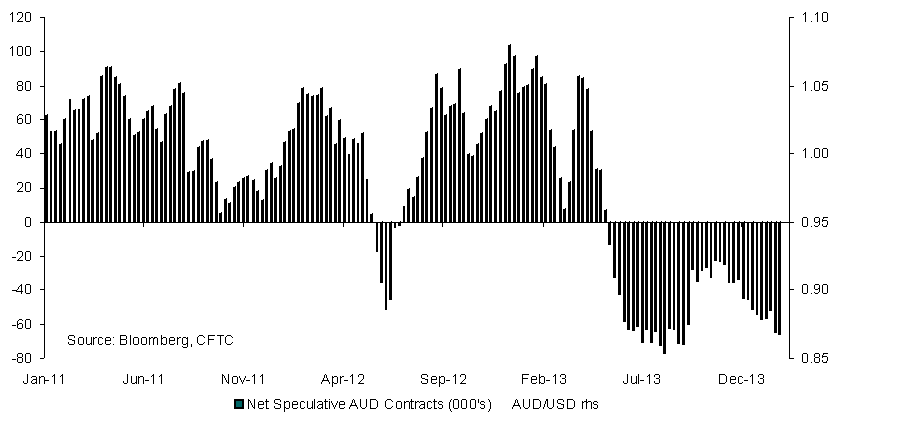
AUD has held up relatively well considering the pressure on risk currencies in general. The fact that speculative positioning in AUD has already fallen to extreme levels suggests 1) scope for further downside is limited and 2) AUD could bounce strongly in the event of good news.

In the event, the RBA unsurprisingly left policy rates unchanged but focussed attention on the recent rise in inflation. The RBA highlighted in its accompanying statement that inflation has been higher than forecast. Moreover, the RBA does not appear to be actively talking the AUD down but highlighting the benefits of past AUD weakness if sustained.

Overall, the statement is bullish for the AUD especially as it appears to confirm that the policy easing cycle is over. Consequently the bounce in AUD following the rate decision is likely to be strong.

AUD/USD technical support is seen around 0.8660, with resistance at 0.8889.

Posted in Australia. Tags: , . Leave a Comment »

Japanese yen firms as US yields drop

USDJPYyielddiff

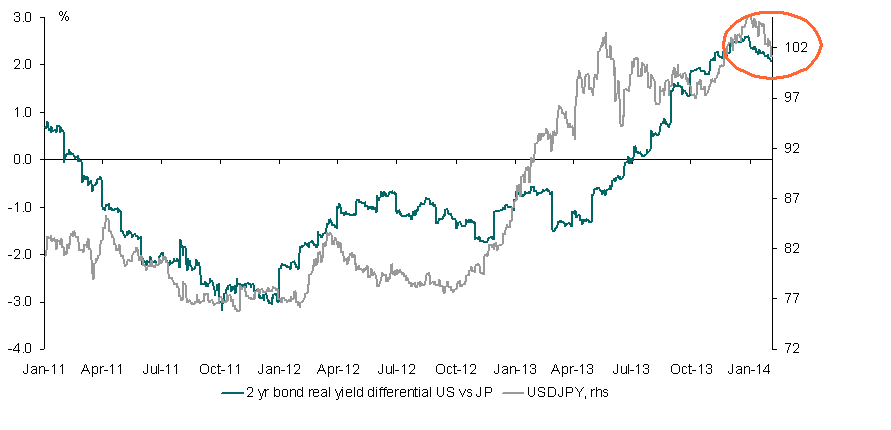
Safe haven currencies in particular the JPY and CHF remain well supported, with the former resting on its 100 day moving average around 101.10 versus USD. USD/JPY is set to remain under downward pressure but will face some difficulty in sustaining a move below 101.10 unless US bond yields slip further narrowing the US yield differential with Japan; the yield differential between 10 year US Treasuries and 10 year Japanese JGB yields has already dropped by around 89 basis points since the start of the year.

The drop in Japanese equities has also corresponded to upward pressure on the JPY, with the Nikkei among the worst performing stock markets so far this year. The prospect of further equity weakness suggests that JPY will not resume a weaker trend anytime soon.

Posted in Japan. Tags: , . Leave a Comment »

A further blow to risk appetite

Amid a market that is already very nervous the much weaker than expected US ISM manufacturing confidence index (51.3 versus 56.0 consensus) taken together with the weaker Chinese non manufacturing purchasing managers index (53.4 versus 54.6 prior) dealt another blow to risk appetite.

Consequently the VIX fear gauge has spiked to its highest level since the end of 2012 and our risk barometer has moved swiftly into risk hating territory. US Treasury yields have continued to drop, with the 10 year yield having slid by around 45 basis points so far this year.

Suffice to say investors should steer clear of risk assets over the short term as the turmoil does not look like it will be over anytime soon. A combination of tapering, a confluence of country specific emerging market country concerns and weaker growth in China provide the backdrop for a volatile few weeks if not longer, ahead.

The main event today is the Reserve Bank of Australia meeting where we look for no change in policy. However, the key events of the week are yet to come, with the European Central Bank and Bank of England policy decisions and US January jobs report all on tap over coming days. In brief, no change in policy is expected from either central bank and payrolls are expected to come in around 200k.