Risk on, risk off

The USD has lost some upward momentum as risk appetite improved but FX markets remain skittish as sentiment gyrates between ‘risk on’ and ‘risk off’. The fact that US Q1 GDP was left unrevised whilst jobless claims surprisingly increased together with ongoing Greece concerns suggests that a risk off mood may filter into markets despite positive US earnings. Although the USD has not particularly benefitted from any rise in risk aversion lately, worries about the next IMF tranche being withheld from Greece will likely play more positively for the USD.

Nonetheless, lurking in the background and helping to keep the USD restrained is the Fed’s ongoing asset purchases as QE2 remains in place until the end of June. Moreover US data disappointments points to risks that the Fed will only slowly embark on its exit strategy. Additionally any agreement towards extending the US debt ceiling appears to be far off, and threatens to go down to the wire all the way to August 2. US debt markets and the USD appear to be downplaying this issue at present but it remains a clear threat to US markets.

Continuing to limit any upside in the EUR is the fact that officials and markets continue to gyrate on whether Greece will or will not restructure its debt. Apparent divisions between the view of some officials and the ECB are adding to the confusion whilst fresh worries about the IMF withholding funding for Greece will likely keep EUR/USD capped.

Peripheral worries as well as growth concerns are clearly weighing on confidence and a broad based decline in economic and business confidence in various eurozone May measures is expected to be revealed in data today . Weaker data taken together with ongoing concerns about the eurozone periphery will likely see the EUR struggle, with the currency set to settle into a range versus USD over the short-term, with technical support around 1.3968 and resistance at 1.4210.

The loss of USD momentum has also been exhibited in USD/JPY which has turned lower following its recent upward move hitting a low around 81.09. The big news was the fact that April nationwide core CPI recorded its first YoY increase since December 2008. At the margin may reduce the pressure on the Bank of Japan (BoJ) to enact more aggressive policy measures, which in turn is positive for the JPY. A big factor contributing to keeping the JPY supported over recent weeks is the ongoing inflow of foreign capital into Japan’s bond and equity markets, with Japan recording six straight weeks of net inflows.

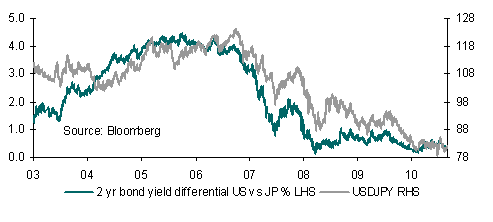
USD/JPY is one currency pair where the correlation with US – Japan 2-year bond yield differentials is holding up well over the past 3-months. The fact that the yield differential has dropped to its lowest level since November 2010 at around 30bps reveals the declining US yield advantage, and plays for a lower USD/JPY. Against this background the JPY is likely to remain supported in the short-term, but will find it tough to break through technical support around USD/JPY 80.15.
US Dollar Ugly But Not Hideous

The USD has strengthened by around 5% since the beginning of the month. The move has been particularly sharp this week as higher risk aversion and intensifying fears about the eurozone periphery have given the currency a boost, albeit with the USD remaining one of the least ugly currencies amongst a fairly hideous bunch.

Eurozone country and overall ‘flash’ May purchasing managers indices (PMI) managed to further sour an already fragile mood yesterday, with the data revealing bigger than expected declines, albeit still at levels that are high in absolute terms. Data today is unlikely to result in any improvement in sentiment for eurozone assets, with the Germany IFO Business Climate index likely to slip, albeit from a relatively high level.

The EUR doesn’t need much of an excuse to sell off at present, with a softer IFO likely to provide further reason for investors to offload long positions in the currency. Against this background EUR/USD is likely to sustain a drop below the 1.4000 level, with the 100 day moving average level of 1.3972 likely to be breached shortly.

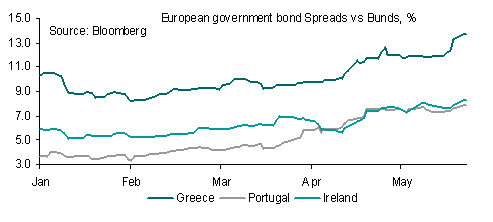
More importantly in terms of sentiment drivers the malaise in the eurozone periphery especially Greece remains the biggest risk for the EUR. As much as officials in Europe and Greece deny speculation of debt restructuring the market is far from convinced as reflected in the widening in peripheral debt spreads.

Greece’s Prime Minister Papandreou’s attempt to push through austerity measures in the Greek parliament yesterday by announcing accelerated asset sale plan and EUR 6 billion in budget cuts have done little to turn market sentiment despite the fact that at the least it shows a willingness to stick to the plan in the face of growing domestic resistance.

The USD has also edged higher against the JPY over recent days despite a rise in risk aversion. As revealed in the latest IMM data markets have been net long JPY over the past couple of weeks, with positioning well above the 3-month average, suggesting some scope for a liquidation of long positions. Nonetheless, the rise in USD/JPY has occurred despite 2-year US / Japan yield differentials remaining at a relatively low level suggesting that the USD may lose momentum, with USD/JPY resistance around 82.74 likely to cap gains.

GBP has also slid suffering in the wake of a resurgent USD and unconfirmed reports that Moody’s ratings agency is expected to announce that is placing 14 out of 18 UK banks on review for a downgrade. GBP is likely to trade nervously ahead of UK data releases today including public finances and CBI data, with further downside risks opening up. A drop below GBP/USD 1.6000 could see the currency pair test support around 1.5972.

Risk off mood

A ‘risk off’ tone is quickly permeating its way through the market psyche as tensions surrounding the eurozone periphery reach fever pitch. This is reflected in the sharp jump in equity volatility as indicated by the VIX ‘fear’ gauge. Equity markets and risk trades in general look set to remain under pressure in the current climate.

Moreover, the EUR which is finally succumbing to bad news about the periphery will continue to face pressure over the short-term. Against this background economic data will likely be relegated to the background this week but it worth noting that what data there is on tap, is likely to send a weaker message, with data such as durable goods orders in the US as well as various purchasing managers indices (PMI) data in the eurozone today likely to show some slippage.

The Greek saga remains at the forefront of market attention, with restructuring speculation remaining high despite various denials over the weekend by Greek and European Central Bank (ECB) officials. News that Norway has frozen payments to Greece, whilst Fitch ratings agency’s downgrades of Greece’s ratings by 3 notches and S&P’s downgrade of Italy’s ratings outlook to negative, have all contributed to the malaise afflicting the periphery.

This weekend’s local election in Spain in which Prime Minister Zapatero and his Socialist Party suffered its worst defeat in more than 30 years leading to a transfer of power in the Spanish regions, will lead to concerns about the ability of the government to carry out much needed legislative changes.

It is difficult to see any improvement in sentiment towards the peripheral Europe and consequently the EUR over the short-term. In Greece, Prime Minister Papandreou will attempt to push through further unpopular austerity measures through parliament this week in advance of a 5th bailout tranche of EUR 12 billion scheduled for next month. This comes at a time when opinion polls show the government losing more support and 80% of those surveyed saying they would not accept more austerity measures.

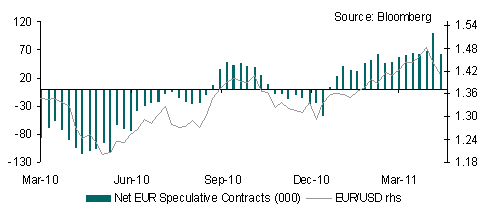
The deterioration in sentiment for the EUR has been rapid as reflected in the CFTC IMM data, with net long speculative positions now at their lowest since 15 February and heading further downhill. Conversely, USD short covering has been significant though there is still a hefty USD short overhang, which points to more USD short covering as EUR sentiment sours.

Nonetheless, the USD still has plenty of risks hanging over it including the fact that it still suffers from an adverse yield differential (note that 2-year Treasury yields have fallen to the lowest since 6 December 2010). Safe haven currencies in particular CHF are the key beneficiaries and notably EUR/CHF touched a record low around 1.2354 and is showing little sign of any rebound.

US Dollar On The Rise

There are plenty of US releases on tap this week but perhaps the most important for the USD will be the minutes of the April 26-27 Fed FOMC meeting. Taken together with speeches by Fed officials including Bernanke, FX markets will attempt to gauge clues to Fed policy post the end of QE2. The Fed’s stance at this point will be the major determinant of whether the USD can sustain its rally over the medium term. The lack of back up in US bond yields suggests that USD momentum could slow, with markets likely to move into wide ranges over coming weeks.

It is worth considering which currencies will suffer more in the event that the USD extends its gains. The correlation between the USD index and EUR/USD is extremely strong (even accounting for the fact that the EUR is a large part of the USD index) suggesting that the USDs gains are largely a result of the EUR’s woes. Aside from the EUR, GBP, AUD and CAD are the most sensitive major currencies to USD strength whilst many emerging market currencies including ZAR, TRY, SGD, KRW, THB, IDR, BRL and MXN, are all highly susceptible to the impact of a stronger USD.

Robust Q1 GDP growth readings in both Germany and France helped to spur gains in the EUR but this proved short-lived. Sentiment for the currency has soured and as reflected in the CFTC IMM data long positions are being scaled back. Nonetheless, there is still plenty of scope for more EUR selling given ongoing worries about the eurozone periphery, which are finally taking their toll on the EUR. A break below EUR/USD 1.4021 would open the door for a test of 1.3980.

The eurogroup and ecofin meetings will be of interest to markets this week but any additional support for Greece is unlikely to be announced at this time. However, likely approval of Portugal’s bailout may alleviate some pressure on the EUR but any positive impetus will be limited. Even on the data front, markets will not be impressed with the German ZEW index of investor confidence likely to register a further decline in May.

Japanese officials have been shying away from further FX intervention by blaming the drop in USD/JPY over recent weeks on general USD weakness despite the move towards 80. However, this view is not really backed up by correlation analysis which shows that there is only a very low sensitivity of USD/JPY to general USD moves over recent months. One explanation for the strength of the JPY is strong flows of portfolio capital into Japan, with both bond and equity markets registering net inflows over the past four straight weeks.

This is not the only explanation, however. One of the main JPY drivers has been a narrowing in yield differentials. This is unlikely to persist with yield differentials set to widen sharply over coming months resulting in a sharply higher USD/JPY. As usual data releases are unlikely to have a big impact on the JPY this week but if anything, a further decline in consumer confidence, and a negative reading for Q1 GDP, will maintain the pressure for a weaker JPY and more aggressive Bank of Japan (BoJ) action although the BoJ is unlikely to shift policy this week.

Australian dollar hit by weak jobs data

The USD’s bounce since the beginning of the month appears to be gaining more traction, with the USD index up over 3% from its recent lows. I’m still cautious about whether this move can extend much further in the absence of a back up in US bond yields especially given ongoing asset purchases / global USD liquidity injections by the US Federal Reserve at least until the end of June.

Nonetheless, given the magnitude of USD short positioning, which had moved ever close to revisiting record levels, the potential for short-covering was significant. US data today could provide some influence, with attention on April retail sales data, PPI inflation and jobless claims. A relatively positive outcome for retail sales could give the USD further support.

The day has started badly for the AUD, with the currency hit by an awful jobs report, with employment dropping by 22.1k in April compared to consensus expectations of +17k. The details were even more negative than the headline reading, with full time employment dropping by 49.1k and only partially mitigated by a 26.9k rise in part time employment.

The Reserve Bank of Australia will likely pay close attention to the data and it will likely result in any residual expectation of a rate hike by the RBA next month being taken off the table. Already today there has been a sharp rally in bank bill futures as markets pare back interest rate expectations and markets are not even pricing in a further full 25bps rate hike by year end.

The data weighed heavily on the AUD, with AUD/USD hitting a low below 1.06. AUD is likely to trade with a heavy tone over coming sessions, with the currency already under pressure from a generally firmer USD. Moreover, the rally in Australian bank bill futures will add further pressure to the currency as Australia’s favourable rate differential narrows further with the US.

Taken together with the fact that AUD positioning is close to its all time highs and that even compared to interest rate differentials its gains look overdone, it suggests more downside risks over the short-term, with AUD/USD 1.0537 seen as a near term technical support level.

In contrast GBP benefitted from a back up in UK bond yields in reaction to the Bank of England’s Quarterly Inflation Report. Inflation forecasts were revised higher but growth forecasts were revised lower as expected. The In truth, the reaction looked overdone but GBP has gained some momentum versus EUR and looks set to extend its gains, with focus on the 200 day moving average level of 0.8558.