US dollar on the rise

Risk aversion is on the rise as uncertainties about Greece and worries about weaker economic data weigh on sentiment. A number of key events rather than data will be the main drivers this week. First and foremost amongst these is the vote in the Greek parliament on the country’s budget reform plan, which if passed will pave the way for the way for a disbursement of EUR 12 billion from the European Union / IMF and a new bailout package.

Meanwhile in the US talks on raising the debt ceiling are likely to resume in earnest, with the market likely to become increasingly nervous about the lack of resolution on the issue. Nonetheless, it is Europe that will dominate the headlines and on this front even if the reform plan is passed any market relief is likely to be limited given the ongoing uncertainty about private sector participation in any Greek debt roll over. This suggests that the EUR will remain under pressure over the week despite reassuring comments from Chinese Premier Wen.

Data releases will be relegated to background noise but what there is will not help sentiment. Signs of slowing activity remain evident as revealed in disappointing eurozone manufacturing surveys last week and this will be echoed in the US ISM manufacturing survey at the end of this week. Economic sentiment gauges in Europe are also set to reveal a decline. Given the lack of ammunition and/or unwillingness to risk using further stimulus from the Fed, the sensitivity of markets to weak data will be high, keeping risk aversion elevated.

Indeed, although well flagged the end of the Fed’s QE2 this week will mark a major shift in market dynamics, especially in currency markets where the USD will finally see a massive weight lifted from its shoulders. As indicated by Fed Chairman Bernanke following the FOMC meeting the Fed is not considering a further round of asset purchases, a fact that will help the USD to find firmer support.

Notably the USD index moved has above its 100-day moving average providing a positive technical signal given that it has failed on its last two attempts. The USD index now looks set to break its April high around 76.610.
Asia Helps The Euro Again

Following the pressure on markets over recent days there is some relief filtering through markets today although sentiment remains fickle. Weaker than expected US April durable goods orders data failed to dent confidence with equity markets ending in positive territory overnight even though the data added to a plethora of global data disappointments over recent weeks.

Once again the EUR has been saved by Asian demand, this time not directly for the EUR itself but by reports that China and other Asian investors will purchases EFSF bailout bonds, with China apparently reported to be “clearly interested” in the mid June sales of Portuguese bailout bonds, with Asian investors representing a “strong proportion” of the buyers.

Despite the reassuring news about Asian official interest in eurozone debt, problems in the periphery remain a major drag on the EUR. Developments at the two day G8 heads of governments meeting in Deauville and various speeches by officials from the European Financial Stability Facility (EFSF), European Union (EU) and European Central Bank (ECB) regarding Greece’s travails will be particularly important for EUR direction.

The various speakers are likely to maintain the pressure on peripheral countries to continue their austerity programmes in order to gain external support. Nonetheless, there still appears to be conflicting comments about what Greece will do with regard to its debt burden. Whilst some EU officials have espoused the benefits of extending Greek debt maturities on a voluntary basis, the ECB has steadfastly stood against any form of restructuring.

Other than the events above, in the US the second reading of Q1 GDP will be released. The consensus looks for an upward revision to a 2.1% annual rate from an initial estimate of 1.8% due mainly to an upward revision to inventories. US weekly jobless claims will also be of interest especially as the recent increase in the 4-week average for jobless claims has provoked renewed fears about the jobs market recovery.

Position Unwinding Boosts USD

The USD’s multi-month fall has come to an abrupt halt, with the currency registering gains in reaction to what appears to be a major position unwinding across asset markets, led by a drop in commodity prices.

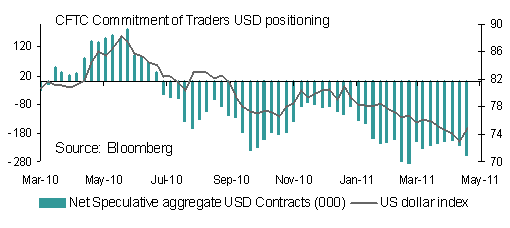
Will it continue? Whilst I am amongst the more bullish forecasters on the USD over the medium term, the current rally could prove to be short-lived in the absence of a shift in Federal Reserve rhetoric or end to quantitative easing (QE2). Nonetheless, the market had got itself very short USDs (as reflected in the CFTC IMM data as of early last week which showed an increase in net short positions) and the rally in the USD last week was likely spurred by major short-covering which could extend further into this week.

The move in the USD gained momentum as European Central Bank (ECB) President Trichet proved to be less hawkish than many expected in the press conference following last Thursday’s ECB meeting. Moreover, renewed worries about Greece at the end of last week, with a report in the German Der Spiegel, later denied by Greek officials, that the country was planning to leave the Eurozone dented the EUR,

Taken together with the improving trend in US April non-farm payrolls (April registered +244k increase, with private payrolls 268k), these factors colluded to provide further positive stimulus to the USD and negative fallout on the EUR. The room for EUR downside is evident in the net long EUR speculative position, which rose to its highest since December 2007 as of 3rd May.

This week’s batch of US releases including March trade data, April retail sales and CPI, are unlikely to result in a reversal in last week’s trend though a trend like reading for core CPI, with the annual rate below the Fed’s comfort zone will reinforce expectations of dovish Fed policy being maintained, which could inject a dose of caution into the USD’s rally.

Against the background of a likely widening in the US trade deficit in March there will plenty of attention on the annual strategic and economic dialogue beginning today, with markets interested in discussions on Chinese worries about the gaping US fiscal deficit and US concerns about China’s exchange rate policy.

Greece’s denial of plans to leave the eurozone and discussions over a further adjustment to Greece’s bail out package, may help limit any drop in the EUR this week though it will by no means mark the end of such speculation about the periphery especially with this weeks’ Q1 GDP data releases across the eurozone likely to further highlight the divergence between the core and the periphery even if the headline eurozone reading rebounds strongly as we expect.

In the UK the Bank of England Quarterly Inflation Report will be the main influence on GBP. Downward growth revisions will play into the view that inflation will eventually moderate, capping expectation of higher interest rates over the coming months. However, the likely upward revision to near term inflation forecasts will help limit any damage to GBP.

GBP has lost ground to the USD but it should be noted that it has outperformed the EUR over recent days, reversing some of the recent run up in EUR/GBP. Given that EUR sentiment is likely to remain fragile this week, GBP may continue to capitalise, with a test of EUR/GBP 0.8672 on the cards.

Financial Times Guest post: Rupee can serve as a reserve currency too

Please see below an excerpt from the Financial Times beyondbrics section in which I wrote a guest post about the Indian rupee.

Amidst the euphoria surrounding the internationalisation of China’s currency, the renminbi, attention on the Indian rupee appears to have fallen into the shadows. Admittedly China has been announcing new measures on the path to internationalisation almost on a weekly basis whilst India appears to have taken a more gradual approach, but it’s not too late for India to regain some of the limelight.

Perhaps it is surprising that the rupee is hardly talked about when discussing reserve currencies. The last BIS Triennial Survey of FX market activity revealed that the rupee accounted for 0.9 per cent (the same as the Russian rouble) of daily foreign exchange market turnover, which may seem small compared to the 84.9 per cent of turnover accounted for by the USD or 39.1 per cent by the EUR but is still ahead of many other developing currencies including China, which accounts for only 0.3 per cent of turnover. Moreover, India’s share of turnover has risen steadily from 0.1 per cent in 1998.

Read the rest at http://blogs.ft.com/beyond-brics/2011/04/14/guest-post-rupee-can-serve-as-a-reserve-currency-too/

Markets in limbo ahead of policy rate decisions

Markets are generally range-bound ahead of tomorrow’s Japan, Eurozone and UK interest rate decisions, as reflected in the flat performance of equity markets overnight. Risk appetite remains positive though still lower than the high levels seen during most of March. China’s interest rate hike did not change the market’s perspective, with markets reacting well.

Overnight the Fed FOMC minutes reflected a range of opinions on the timing of the end of QE2 and the Fed’s exit strategy but the majority view was to end QE2 as planned at the end of June leaving markets, with little new to digest. The USD was a little undermined by a weaker than expected US March ISM non-manufacturing survey but losses are likely to be limited.

Meanwhile there was more negative peripheral news in Europe, with Moody’s cutting Portugal’s sovereign credit ratings by one notch, with Moody’s highlighting the urgent need for financial support from the EU. Portuguese debt took a hit but eurozone markets in general including the EUR continue to take such news in their stride, with EUR/USD holding above 1.4200. Firm readings for the eurozone final services purchasing managers index (PMI) in March helped to support sentiment, outweighing the negative impact of a drop in eurozone retail sales.

GBP was a key outperformer, helped by a much stronger than expected services PMI, which helped GBP/USD breach 1.63 overnight. Today’s industrial and manufacturing production data will likely reveal firm readings too, helping GBP to consolidate its gains but the currency looks rather rich around current levels, with risks skewed to the downside.

JPY was another mover, having breached 85.00 versus the USD, with USD/JPY now some 6 big figures higher from its post earthquake lows. Japanese authorities will undoubtedly see a measure of success from their joint intervention but the reality is that the shift in bond yields (2-year US / Japan yield differentials have widened by close to 30 basis points since mid March, are finally having some impact on USD/JPY as reflected in the strengthening in short-term correlations.

EUR/USD remains resilient to negative peripheral news such as the Portugal credit ratings downgrade, with further direction from tomorrow’s European Central Bank (ECB) meeting and accompanying statement. The risk that the ECB is not as hawkish as the market has priced in holds some downside risks to EUR.

Asian currencies are holding up well though it looks as though the ADXY (Bloomberg-JP Morgan Asian currency index) may have hit a short term barrier. Range trading for EUR/USD suggests little directional influence for Asian currencies in the short-term. Nonetheless, portfolio capital inflows continue to support Asian FX with all Asian equity markets recording foreign inflows so far this month. In particular, KRW continues to outperform. Note that Korea has recorded a whopping inflow of $1.1bn in equity inflows month-to-date.