Euro fails too hold on to gains

Any improvement in sentiment following the USD liquidity support announcement by various central banks last week is already filtering away against the background of European Union (EU) officials’ failure to make any headway at the Ecofin meeting over the weekend, a delay in the approval of the next bailout tranche for Greece and ongoing collateral dispute between Greece and Finland. On top of all of this German Chancellor Merkel suffered a further setback in regional elections over the weekend.

Greece will remain in focus this week and markets will look for signs that the country is back on track on its austerity plans and its next loan tranche. Prime Minister Papandreou cancelled a trip to the US while the Greek cabinet are apparently deciding on new fiscal measures. Attention will turn to a teleconference today from the Greek Finance Minister with EU and IMF officials.
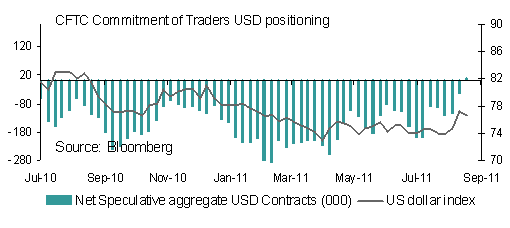
Speculative sentiment for the EUR has already soured further and according to the latest CFTC IMM report, positioning in EUR is at its lowest since the end of June 2010. EUR/USD will continue to look very vulnerable having already dropped sharply from a high of around 1.3899 in Asian morning trading as the bad weekend news hit the currency. EUR/USD will find some technical support just below 1.3500 this week but any upside is set to prove limited unless some concrete announcements are delivered relating to Greece over coming days.

In contrast to the EUR, USD speculative appetite has turned net long for the first time since July 2010. The extended Fed FOMC meeting will help to dictate USD sentiment as markets wait for further measures to stimulate the economy. The Federal Reserve has already committed to hold rates steady until at least mid 2013 and the extended two day meeting this week will likely discuss further options. However, more quantitative easing (QE3) appears unlikely at this stage while an ‘Operation Twist’ type approach is more probable. The USD will benefit from a lack of further quantitative easing but this is largely already priced in.

Euro slides as Greek worries intensify

The USD ended last week on high a note having overcome speeches by Fed Chairman Bernanke and President Obama. Bernanke’s lack of detail on potential further Fed stimulus offered the USD a lifeline as there was no mention of QE3 but nervousness may mount ahead of the September 21 FOMC meeting.

This week’s data releases (including retail sales, inflation, industrial production and regional manufacturing surveys may offer some direction to the USD and it is likely that the data over coming days will look less negative than in past weeks, giving the USD some support. Having broken above its 200 day moving average around 76.1986 for the first time in a year the USD index is set to begin the week in positive mode and will likely extend its gains over coming days.

In sharp contrast, EUR/USD crumbled at the end of last week dropping through its 200 day moving average despite positive news from Germany (rejection of bills in the constitutional court) and Italy (passage of austerity measures). The European Central Bank (ECB) did not help the EUR’s cause however, with the change in its stance to a more balanced assessment of risks from its more hawkish stance previously.

However, the real damage occurred as speculation of a Greek default intensified and ECB hawk Stark resigned from the ECB council, highlighting the divisions within the governing board. This week attention will remain on Greece as negotiations between the Troika (ECB, EU and IMF) and Greek officials resume.

Ahead of the talks Greece approved a further EUR 2 billion in austerity measures over the weekend but nonetheless, despite denials by Greek officials speculation of a debt default will continue to hammer the EUR lower. Near term technical support is seen around 1.3525 for EUR/USD.

GBP found some relief last week following the decision by the Bank of England to leave policy unchanged though it is unlikely to be able to make much if any headway against the USD over coming sessions as expectations of further UK quantitative easing may simply have been pushed back to the November meeting.

Inflation data this week will give further clues to policy but once again there is likely to be no sign of any easing in inflation pressure, limiting the room for maneuver for the BoE. Moreover, a weak outcome for UK retail sales in August will maintain the trend of soft UK data keeping up the pressure for more BoE action. As a result GBP will struggle against the USD but given that problems in Europe look even worse, GBP will likely extend gains against the EUR this week.

Payrolls sour mood, Eurozone concerns intensify

The market mood has soured further and risk aversion has increased following disappointing August US jobs report in which the change in payrolls was zero and downward revisions to previous months has reinforced the negative mood on the US and global economy while raising expectations of more Federal Reserve action. Moreover, the report has put additional pressure on US President Obama to deliver fresh jobs measures in his speech on Thursday though Republican opposition may leave Obama with little actual leeway for further stimulus.

There is plenty of event risk over coming days, with a heavy slate central bank meetings including in Europe, UK, Japan, Australia, Canada and Sweden. The European Central Bank will offer no support to a EUR that is coming under growing pressure, with the Bank set to take a more neutral tone to policy compared its previously hawkish stance. In the UK, GBP could also trade cautiously given recent comments by Bank of England Monetary Policy Committee members about potential for more UK quantitative easing.

The EUR has been unable to capitalise on the bad economic news in the US as news there has been even worse. The negative news includes the weekend defeat of German Chancellor Merkel’s centre-right bloc in regional elections, which comes ahead of a vote in Germany’s constitutional court on changes to the EFSF bailout fund.

The withdrawal of the Troika (ECB, IMF and EU) from Greece has also put renewed emphasis on the country at a time when protests are escalating. If all of this is not enough there is growing concern about Italy’s apparent backtracking on austerity measures, with the Italian parliament set to discuss measures this week. Separately Germany, Holland and Finland will hold a meeting tomorrow on the Greek collateral issue. On top of all of this is the growing evidence of deteriorating growth in the euro area.

Data releases are unlikely to garner a great deal of attention amidst the events noted above, with mainly service sector purchasing managers indices on tap and at least threw will look somewhat better than their manufacturing counterparts. In the US the Beige Book and trade data will be in focus but all eyes will be on Obama’s speech later in the week. The USD has maintained a firm tone despite the jobs report but its resilience may be better explained by eurozone negativity rather than US positivity. Even so, the USD is looking less uglier than the EUR in the current environment.

USD weaker, EUR resilient, JPY supported, CHF pressure

Why has the USD come under pressure even after Fed Chairman Bernanke failed to signal more QE? The answer is that Bernanke offered hope of more stimulus and gave a shot in the arm to risk trades even if QE3 was not on the cards. Consequently the USD has looked vulnerable at the turn of this week but we suspect that a likely batch of soft US data releases over coming days including the August jobs report at the end of the week, ISM manufacturing survey on Thursday and consumer confidence today, will erase some of the market’s optimism and leave the USD in better position. The FOMC minutes today may also give some further guidance to the USD as more details emerge on the potential tools the Fed has up its sleeve.

The EUR’s ability to retain a firm tone despite the intensification of bad news in the eurozone has been impressive. Uncertainty on various fronts in Germany including but not limited to concerns about the outcome of the German Bundestag vote on the revamped EFSF on September 30, German commitment to Greece’s bailout plan and German opposition party proposals for changes to bailout terms including the possibility of exiting the eurozone, have so far gone unnoticed by EUR/USD as it easily broke above 1.4500. EUR was given some support from news of a merger between Greece’s second and third largest banks. Likely weak economic data today in the form of August eurozone sentiment surveys may bring a dose of reality back to FX markets, however.

The lack of reaction of the JPY to the news that Japan’s former Finance Minister Noda won the DPJ leadership and will become the country’s new Prime Minister came as no surprise. The JPY has become somewhat used to Japan’s many political gyrations over recent years and while Noda is seen as somewhat of a fiscal hawk his victory is unlikely to have any implications for JPY policy. Instead the JPY‘s direction against both the USD and EUR continues to be driven by relative yield and in this respect the JPY is likely to remain firmly supported. Both US and European 2-year differentials versus Japan are at historic lows, with the US yield advantage close to disappearing completely. Until this picture changes USD/JPY is set to languish around current levels below 77.00.

EUR/CHF has rebounded smartly over recent weeks, the latest bounce following speculation of a fee on CHF cash balances, with the currency pair reaching a high of 1.1972 overnight. The pressure to weaken the CHF has become all the more acute following the much bigger than anticipated drop in the August KOF Swiss leading indicator last week and its implications for weaker Swiss growth ahead. The ‘risk on’ tone to markets following Bernanke’s speech has provided a helping hand to the Swiss authorities as safe haven demand for CHF lessens but given the likely weak slate of economic releases this week his speech may be soon forgotten. Nonetheless, the momentum remains for more EUR/CHF upside in the short term, at least until risk aversion rears its head again.

All Eyes On Jackson Hole

It’s all about Jackson Hole and ahead of the Fed symposium the USD index is likely to maintain its place in towards the middle end of its recent 73.47 – 75.12 range helped by weaker equity markets. Expectations or hopes that Fed Chairman Bernanke will announce or at least hint at a fresh round of quantitative easing have receded allowing the USD to escape further pressure. Bernanke will likely keep all options open but there are still some in the FOMC who do not want to embark on QE3.

Although the USD may be saved from a further drubbing the commitment to maintain exceptionally accommodative monetary policy through Q2 2013 has contributed to a relative reduction in US bond yields and in turn is acting to restrain the US currency. A likely revision lower to US Q2 GDP will not help the USD in this respect.

One currency in particular that is reactive to yield differentials is USD/JPY, which registers an impressively high correlation with US – Japan yield differentials. Attempts this week by the Japanese authorities to encourage capital outflows and a downgrade of Japan’s credit ratings by Moody’s have done little to weaken the JPY.

Even the usually bearish JPY Japanese margin traders have been scaling back their long USD/JPY positions over recent weeks while speculative investors remain overly long (well above the three-month average) JPY according to IMM data. The risk of a shake out of long JPY positions is high but unless yield differentials reverse renewed JPY weakening looks unlikely in the short-term.

Eurozone peripheral issues will be put on the backburner ahead of the Jackson Hole meeting but that doesn’t mean they have gone away. As the continued pressure on Greek bonds shows markets continue to be fixated on the country’s problems and there may be growing nervousness ahead of the decision to distribute the next IMF loan tranche at the end of September. Nervousness also extended to Germany, with ratings agencies having to confirm the country’s AAA rating.

So far this week EUR has shown impressive resilience despite weak data in the form the German August IFO business and ZEW investor confidence surveys. However, there is a risk of EUR weakness should Bernanke not hint at QE3, with the currency already trading around the bottom of its multi-day range.

AUD has failed to recoup its end July losses and is still some 5% below its high above 1.10 versus USD. There is scope for some AUD appreciation especially as AUD speculative positioning has dropped sharply over recent weeks reducing sharply the net long overhang in the currency.

Moreover, markets have become overly aggressive in pricing in interest rate cuts in Australia and as evidenced from the AUD bounce following RBA Governor Stevens comments this morning (in which he referred to inflation data as still being concerning) there is an asymmetric risk to the AUD on the upside.

Nonetheless, AUD has experienced an increase in sensitivity to risk over recent weeks and will continue to be driven by gyrations in risk appetite. In this respect it is too early to assume the worst is over, suggesting that any further gains in AUD will be limited.