EU Deal Boosts Euro But Momentum To Fade

The European Union deal for Greece was clearly on the positive side of expectations and from that perspective helped to buoy sentiment for European assets. The fact that EU leaders managed to work over differences and emerge with a solid deal will help remove some of the uncertainty about Greece’s future and lower the risks of contagion.

To recap EU leaders announced a EUR 109 billion second aid package for Greece. Private bondholders will contribute a target of a further EUR 37 billion via bond swaps or rolling over existing debt for new bonds maturing in 30 years. Investors will have the option to exchange existing debt into four instruments. The aim is to obtain 90% participation from Greek bondholders.

Moreover, it appears that governments will guarantee any defaulted Greek debt offered as collateral until the country can return to the market. Effectively this means that even if ratings agencies declare a default rating on Greek debt, Greek banks may still be able to obtain funding from the European Central Bank (ECB) as the debt is guaranteed by national governments.

Greece, Portugal and Ireland will benefit from lower interest rates on loans and longer maturities. Moreover, the European Financial Stability Facility (EFSF) bailout fund will have a wider scope for bond buying directly from investors. This lets the ECB off the hook to avoid further use of its own bond purchase programme and removes any further impairing of its balance sheet. The idea of a tax on banks was removed, as criticism of the workability of such a plan increased.

The downside of the deal includes the fact that:
1) European tax payers are on the line for a potentially unlimited amount to guarantee defaulted Greek debt,
2) The bondholder programme is only limited to Greece, so there is no contingency should something similar be needed in other countries
3) The participation rate for private bondholders is yet to be known (but will most likely be high).
3) The deal will lead to a default on Greek debt given the programme amounts to a 21% drop in value but a credit event is unlikely to be triggered.
4) Greece still has a highly ambitious privatisation and austerity plan to implement which even some Greek officials have admitted is overly optimistic and at worst could turn into a fire sale of Greek assets.
5) EFSF bond purchases will need the “mutual agreement” of member states which is by no means guaranteed.
6) The fund size is not large enough should Italy and Spain need similar bailouts especially as leaders have stressed that the Greek package will not be replicated for other countries.

The EUR rallied on the outcome of the European talks. However, the EUR has plenty of other worries to deal with including divergence in growth across the eurozone, overly long EUR market positioning, EUR overvaluation, likely growth underperformance versus the US and a likely rebound in general for the USD over coming months especially if the Fed does not embark on QE3 and agrees a deal to raise the debt ceiling. EUR/USD is likely to remain supported in the near term, with near term resistance around 1.4467. I still suspect that the momentum will not last, with EUR/USD looking particularly rich at current levels.
Edging Towards A European Deal For Greece

The momentum towards some form of agreement at the Special EU Summit today is growing, with French and German leaders reaching a “joint position on Greece’s debt situation”. Details of this position are still unknown, however. EUR has found support as expectations of a positive outcome intensify.

However, given that positive news is increasingly being priced in, and the market is becoming increasingly long, upside EUR potential will be limited even in the wake of a comprehensive agreement. A break above EUR/USD resistance around 1.4282 would bring in sight the next key resistance level around 1.4375 but this where the rally in EUR/USD is set to be capped.

Prospects of a major US debt default or at the least a government shutdown appear to be receding as the US administration has indicated some willingness to opt for a short term increase in the US borrowing limit to give more time for a bigger deficit reduction deal to be passed by Congress. Meanwhile, there will be further news on the deficit reduction plans put forward by the “gang of six” US senators, with a press conference scheduled for later today.

Debt ceiling negotiations are likely to be the main focus of market attention, with the Philly Fed manufacturing survey and weekly jobless claims relegated to the background. A speech by Fed Chairman Bernanke is unlikely to deliver anything new today. The USD is likely to be on the back foot given expectations of a deal in Europe and improved risk appetite but we expect losses to be limited.

The JPY continues to defy my bearish expectations. Over recent days the US yield advantage over Japan in terms of 2Y bonds dropped to multi-year lows below 20bps. Given the high correlation between USD/JPY and yield differentials, this has corresponded with the fall below 80.00.

Expectations of JPY weakness versus USD is highly dependent on the US – Japan yield gap widening over coming months. For this to happen it will need concerns about the US economy and expectations of more Fed asset purchases to dissipate, something that may not happen quickly given the rash of disappointing US data releases lately.

GBP found itself on the front foot following the release of the Bank of England Monetary Policy Committee minutes, which were less dovish than anticipated. They also revealed that the BoE expects inflation to peak higher and sooner than previously expected. However, the fact that the overall tone was similar to the last set of minutes meant there was little follow through in terms of GBP.

Further direction will come from June retail sales data today and forecasts of a bounce in sales will likely help allay concerns about a downturn in consumer spending. Nonetheless, GBP is still likely to struggle to break through resistance around 1.6230 versus USD.

G7 Intervention Hits Japanese Yen

One could imagine that it was not difficult for Japan to garner G7 support for joint intervention in currency markets given the terrible disaster that has hit the country. Given expectations of huge repatriation flows into Japan and a possible surge in the JPY Japanese and G7 officials want to ensure currency stability and lower volatility. Moreover, as noted in the G7 statement today officials wanted to show their solidarity with Japan, with intervention just one means of showing such support.

Although Japanese Finance Minister Noda stated that officials are not targeting specific levels, the psychologically important level of 80.00 will likely stick out as a key level to defend. Note that the last intervention took place on 15 September 2010 around 83.00 and USD/JPY was trading below this level even before the earthquake struck. The amount of intervention then was around JPY 2.1 trillion and at least this amount was utilised today. The last joint G7 intervention took place in September 2000.

Unlike the one off FX intervention in September 2010, further intervention is likely over coming days and weeks by Japan and the Federal Reserve, Bank of France, Bundesbank, Bank of England, Bank of Canada and other G7 nations. The timing of the move today clearly was aimed at avoiding a further dramatic drop in USD/JPY, with Thursday’s illiquid and stop loss driven drop to around 76.25 adding to the urgency for intervention. USD/JPY will find some resistance around the March high of 83.30, with a break above this level likely to help maintain the upside momentum.

The JPY has become increasingly overvalued over recent years as reflected in a variety of valuation measures. Prior to today’s intervention the JPY was over 40% overvalued against the USD according to the Purchasing Power Parity measure, a much bigger overvaluation than any other Asian and many major currencies. The trade weighted JPY exchange rate has appreciated by around 56% since June 2007. In other words there was plenty of justification for intervention even before the recent post earthquake surge in JPY

Although Japanese exporters had become comfortable with USD/JPY just above the 80 level over recent months, whilst many have significant overseas operations, the reality is that a sustained drop in USD/JPY inflicts significant pain on an economy and many Japanese exporters at a time when export momentum is slowing. Japan’s Cabinet office’s annual survey in March revealed that Japanese companies would remain profitable if USD/JPY is above 86.30. Even at current levels it implies many Japanese companies profits are suffering.

Upward pressure on the JPY will remain in place, suggesting a battle in prospect for the authorities to weaken the currency going forward. Round 1 has gone to the Japanese Ministry of Finance and G7, but there is still a long way to go, with prospects of huge repatriation flows likely to make the task of weakening the JPY a difficult one. The fact that there is joint intervention will ensure some success, however and expect more follow up by other G7 countries today to push the JPY even weaker over the short-term.

US Dollar On A Slippery Path

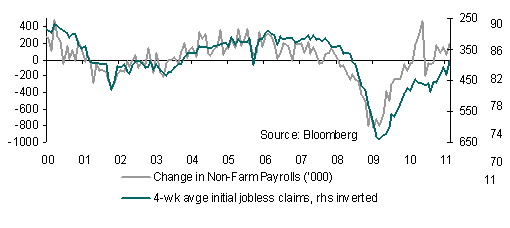
The USD has been a on a slippery path over recent weeks, weighed down by adverse interest rate differentials despite improving US economic data. Adding to the run of encouraging US data releases the February jobs report revealed a 192k increase in jobs and a drop in the unemployment rate to 8.9%.

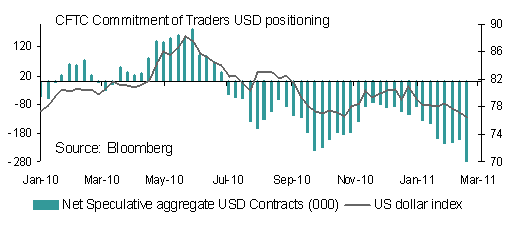
In particular the Fed’s dovish tone highlights that whilst asset purchases under QE2 will stop at the end of June, the failure to hit the Fed’s dual mandate of maximum employment and stable prices, implies that the Fed Funds rate will not be hiked for a long while yet. This dovish slant has undermined the USD to the extent that USD speculative positioning as reflected in the CFTC IMM data dropped to all time low in the week to 1 March. There is certainly plenty of scope for short-covering but the market is no mood to buy the USD yet.

This week’s releases will provide less direction, with a slight widening in the trade deficit likely in January, a healthy gain in February retail sales and a small drop in the preliminary reading of March Michigan sentiment.

In contrast, even the generally hawkish market expectations for the European Central Bank (ECB) proved too timid at last week’s Council meeting as Trichet & Co. strongly implied via “strong vigilance” that the refi rate would be hiked by 25bps in April. EUR/USD lurched higher after the ECB bombshell breaking the psychologically important 1.4000 barrier but appeared to lose some momentum at this level. Should EUR/USD sustain a break of 1.4000, the next level of resistance is at 1.4281 (November high), with support seen around 1.3747.

The lack of major eurozone data releases this week, with only industrial production data in Germany and France of interest, suggests that EUR may consolidate over the short-term with the main interest on the informal Heads of State meeting at the end of the week to determine whether credible plans can be drawn up to restore confidence in the periphery.

This week it is the turn of the Bank of England (BoE) to decide on monetary policy but unlike the ECB we do not expect any surprises with an unchanged decision likely. Further clues will only be available in the Monetary Policy Committee (MPC) minutes on 23 March. However, markets may be nervous given that it could feasibly only take another two voters aside from the three hawkish dissenters last month, to result in a policy rate hike. Notably one possible hawkish dissenter, Charles Bean did not sound overly keen on higher rates in a speech last week, a factor that weighed on GBP alongside some weaker service sector Purchasing Managers Index (PMI) data.

UK manufacturing data will be the main data highlight of the calendar but this will be overshadowed by the BoE meeting. GBP/USD could continue to lag the EUR and given a generally bullish EUR backdrop, our preferred method of playing GBP downside remains via a long EUR/GBP position.