Markets in limbo ahead of policy rate decisions

Markets are generally range-bound ahead of tomorrow’s Japan, Eurozone and UK interest rate decisions, as reflected in the flat performance of equity markets overnight. Risk appetite remains positive though still lower than the high levels seen during most of March. China’s interest rate hike did not change the market’s perspective, with markets reacting well.

Overnight the Fed FOMC minutes reflected a range of opinions on the timing of the end of QE2 and the Fed’s exit strategy but the majority view was to end QE2 as planned at the end of June leaving markets, with little new to digest. The USD was a little undermined by a weaker than expected US March ISM non-manufacturing survey but losses are likely to be limited.

Meanwhile there was more negative peripheral news in Europe, with Moody’s cutting Portugal’s sovereign credit ratings by one notch, with Moody’s highlighting the urgent need for financial support from the EU. Portuguese debt took a hit but eurozone markets in general including the EUR continue to take such news in their stride, with EUR/USD holding above 1.4200. Firm readings for the eurozone final services purchasing managers index (PMI) in March helped to support sentiment, outweighing the negative impact of a drop in eurozone retail sales.

GBP was a key outperformer, helped by a much stronger than expected services PMI, which helped GBP/USD breach 1.63 overnight. Today’s industrial and manufacturing production data will likely reveal firm readings too, helping GBP to consolidate its gains but the currency looks rather rich around current levels, with risks skewed to the downside.

JPY was another mover, having breached 85.00 versus the USD, with USD/JPY now some 6 big figures higher from its post earthquake lows. Japanese authorities will undoubtedly see a measure of success from their joint intervention but the reality is that the shift in bond yields (2-year US / Japan yield differentials have widened by close to 30 basis points since mid March, are finally having some impact on USD/JPY as reflected in the strengthening in short-term correlations.

EUR/USD remains resilient to negative peripheral news such as the Portugal credit ratings downgrade, with further direction from tomorrow’s European Central Bank (ECB) meeting and accompanying statement. The risk that the ECB is not as hawkish as the market has priced in holds some downside risks to EUR.

Asian currencies are holding up well though it looks as though the ADXY (Bloomberg-JP Morgan Asian currency index) may have hit a short term barrier. Range trading for EUR/USD suggests little directional influence for Asian currencies in the short-term. Nonetheless, portfolio capital inflows continue to support Asian FX with all Asian equity markets recording foreign inflows so far this month. In particular, KRW continues to outperform. Note that Korea has recorded a whopping inflow of $1.1bn in equity inflows month-to-date.
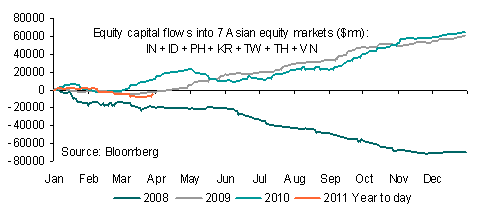
Equity Flow Reversal Supports Asian FX

Asian currencies have rebounded smartly from their post Japan earthquake lows on March 16. The ADXY (Bloomberg-JP Morgan Asia Currency index) is now at its highest level since September 1997 reflecting a sharp rebound in capital inflows to the region. The performance of Asian currencies continues to correspond closely with the movement in capital flows.

Although almost all Asian equity markets have registered outflows so far this year (total equity outflows -$6.2bn), the trend is reversing. Over the past month there has been a major slowing in capital outflows for most countries in Asia whilst India, Thailand and the Philippines have actually registered sizeable inflows. South Korea is notable in that there has been a sharp increase in equity capital inflows over the past week.

Although there has been much focus on a rotation of capital flows out of Asia and into developed economies this year, it is worth noting that the pattern of equity flows in Q1 2011 has not been too different from that witnessed in the past couple of years. In both 2009 and 2010 equity outflows were recorded over the two (2010) or three (2009) months of the year before a reversal took place. This pattern looks like it is repeating itself.

Clearly the environment for Asian equity markets is not as supportive as it was last year given the belated tightening in monetary policies being undertaken by many central banks and prospects of an end to QE2 in the US. Whilst this will result in some reduction in capital flows to the region compared to last year, the overall outlook is positive. Easing risk aversion (our risk aversion barometer has already reversed all of its post Japan earthquake spike and is trending lower), positive growth outlook and maintenance of low US rates point to more inflows.

One currency in particular that will benefit is KRW, with a further drop in USD/KRW likely over coming weeks. KRW has already strengthened by around by around 2.7% since its post Japan earthquake low making it the best performing currency since then. Further gains are likely; a test of USD/KRW 1100 is on the cards in the short-term, with the year end target standing at 1050.

Why buy KRW? 1) Korea has registered the biggest improvement in equity capital flows recently, 2) KRW has been the most sensitive Asian currency to risk over the past month and therefore benefits the most as risk appetite improves, 3) Estimated Price/Earnings ratio for Korean equities looks cheap compared to its historical z-score according to our estimates. As a result our quantitative model on USD/KRW based on commodity prices, risk aversion and equity performance highlights the potential for significantly more KRW strength.

Euro resilient but for how long?

The resilience of the EUR to bad news has been impressive but is unlikely to persist. The recent negatives include 1) the rejection of the Portuguese government’s austerity plan and the increased likelihood of a bailout, 2) a likely delay in the decision on increasing the size and scope of the EFSF EU bailout fund, 3) a drop in Eurozone purchasing managers indices in March, 4) downgrades to Portugal’ sovereign credit ratings by Fitch last night and S&P and 5) Moodys downgrades of 30 Spanish banks. Despite all of this, and after hitting a low of around EUR/USD 1.4054, EUR has bounced back close to the 1.4200 level.

Further direction will come from the outcome of the EU leaders’ summit today and the March German IFO business confidence survey. For the former there is unlikely to be a decisive result, with the optimism following the informal March 11 leaders’ summit likely to give way to delay due to wrangling over details. For the latter, a slight moderation in the IFO is expected following February’s upside surprise. However, there is a bigger risk of a downside surprise following the softer than forecast March German manufacturing PMI released. Against this background, EUR/USD is likely to struggle to break resistance around 1.249.

In general FX markets look somewhat more stable and even the pressure on the USD appears to have abated slightly despite a much weaker than expected outcome for US February durable goods orders yesterday, which revealed a drop in both headline and ex-transportation orders. My composite FX volatility measure has dropped sharply over recent days, led by short term implied JPY volatility which has dropped close to pre-crisis levels. Lower volatility has also likely reduced the prospects of further FX intervention although USD/JPY 80 will continue to be well defended.

Lower volatility as also reflected in the sharp drop in the VIX index has corresponded with a general easing in risk aversion as both Middle East and Japan tensions have eased slightly. US data today are unlikely to offer much direction, with a slight upward revision to US Q4 GDP and an unchanged outcome for the final reading of Michigan consumer confidence expected.

Risk on, US dollar pressure

FX markets have plenty of different factors to digest these days and after a harrowing couple of weeks markets began this week on a firmer footing. The overall tone into this week is to load up on risk assets. News that the nuclear situation in Japan may closer to stabilising has helped, whilst markets easily shook off another hike in China’s reserve ratio and ongoing conflict in Libya as Allied forces step up their campaign in the face of continuing resistance from Gaddafi’s forces.

Improved risk appetite has helped to keep the JPY on the defensive along with the continued threat of FX intervention, with further official JPY selling likely in the days ahead. Interestingly the intervention last Friday was estimated at only JPY 530 billion ($6.2 billion), much lower than previously thought. USD/JPY 80 remains a major line in the sand and any sign of another breach of this level will likely be met with official JPY selling. I suspect that the Japanese authorities will not be content until USD/JPY is far higher. In this respect its worth noting an official report released earlier in March highlighting that Japanese companies are not profitable at a USD/JPY rate below 86.

The EUR looks overbought around the 1.42 level but seems to be a beneficiary of Japanese FX intervention (perhaps a recycling of USDs into EUR) as well as comments by European Central Bank (ECB) Council members reiterating their intention to hike the refi policy rate, likely at the April ECB meeting. In a similar vein to the recycling of intervention USDs into EUR, Middle East entities may also be recycling petrodollars into EUR whilst news that Russia has permitted one of its oil related funds to buy Spanish debt has given a lift to sentiment for the EUR. Over the near term EUR/USD may struggle to make much headway above 1.42, with further direction coming from the EU leaders meeting on 24/25 March.

GBP is also doing well, having jumped close to the 1.6400 level versus USD, with UK February CPI giving the currency a further lift. The outcome at 4.4% YoY, which was not as bad as rumoured but in any case worse than consensus will give the hawks in the Bank of England MPC further ammunition to push for a policy rate hike. The fact that core inflation also increased suggests that the jump in headline inflation cannot merely be brushed under the table. A BoE rate hike is increasingly looking like a done deal. Renewed inflation worries in the UK and the hawkish rhetoric from ECB officials is sufficient to keep the USD under pressure.

G7 Intervention Hits Japanese Yen

One could imagine that it was not difficult for Japan to garner G7 support for joint intervention in currency markets given the terrible disaster that has hit the country. Given expectations of huge repatriation flows into Japan and a possible surge in the JPY Japanese and G7 officials want to ensure currency stability and lower volatility. Moreover, as noted in the G7 statement today officials wanted to show their solidarity with Japan, with intervention just one means of showing such support.

Although Japanese Finance Minister Noda stated that officials are not targeting specific levels, the psychologically important level of 80.00 will likely stick out as a key level to defend. Note that the last intervention took place on 15 September 2010 around 83.00 and USD/JPY was trading below this level even before the earthquake struck. The amount of intervention then was around JPY 2.1 trillion and at least this amount was utilised today. The last joint G7 intervention took place in September 2000.

Unlike the one off FX intervention in September 2010, further intervention is likely over coming days and weeks by Japan and the Federal Reserve, Bank of France, Bundesbank, Bank of England, Bank of Canada and other G7 nations. The timing of the move today clearly was aimed at avoiding a further dramatic drop in USD/JPY, with Thursday’s illiquid and stop loss driven drop to around 76.25 adding to the urgency for intervention. USD/JPY will find some resistance around the March high of 83.30, with a break above this level likely to help maintain the upside momentum.

The JPY has become increasingly overvalued over recent years as reflected in a variety of valuation measures. Prior to today’s intervention the JPY was over 40% overvalued against the USD according to the Purchasing Power Parity measure, a much bigger overvaluation than any other Asian and many major currencies. The trade weighted JPY exchange rate has appreciated by around 56% since June 2007. In other words there was plenty of justification for intervention even before the recent post earthquake surge in JPY

Although Japanese exporters had become comfortable with USD/JPY just above the 80 level over recent months, whilst many have significant overseas operations, the reality is that a sustained drop in USD/JPY inflicts significant pain on an economy and many Japanese exporters at a time when export momentum is slowing. Japan’s Cabinet office’s annual survey in March revealed that Japanese companies would remain profitable if USD/JPY is above 86.30. Even at current levels it implies many Japanese companies profits are suffering.

Upward pressure on the JPY will remain in place, suggesting a battle in prospect for the authorities to weaken the currency going forward. Round 1 has gone to the Japanese Ministry of Finance and G7, but there is still a long way to go, with prospects of huge repatriation flows likely to make the task of weakening the JPY a difficult one. The fact that there is joint intervention will ensure some success, however and expect more follow up by other G7 countries today to push the JPY even weaker over the short-term.