Japanese yen spikes higher

Events in Japan continue to dominate market action in this respect the situation is highly fluid. Markets will continue to gyrate on various pieces of news concerning the nuclear situation in Japan. As a result, risk aversion remains highly elevated and safe haven assets including US Treasuries, German bunds and the CHF are the main beneficiaries. In contrast, risk assets including global equity markets and risk currencies have come under growing pressure.

Prior to Japan’s earthquake risk aversion was already elevated amidst renewed eurozone peripheral bond tensions but the aftermath of the earthquake has seen our risk barometer rise to its highest level since the end of August last year. Any decline in risk aversion will depend on the nuclear situation coming under some form of control but until then the general “risk off” market tone will continue. Similarly currency and equity volatility will also remain relatively high.

Risk had been losing its influence on currencies over recent months but the spike in risk aversion over recent weeks has seen short-term correlations increase. The most highly impacted (highest correlations over the past month) currencies from higher risk aversion USD/JPY, USD/CHF, NZD/USD, NOK/SEK, EUR/CHF, EUR/HUF, EUR/PLN, USD/KRW. Over a three-month period all of the correlations are much lower and insignificant for the most part. JPY and CHF will likely remain the key beneficiaries in the current environment.

USD/JPY hit a low of 76.25 amidst volatile trading conditions but Japanese authorities noted that rumours of Japanese life and non life insurance companies repatriating funds back to Japan are “groundless”. USD/JPY bounced from its lows but there appears to be no sign of intervention although there may have been Bank of Japan rate checking, which helped to provoke some fears about imminent intervention. There is a high risk of FX intervention as long as USD/JPY remains below the 80.00 level.
EUR boosted, USD under pressure

Market attention remains fully focussed on events in Japan especially related to the country’s nuclear facilities. Risk aversion has spiked higher as a result, with ongoing Middle East tensions adding to the risk off tone. CHF is a key beneficiary of safe haven demand but the picture for JPY is obscured by repatriation expectations on one hand and FX intervention risks/Bank of Japan liquidity injections on the other, keeping USD/JPY clsoe to the 82.00 level. In contrast the AUD is vulnerable to a drop below parity with the USD on Japan worries, especially as Australia is a key destination for Japanese investment and therefore potential for reversal of such flows if Japanese institutions repatriate funds.

The EUR recovered over recent days as worries about the eurozone periphery ease and peripheral bonds spreads narrow. It is only a matter of time before overly long market positioning catches up with the EUR especially as the prospects of further interest rate support to the currency looked limited; markets have already priced in 75bps of policy rate hikes in the eurozone this year, which looks appropriate. It is difficult to see markets pricing in any more tightening than this over coming weeks. Despite its bounce back EUR/USD will struggle to break resistance around 1.4036.

Markets will digest the fallout from the informal EU leaders meeting last Friday which prepared the groundwork for the official meeting on 24/25 March. The initial reaction of the EUR appears to be positive but there is a significant risk of disappointment if the outcome of the meeting on 24/25 March does not live up to expectations. Indeed although Friday’s meeting resulted in an agreement in principle of a new “pact for the Euro” much will depend on the eventual details later this month.

Leaders also agreed on lowering interest rates to Greece by 100bps, and in principle enlarging the scope of the European Financial Stability Facility (EFSF) bailout fund to EUR 440 billion. The main positive surprise was opening the door for the fund to purchase eurozone debt. Data releases will offer little support to the EUR this week, with limited gains in the March German ZEW investor confidence survey today likely to leave markets unperturbed.

The USD’s gains last week proved short-lived and the currency will be tested by another relatively dovish Fed FOMC statement today and a benign reading for core CPI inflation in February. The Fed FOMC meeting is unlikely to deliver any changes to the Fed’s stance and whilst there has recently been some speculation that the Fed will soon remove its “extended period” comment, this is unlikely to happen any time soon. The statement will remind markets that the Fed is in no rush to alter its policy settings, an outcome that may limit the ability of the USD to strengthen this week even if data releases continue to remain on the positive side, including manufacturing survey and industrial production over coming days.

Japan’s Earthquake Aftermath

The aftermath of the devastating earthquake and Tsunami in Japan will largely drive markets this week outweighing the ongoing tensions in the Middle East. Having been in Tokyo as the earthquake struck I can testify to the severity and shock impact of the earthquake. Aside from the terrible human cost the economic cost will be severe at least for the next few months before reconstruction efforts boost growth. An early estimate suggests around a 1% negative impact on GDP this year.

The government is expected to announce a spending package over coming weeks to help fund relief efforts but this will likely put additional strain on Japan’s precarious debt situation at a time when worries about the country’s fiscal health were already high. Nonetheless, there is around JPY 550 billion available from the Fiscal Year 2010 and FY 2011 budgets even before a supplementary budget is needed.

The initial negative JPY impact of the natural disaster gave way to strength in anticipation of expected repatriation flows by Japanese life insurance companies and other institutions as they liquidate assets abroad in order to pay for insurance payments in Japan. The bias to the JPY will likely continue to be upwards but trading will be choppy.

Many of the margin traders holding extreme long USD/JPY positions will likely reduce these positions in the weeks following the earthquake in order to fulfil JPY demand. This may be countered by some foreign selling of Japanese assets especially given that foreigners have accelerated Japanese asset purchases over recent weeks. Therefore, it’s not a straight forward bet to look for JPY strength.

If however, the JPY strengthens rapidly and threatens to drop well below the psychologically important level of 80 the spectre of FX intervention will loom large. Indeed, following the Kobe earthquake in 1995 the JPY strengthened sharply by around 18% but the USD was already in decline prior to the earthquake and USD/JPY was also being pressured lower by Barings Bank related liquidation.

Therefore, comparisons to 1995 should be taken with a pinch of salt. Nonetheless, Japanese authorities will be on guard for further upward JPY pressure. The immediate market focus will be on the Bank of Japan (BoJ) meeting today, with the BoJ announcing the addition of JPY 7 trillion in emergency liquidity support to help stabilise markets.

Interest Rate Decisions Galore

The Reserve Bank of New Zealand (RBNZ) decision to cut policy rates by a bigger than expected 50bps does not necessarily mark the onset of a new wave of NZD selling. Indeed, whilst the NZD was hit by the rate cut it recovered quickly.

The NZD was aided by comments from the RBNZ Governor Bollard that short term inflation may spike due to the earthquake but this tempered by another RBNZ official who stated that the central bank may hold rates at 2.5% at least until January 2012. The post meeting statement indicated that the RBNZ will not embark on a series of rate cuts, a fact that will provide some relief to the Kiwi. Moreover, the currency looks increasingly oversold especially relative to the AUD as indicated by relative positioning.

Weaker than expected employment data in Australia will also help to stem AUD strength versus NZD. After many months of positive surprises the labour market is showing signs of cracking. Admittedly full time employment rose but this was outweighed by an even bigger drop in part time employment, resulting in a 10.1k fall in overall employment.

Although the AUD is unlikely to face too much downside markets the data will likely dampen expectations of possible rate hikes in the months ahead. My preferred way of playing possible AUD underperformance is via the NZD. AUD/NZD is likely to face plenty of resistance around the 1.3800 level and eventually as indicated by our quantitative models the currency pair is likely to move lower over coming weeks.

In sharp contrast to the RBNZ, the Bank of Korea hiked interest rates by 25bps in a further move to normalize policy. The decision was not much of a surprise and the statement indicated that more rate hikes should be expected. The KRW remains rangebound but the currency remains on path for further appreciation over coming months. The surprise trade deficit in China has weighed on Asian currencies in general but weakness is likely to be limited.

The Bank of England is the next central bank on tap today but is unlikely to hike rates despite the hawkish shift within the Monetary Policy Committee. A rate hike is moving closer but the Bank will likely wait until at least May before moving. Further details about today’s decision will as usual wait for the minutes in two weeks time. GBP looks vulnerable and whilst a rate move today is not expected the currency may lose ground over coming days against the background of a firmer USD.

US Dollar On A Slippery Path

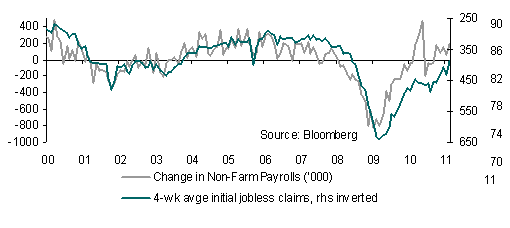
The USD has been a on a slippery path over recent weeks, weighed down by adverse interest rate differentials despite improving US economic data. Adding to the run of encouraging US data releases the February jobs report revealed a 192k increase in jobs and a drop in the unemployment rate to 8.9%.

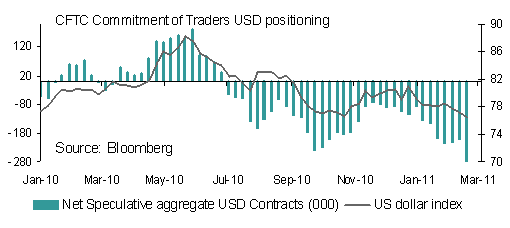
In particular the Fed’s dovish tone highlights that whilst asset purchases under QE2 will stop at the end of June, the failure to hit the Fed’s dual mandate of maximum employment and stable prices, implies that the Fed Funds rate will not be hiked for a long while yet. This dovish slant has undermined the USD to the extent that USD speculative positioning as reflected in the CFTC IMM data dropped to all time low in the week to 1 March. There is certainly plenty of scope for short-covering but the market is no mood to buy the USD yet.

This week’s releases will provide less direction, with a slight widening in the trade deficit likely in January, a healthy gain in February retail sales and a small drop in the preliminary reading of March Michigan sentiment.

In contrast, even the generally hawkish market expectations for the European Central Bank (ECB) proved too timid at last week’s Council meeting as Trichet & Co. strongly implied via “strong vigilance” that the refi rate would be hiked by 25bps in April. EUR/USD lurched higher after the ECB bombshell breaking the psychologically important 1.4000 barrier but appeared to lose some momentum at this level. Should EUR/USD sustain a break of 1.4000, the next level of resistance is at 1.4281 (November high), with support seen around 1.3747.

The lack of major eurozone data releases this week, with only industrial production data in Germany and France of interest, suggests that EUR may consolidate over the short-term with the main interest on the informal Heads of State meeting at the end of the week to determine whether credible plans can be drawn up to restore confidence in the periphery.

This week it is the turn of the Bank of England (BoE) to decide on monetary policy but unlike the ECB we do not expect any surprises with an unchanged decision likely. Further clues will only be available in the Monetary Policy Committee (MPC) minutes on 23 March. However, markets may be nervous given that it could feasibly only take another two voters aside from the three hawkish dissenters last month, to result in a policy rate hike. Notably one possible hawkish dissenter, Charles Bean did not sound overly keen on higher rates in a speech last week, a factor that weighed on GBP alongside some weaker service sector Purchasing Managers Index (PMI) data.

UK manufacturing data will be the main data highlight of the calendar but this will be overshadowed by the BoE meeting. GBP/USD could continue to lag the EUR and given a generally bullish EUR backdrop, our preferred method of playing GBP downside remains via a long EUR/GBP position.