Is EUR/USD Parity Inevitable?

Reading this article in the WSJ “Hedge Funds Try ‘Career Trade’ Against Euro“, it would seem that there is an increasing amount of investors, especially hedge funds, looking for the EUR to fall to parity against the USD.  It is hard to believe that only a few months ago it looked as though the EUR was heading back towards its previous highs around 1.60 hit in April 2008. 

Following the surge in the USD during the financial crisis EUR/USD dropped to below 1.25 in November 2008 and then managed to eek out some gains as risk appetite improved and the USD came under pressure during most of 2009.

The picture towards the end of 2009 reversed as initially investors covered short USD positions and then bought USDs on rising risk aversion and growing problems in Greece.  The trend looks well set now and a move even lower beckons for EUR/USD.  

So how low will it go?  It is tempting to say that record short speculative positioning in EUR/USD means that the market is already stretched and like an elastic band pulled too far the EUR could rebound sharply.  On the other hand the band could also snap and in the case of EUR/USD this would imply a collapse in the currency as other investors join the bandwagon of selling EUR.

It is difficult to see any quick resolution to the problems in Europe at present.  Growing social/ labour unrest in the wake of austerity measures to cut burgeoning fiscal deficits highlight that implementing budget cuts mean tough political choices.   Greece has borne the brunt of this unrest but it appears to be spreading across Europe.   

In the past countries could devalue their way out of their debt problems but this solution is not available to individual countries in the eurozone.  Another option is to inflate your way out of the debt but again this is something that the European Central Bank (ECB) will not tolerate and could do much greater long term damage.  

So the only viable solution is to cut spending, raise taxes, implement reforms and raise retirement ages, all of which will fuel plenty of tensions in the countries concerned.  The difficulty of raising taxes was highlighted by the fact that even Greek tax inspectors have gone on strike, a fact which makes a mockery out of the government’s plans.  

Assuming that austerity measures are actually carried out it will mean that growth in Greece and many of the other bigger countries in Europe that carry out these measures will weaken further, making a “double-dip” scenario for the eurozone economy more likely.  

The bottom line is that it is extremely difficult to see the EUR make a sustainable recovery against this background.  Yes, the market is positioned short but so what? We may see short positioning increase further before any stability in the EUR is achieved.   

The last time EUR/USD was at parity was in December 2002.  Given the lack of alternatives in Europe at present another test of parity does not look as inconceivable as it did only a few months ago.
Risk Appetite Puts Dollar On The Back Foot

Markets look somewhat calmer going into this week helped by comments by Fed members who noted that the discount rate hike did not signal a shift in monetary policy, something which is likely to be repeated by Fed Chairman Bernanke in his testimony to Congress on Wednesday and Thursday.  A tame US January CPI report last Friday helped too, giving further support to the view that the Fed will not hike the Fed Funds rate for some time yet; a rate hike this year seems highly unlikely in my view.  

Data this week will be conducive to a further improvement in risk appetite and despite the lingering concerns about Greece the EUR may find itself in a position to extend gains.  In Europe all eyes will be on the February German IFO survey and eurozone sentiment indicators, which following the surprising strength in the manufacturing Purchasing Managers Indices (PMIs), are likely to reveal solid gains. 

The main highlights in Japan this week includes January trade data and industrial production. The trade numbers will be particularly important to determine whether the rebound in exports due in large part to robust Asian demand, has continued whilst the bounce back in exports will be a key factor in fuelling a further gain in industrial output. 

In the US aside from the testimonies by Fed Chairman Bernanke there are plenty of releases on tap including consumer confidence, new and existing home sales, durable goods orders and a likely upward revision to Q4 GDP.  For the most part the data will show improvement and play for a further improvement in risk appetite. 

FX direction will depend on whether markets focus on the potentially positive USD impact of a reduction in USD liquidity or on the likely firmer tone to risk appetite this week.  Given expectations of firmer data and the soothing tone of the Fed, risk currencies will likely perform better, with crosses such as AUD/JPY favoured.  The USD will likely be placed on the back foot, especially given the very long market positioning in the currency.

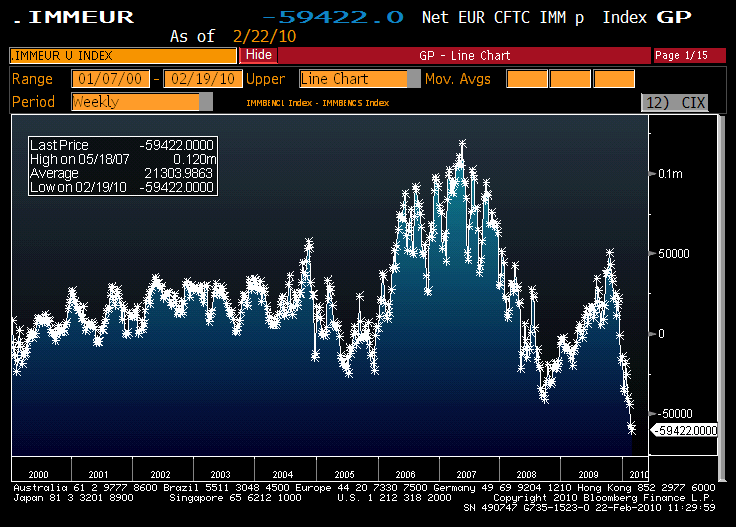
The EUR will be helped by the fact that speculative market, according to the CFTC IMM data, holds record short positions in the EUR (as of the week ended 16 February) giving plenty of potential for short-covering.   The more timely Tokyo Financial Exchange (TFX) data also reveals that positioning in EUR/JPY has continued to be scaled back.  

CFTC Commitment of Traders (IMM) data – Net EUR speculative positioning

EUR/USD bounced smartly from its lows around 1.3444 on Friday, partly reflecting some short covering and the drop in FX volatility suggests the market is more comfortable with EUR/USD around these levels.  A positive IFO survey and improved risk appetite could see EUR/USD test resistance around 1.3774, its 20 day moving average, over coming days.  Ongoing Greek concerns suggest that any EUR bounce will be limited, however. 

USD/JPY looks well supported and although data this week will suggest that exports are improving despite JPY strength, the relatively more aggressive stance of the Fed compared to the BoJ, long JPY positioning, and improved risk appetite, give plenty of scope for the JPY to extend losses, with technical USD/JPY support seen around 91.28.

Euro Still Vulnerable

Markets have become rather skittish, with attention gyrating between sovereign deficit/debt concerns on the one hand and better news on the corporate and economic front on the other.  This week the latter appears to be gaining the upper hand helped by an easing of concerns about Greece. Although the Greek saga is by no means close to an end, especially given the new deadlines set by the EU Commission on adherence to budget cuts, the chances of the worst case scenario of default or pull out from the EU looks to have diminished. 

Renewed attention on other EU members, especially in light of the derivatives transactions carried out by Greece and potentially by other European countries to disguise the extent of their budget problems suggests that there is still more pain ahead. Nonetheless, it is increasingly clear that investors are differentiating between Europe and the rest of the world much to the chagrin of the EUR.  

Differentiation between the eurozone and the US was particularly apparent in the wake of stronger than forecast earnings and data in the US. Two more companies joined the three-quarters of S&P 500 companies beating earnings forecasts whilst economic reports including US January industrial production and housing starts came in ahead of forecasts.  This pattern is set to continue today, with the US Philly Fed manufacturing index set to increase to around 17 in February from 15.2 in January. 

In contrast, data in Europe has been much less impressive, with for example, the February ZEW survey of investor confidence recording its 5th consecutive decline in February.  The eurozone economic news may look a little better in the form of likely increases in manufacturing Purchasing Managers Indices (PMIs) but unless the data reveals particularly strong readings the growing perception that Europe is falling behind in the recovery process will remain in place.

Despite the improvement in risk appetite the USD has taken a firmer tone, appearing to react more to positive data and implications for a reduction in policy accommodation by the Fed.  In particular, the USD was spurred by the FOMC minutes of the January 26-27 meeting, in which the Fed debated its exit strategy from quantitative easing.  Some officials even went as far as pushing for asset sales in the “near future” to reduce the size of the Fed’s balance sheet.

Even though the USD has taken a firmer tone it will continue to be buffeted by the conflicting forces of improved risk appetite and shifting interest rate expectations.  Correlations reveal that risk is still the dominant FX factor suggesting that there may still be some further downside left for the USD as risk appetite improves. 

Although commodity currencies have also come under pressure due to the generally firmer USD tone overnight, the downside in these currencies is likely to prove limited especially given strong data releases.  For example, data overnight revealed that business confidence rose to its highest level in 15 years in Australia.  Added to upbeat comments from RBA deputy governor Lowe and strong labour market data, it highlights the growing probability of a March rate hike by the RBA.

The EUR remains the weak link and although it may benefit from easing Greek concerns the growing evidence of a relatively slower economic recovery in the eurozone suggests any upside in the EUR will be limited.  Having dropped below technical support around 1.3580, EUR/USD looks vulnerable to a further push lower in the short-term.

Calming the Tiger

As markets enter the year of the Tiger a somewhat calmer tone appears to be ensuing, with risk appetite edging higher helping equities and the beleaguered EUR to recover some lost ground.  US stocks were helped by a firmer than expected reading for the Empire manufacturing survey (to 24.91 in Feb) and a slight uptick in the US NAHB (National Association of Home Builders) index (to 17 in Feb) but consumer confidence remained weak as indicated by the decline in the weekly reading of ABC Consumer Confidence (-49).  

On the other side of the pond the better than expected February ZEW survey (a survey of investor confidence) in Germany (45.1) helped sentiment although it still recorded a decline from the previous month as Greek fiscal/debt concerns weighed on financial market participants’ confidence.  The bigger impetus came from comments by Greek Finance Minister Papaconstantinou who said there would be no need to for a bailout of the country.

Tensions over Greece eased further following news that tax collectors in the country called off a planned strike, helping to allay some concerns that unions will block planned spending cuts.   On the policy front, the EU Council ratified Greece’s plans but with strings attached, giving the country one month to present a report on the timetable for implementing budget cuts for 2010 and three months to outline policy measures required to cut the deficit below 3% by 2012.

Meanwhile, commodity prices have pushed higher helping currencies such as the AUD and NZD to strengthen.  Moreover, the AUD was boosted by more hawkish interest rate expectations following the release of the minutes of the latest RBA policy meeting which indicated that the Reserve Bank was merely pausing in its rate cycle.  Expectations of a rate hike in March increased as a result.

Overall, the recent rally in the USD is looking increasingly overdone and some reversal is likely over coming weeks.  The fact that market positioning has reached extreme levels in particular in the case of the EUR highlights scope for some recovery in the currency, especially now that the worst case scenario of a Greek default has passed.  The outlook for commodity currencies is even more bullish as risk appetite improves further.     

If anything, data today is likely to give further support to the recovery story, with US industrial production and housing starts expected to post healthy gains.  The Fed FOMC minutes may offer some additional insight into the debate over the implementation of exit strategies but there is unlikely to be much elaboration from the recent comments by Fed Chairman Bernanke in his speech to the US Senate in which he hinted that a rise in the discount rate is not far off.  

Risk currencies including many Asian currencies are likely to benefit from the improvement in risk appetite over the short term.  EUR/USD will likely strengthen as more short positions are covered but will face strong technical resistance around 1.3839.   Asian currencies have been resilient to the recent rise in risk aversion and this is likely to continue over the coming weeks.  As risk appetite recovers currency plays including long AUD/JPY , and even some further upside in EUR/USD look favourable.

Tarnishing The Euro

I am just finishing up a client trip in Japan and waiting to take a flight back to Hong Kong. The time ahead of the flight has allowed some reflection on my meetings here. One thing that has been particularly evident is the strong interest in all events European. Some I have spoken to have wondered out loud whether this the beginning of the end of the European project.  At the least it is evident that fiscal/debt problems in Greece and elsewhere in Europe have tarnished the image of the EUR.

Markets continue to gyrate on any news about Greece and the potential for support from the Europe Union and/or IMF. The divergent views between European countries about how to deal with the problem has intensified, suggesting that reaching an agreement will not be easy. Some countries including the UK and Sweden have suggested enrolling the help of the IMF but this has been resisted by other European countries. Germany and France are trying to rally support ahead of today’s crucial meeting of European officials.

The EUR reacted positively to news that some form of support package is being considered but nothing concrete has appeared yet, leaving markets on edge. The EUR has been heavily sold over recent weeks; speculative market positioning reached a record low in the latest week’s CFTC Commitment of Traders’ IMM report. The fact that EUR positioning has become so negative suggests that the EUR could rebound sharply in the event that some support package for Greece is announced.

Any package will not come without strings attached, however, as European officials will want to avoid any moral hazard. A couple of options hinted at by German officials include fresh loans or some form of plan to purchase Greek debt. Either way, any solution to Greece’s problems will not be quick and will likely result in a sharp contraction in economic activity as the government cuts spending especially as Greece does not have the option of the old remedy of devaluing its currency. Meanwhile, strikes and social tensions in the country could escalate further. A solution for Greece will only constitutes around 2.5% of eurozone GDP will also not prevent focus from continuing to shift to Portugal, Spain and other countries with fiscal problems despite comments by Moody’s ratings agency to differentiate between the countries.

Even if the EUR rebounds on any positive news about support for Greece any relief is likely to prove temporary and will provide better levels to sell into to play for a medium term decline in the currency. Ongoing fiscal concerns, a likely slower pace of economic recovery, divergencies in views of European officials, and the fact that the EUR is still overvalued suggests that the currency will depreciate over much of 2010, with a move to around EUR/USD 1.30 or below in prospect over coming months.