Contest of the uglies

Although there is plenty of event risk in the form of the Greek confidence motion today market sentiment has taken a turn for the better as a ‘risk on’ mood has filtered through. There was little justification in the turn in sentiment aside from some reassuring comments from the EU’s Juncker but clearly markets are hoping for the best.

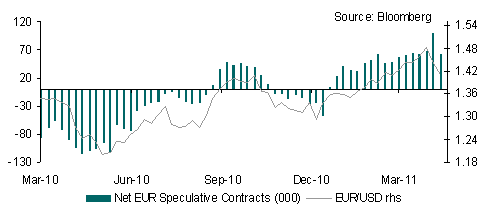
The contest of the ugly currencies continues and recently the EUR is running neck and neck with the USD. News that a final decision on a further tranche of aid for Greece and a second bailout package will not take place until early July was not digested well by European markets, although EUR/USD managed to show its resilience once again overnight.

EUR/USD looks like it will settle into a range over the short-term, with support around the 100 day moving average of 1.4170 and resistance around the 15 June high of 1.4451. A weak German June ZEW investor confidence survey may result in the EUR facing some resistance but the data is likely to be overshadowed by events in Greece.

Although Greece continues to dominate the headlines, the looming Fed FOMC meeting and press briefing tomorrow may just keep USD bulls in check especially given the likelihood of downward growth revisions by the Fed and no change in policy settings. Ahead of this news on the housing market is likely to remain bleak, with a likely drop in May existing home sales as indicated by pending home sales data.

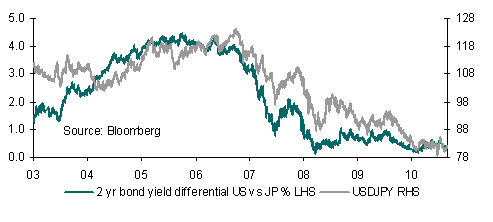
USD/JPY continues to flirt with the 80 level but as yet it has failed to sustain a breach below this level. Contrary to speculation the JPY is not particularly reactive to risk aversion at present but instead continues to be driven higher by narrowing US – Japan bond yield differentials. This is pretty much all due to declining US Treasury yields rather than any increase in Japanese bond (JGB) yields.

However, while Japanese officials continue to back off the idea of FX intervention, even at current levels, data releases such as the May trade balance yesterday continue to build a strong case for weakening the JPY. Even economy minister Yosano sounded worried on the trade front in his comments yesterday. Despite such concerns, it will take a renewed widening in bond yield differentials to result in renewed JPY weakness which will need an improvement in US data to be forthcoming.
Euro Resilience To Fade

There will at least be a little more liquidity in FX markets today following yesterday’s public holidays in the US and UK. Whether this means that there will be a break out of recent ranges is another matter. Clearly global growth worries as well as eurozone peripheral debt concerns are having an important impact on market dynamics but are also providing conflicting signals.

On the one hand the USD ought to garner support from Europe’s problems but on the other, safe haven demand and growth concerns is bolstering demand for US Treasuries keeping US bond yields at very low levels despite the lack of progress on increasing the US debt ceiling and agreeing on medium to long term deficit reduction.

In the wake of a run of US data disappointments including April durable goods orders, Q1 GDP and weekly jobless claims last week, fears of a loss of momentum in the US economy have intensified. Manufacturing and consumer confidence surveys in the form of the May Chicago PMI and Conference Board consumer confidence survey today will be closely scrutinised to determine whether the ‘soft patch’ in the US economy will persist.

This will have important implications for the USD as worries about growth may feed into expectations that the Fed’s ultra loose monetary policy will be sustained for longer. As it is US 2-year bond yields have dropped to their lowest level this year.

Fortunately for the USD only USD/JPY and USD/CHF have maintained a statistically strong correlation with bond yield differentials although we expect the break in relationship for other currencies to prove temporary. In the case of USD/JPY, yield differentials have narrowed between the US and Japan, a factor playing for JPY appreciation.

Perhaps the fact that unlike the US Japanese data has on balance been beating expectations notwithstanding disappointing April household spending and industrial output data has helped to narrow the yield gap with the US. One explanation is that that worst fears of post earthquake weakness have not been borne out, suggesting that economic expectations have been overly pessimistic. In any case, USD/JPY 80 is still a major line in the sand for the currency pair.

The EUR continues to show impressive resistance, with EUR/USD breaking technical resistance around 1.4345, which opens up a test of 1.4423. Reports that Greece had failed to meet any of its fiscal targets and of harsh conditions set by European officials for further aid have failed to dent the EUR. Whether the market is simply becoming fatigued or complacent will be important to determine if the EUR can gain further.

A report in the WSJ that Germany is considering dropping its push for early rescheduling of Greek debt has given some support to the EUR too. Ongoing discussions this week are unlikely to prove conclusive however, with attention turning to meetings of European officials on 20th and 24th June. I still believe EUR gains will limited, with the break above 1.4345 likely to prove shortlived.

US Dollar Ugly But Not Hideous

The USD has strengthened by around 5% since the beginning of the month. The move has been particularly sharp this week as higher risk aversion and intensifying fears about the eurozone periphery have given the currency a boost, albeit with the USD remaining one of the least ugly currencies amongst a fairly hideous bunch.

Eurozone country and overall ‘flash’ May purchasing managers indices (PMI) managed to further sour an already fragile mood yesterday, with the data revealing bigger than expected declines, albeit still at levels that are high in absolute terms. Data today is unlikely to result in any improvement in sentiment for eurozone assets, with the Germany IFO Business Climate index likely to slip, albeit from a relatively high level.

The EUR doesn’t need much of an excuse to sell off at present, with a softer IFO likely to provide further reason for investors to offload long positions in the currency. Against this background EUR/USD is likely to sustain a drop below the 1.4000 level, with the 100 day moving average level of 1.3972 likely to be breached shortly.

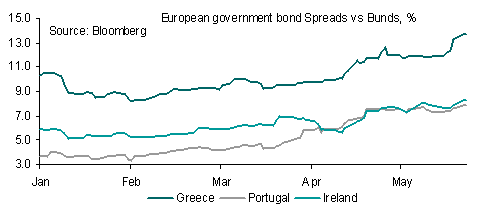
More importantly in terms of sentiment drivers the malaise in the eurozone periphery especially Greece remains the biggest risk for the EUR. As much as officials in Europe and Greece deny speculation of debt restructuring the market is far from convinced as reflected in the widening in peripheral debt spreads.

Greece’s Prime Minister Papandreou’s attempt to push through austerity measures in the Greek parliament yesterday by announcing accelerated asset sale plan and EUR 6 billion in budget cuts have done little to turn market sentiment despite the fact that at the least it shows a willingness to stick to the plan in the face of growing domestic resistance.

The USD has also edged higher against the JPY over recent days despite a rise in risk aversion. As revealed in the latest IMM data markets have been net long JPY over the past couple of weeks, with positioning well above the 3-month average, suggesting some scope for a liquidation of long positions. Nonetheless, the rise in USD/JPY has occurred despite 2-year US / Japan yield differentials remaining at a relatively low level suggesting that the USD may lose momentum, with USD/JPY resistance around 82.74 likely to cap gains.

GBP has also slid suffering in the wake of a resurgent USD and unconfirmed reports that Moody’s ratings agency is expected to announce that is placing 14 out of 18 UK banks on review for a downgrade. GBP is likely to trade nervously ahead of UK data releases today including public finances and CBI data, with further downside risks opening up. A drop below GBP/USD 1.6000 could see the currency pair test support around 1.5972.

US Dollar On The Rise

There are plenty of US releases on tap this week but perhaps the most important for the USD will be the minutes of the April 26-27 Fed FOMC meeting. Taken together with speeches by Fed officials including Bernanke, FX markets will attempt to gauge clues to Fed policy post the end of QE2. The Fed’s stance at this point will be the major determinant of whether the USD can sustain its rally over the medium term. The lack of back up in US bond yields suggests that USD momentum could slow, with markets likely to move into wide ranges over coming weeks.

It is worth considering which currencies will suffer more in the event that the USD extends its gains. The correlation between the USD index and EUR/USD is extremely strong (even accounting for the fact that the EUR is a large part of the USD index) suggesting that the USDs gains are largely a result of the EUR’s woes. Aside from the EUR, GBP, AUD and CAD are the most sensitive major currencies to USD strength whilst many emerging market currencies including ZAR, TRY, SGD, KRW, THB, IDR, BRL and MXN, are all highly susceptible to the impact of a stronger USD.

Robust Q1 GDP growth readings in both Germany and France helped to spur gains in the EUR but this proved short-lived. Sentiment for the currency has soured and as reflected in the CFTC IMM data long positions are being scaled back. Nonetheless, there is still plenty of scope for more EUR selling given ongoing worries about the eurozone periphery, which are finally taking their toll on the EUR. A break below EUR/USD 1.4021 would open the door for a test of 1.3980.

The eurogroup and ecofin meetings will be of interest to markets this week but any additional support for Greece is unlikely to be announced at this time. However, likely approval of Portugal’s bailout may alleviate some pressure on the EUR but any positive impetus will be limited. Even on the data front, markets will not be impressed with the German ZEW index of investor confidence likely to register a further decline in May.

Japanese officials have been shying away from further FX intervention by blaming the drop in USD/JPY over recent weeks on general USD weakness despite the move towards 80. However, this view is not really backed up by correlation analysis which shows that there is only a very low sensitivity of USD/JPY to general USD moves over recent months. One explanation for the strength of the JPY is strong flows of portfolio capital into Japan, with both bond and equity markets registering net inflows over the past four straight weeks.

This is not the only explanation, however. One of the main JPY drivers has been a narrowing in yield differentials. This is unlikely to persist with yield differentials set to widen sharply over coming months resulting in a sharply higher USD/JPY. As usual data releases are unlikely to have a big impact on the JPY this week but if anything, a further decline in consumer confidence, and a negative reading for Q1 GDP, will maintain the pressure for a weaker JPY and more aggressive Bank of Japan (BoJ) action although the BoJ is unlikely to shift policy this week.

Risk Aversion Creeps Higher

The USD index has dropped by around 17% since June 2010 high and despite a slight bounce this week it is unlikely to mark the beginning of a sustained turnaround. Nonetheless, I would caution about getting carried away with positioning for USD weakness. Whilst an imminent recovery looks unlikely the risk/reward of shorting the USD is becoming increasingly unfavourable.

Until then Federal Reserve comments will be watched closely for clues on policy and there are plenty of Fed speakers this week including a speech by Boston Fed’s Rosengren today and Fed Chairman Bernanke tomorrow. The USD will also gain some direction from jobs data and markets will be able to gauge more clues for Friday’s non-farm payrolls data , with the release of the April ADP employment report today.

The EUR is one currency that has suffered this week. News that Portugal’s caretaker government has reached an agreement with the European Union / International Monetary Fund on a bailout of as much as EUR 78 billion has so far been greeted with a muted response. EUR attention is still very much focussed on the ECB meeting tomorrow and prospects of a hawkish press statement suggest that EUR/USD downside will be limited, with support seen around 1.4755.

The JPY has strengthened by around 5% versus USD since its 6th April USD/JPY high around 85.53, confounding expectations that Japan’s FX intervention following the county’s devastating earthquake marked a major turning point in the currency. A combination of narrowing interest rate differentials with the US (2 year US/Japan yield differentials have narrowed by around 20bps in the past month), strong capital inflows to Japan (net bond and equity flows in the last four weeks have increased to their highest this year), and rising risk aversion have all played their part in driving the JPY higher.

As a result USD/JPY is fast approaching the psychologically important level of 80, a level that if breached will likely lead to FX intervention. Although Golden Week holidays in Japan this week suggest that JPY liquidity may be quite thin, Japanese authorities are likely to remain resistant to further gains in the JPY, likely using thinning liquidity to their advantage.

Despite the JPY’s recent strength speculative positioning over the past four weeks has remained net short JPY, whilst Japanese margin traders have also increased their long USD/JPY bets, suggesting that these classes of investors are not to blame for the JPY’s appreciation. This suggests that FX intervention may not be as successful given that the market is already short JPY.

Given the risk of intervention on USD/JPY, the CHF appears to be an easier choice for safe haven demand against the background of rising risk aversion. The currency has risen to a record high against the USD, gaining around 8.3% so far this year. Given the hints of higher interest rates by the Swiss National Bank (SNB) and resilience economic performance, downside risks for CHF are limited at present unless risk appetite improves sharply. Further gains are likely with USD/CHF likely to test the 0.8570 support level over the short-term.