Interest Rate Decisions Galore

The Reserve Bank of New Zealand (RBNZ) decision to cut policy rates by a bigger than expected 50bps does not necessarily mark the onset of a new wave of NZD selling. Indeed, whilst the NZD was hit by the rate cut it recovered quickly.

The NZD was aided by comments from the RBNZ Governor Bollard that short term inflation may spike due to the earthquake but this tempered by another RBNZ official who stated that the central bank may hold rates at 2.5% at least until January 2012. The post meeting statement indicated that the RBNZ will not embark on a series of rate cuts, a fact that will provide some relief to the Kiwi. Moreover, the currency looks increasingly oversold especially relative to the AUD as indicated by relative positioning.

Weaker than expected employment data in Australia will also help to stem AUD strength versus NZD. After many months of positive surprises the labour market is showing signs of cracking. Admittedly full time employment rose but this was outweighed by an even bigger drop in part time employment, resulting in a 10.1k fall in overall employment.

Although the AUD is unlikely to face too much downside markets the data will likely dampen expectations of possible rate hikes in the months ahead. My preferred way of playing possible AUD underperformance is via the NZD. AUD/NZD is likely to face plenty of resistance around the 1.3800 level and eventually as indicated by our quantitative models the currency pair is likely to move lower over coming weeks.

In sharp contrast to the RBNZ, the Bank of Korea hiked interest rates by 25bps in a further move to normalize policy. The decision was not much of a surprise and the statement indicated that more rate hikes should be expected. The KRW remains rangebound but the currency remains on path for further appreciation over coming months. The surprise trade deficit in China has weighed on Asian currencies in general but weakness is likely to be limited.

The Bank of England is the next central bank on tap today but is unlikely to hike rates despite the hawkish shift within the Monetary Policy Committee. A rate hike is moving closer but the Bank will likely wait until at least May before moving. Further details about today’s decision will as usual wait for the minutes in two weeks time. GBP looks vulnerable and whilst a rate move today is not expected the currency may lose ground over coming days against the background of a firmer USD.
Eurozone peripheral tensions

The USD index remains under pressure but will likely continue to consolidate. The USD continues to be undermined by adverse interest rate differentials and is gaining little support from rising risk aversion. One factor that will help dictate USD direction over coming months is the prospects for further quantitative easing once QE2 ends.

Fed officials offered varied views on the subject. Dallas Fed President Fisher hinted he would support cutting short asset purchases before the end of June, whilst Atlanta Fed President Lockhart noted he was “very cautious” about further asset purchases. Meanwhile Chicago Fed President Evans noted that he believes the hurdle for altering the asset purchase plan is “pretty high”.

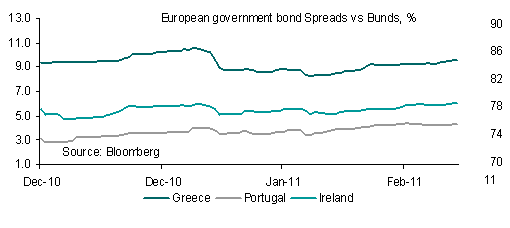
Although there is a lack of first tier data releases in the eurozone this week there is certainly plenty for markets to chew on in terms of peripheral country issues, which may just prevent the EUR from extending its gains. Eurozone peripheral debt spreads have undergone a renewed widening over recent weeks as debt fears have increased and worries that Portugal may follow Ireland and Greece in needing a bailout have risen.

Meanwhile news that Ireland’s incoming government will introduce legislation allowing the restructuring of some senior bank bonds, will add to tensions. Meanwhile, the downgrading of Greece’s government bond ratings to B1 from Ba1 dealt another blow sentiment following hot on the heels of Fitch’s downgrade of Spain’s outlook to negative although the EUR proved resilient to the news. EUR/USD continues to look as though it will consolidate around the 1.4000 level, but worsening sentiment towards the periphery may open up downside as the EUR’s resilience fades.

Upward revisions to eurozone growth and inflation forecasts and of course a hawkish shift in eurozone interest rate expectations may have justified the EUR move higher over recent weeks. However, there does not seem to be much that will provide the stimulus for further gains from current levels.

The market has already priced in an interest hike as early as next month’s European Central Bank (ECB) meeting and further tightening thereafter. The risk now appears asymmetric skewed to the downside especially if tensions between the eurozone core and peripheral countries deepen. How long the EUR can ignore such tensions?

It’s not only the eurozone periphery that should worry about ratings. Japan’s ratings agency R&I has warned that it may be forced to cut Japan’s sovereign ratings before April’s local elections due to current political problems. R&I’s concern revolve around the potential for political problems to delay fiscal reforms. As usual the JPY remains unmoved by political issues and is moving to the stronger side of its recent range against the background of elevated risk aversion.

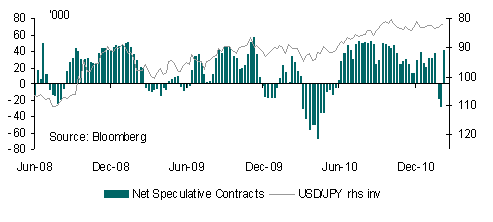
Although the JPY has not been particularly sensitive to risk over recent months shorter-term correlations shows that its sensitivity has increased. Given that Middle-East tensions do not appear to be easing the JPY will remain well supported. Indeed, speculative positioning data reveals the highest JPY net long position since November 2010. As risk appetite improves JPY positioning will be pared back but this is unlikely to be imminent, with USD/JPY set to remain close to support around 81.10.

US Dollar On A Slippery Path

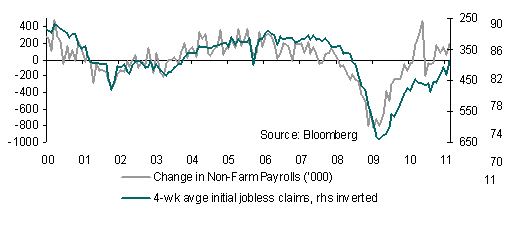
The USD has been a on a slippery path over recent weeks, weighed down by adverse interest rate differentials despite improving US economic data. Adding to the run of encouraging US data releases the February jobs report revealed a 192k increase in jobs and a drop in the unemployment rate to 8.9%.

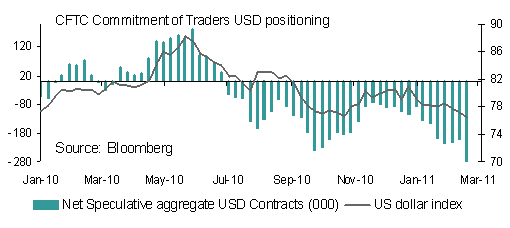
In particular the Fed’s dovish tone highlights that whilst asset purchases under QE2 will stop at the end of June, the failure to hit the Fed’s dual mandate of maximum employment and stable prices, implies that the Fed Funds rate will not be hiked for a long while yet. This dovish slant has undermined the USD to the extent that USD speculative positioning as reflected in the CFTC IMM data dropped to all time low in the week to 1 March. There is certainly plenty of scope for short-covering but the market is no mood to buy the USD yet.

This week’s releases will provide less direction, with a slight widening in the trade deficit likely in January, a healthy gain in February retail sales and a small drop in the preliminary reading of March Michigan sentiment.

In contrast, even the generally hawkish market expectations for the European Central Bank (ECB) proved too timid at last week’s Council meeting as Trichet & Co. strongly implied via “strong vigilance” that the refi rate would be hiked by 25bps in April. EUR/USD lurched higher after the ECB bombshell breaking the psychologically important 1.4000 barrier but appeared to lose some momentum at this level. Should EUR/USD sustain a break of 1.4000, the next level of resistance is at 1.4281 (November high), with support seen around 1.3747.

The lack of major eurozone data releases this week, with only industrial production data in Germany and France of interest, suggests that EUR may consolidate over the short-term with the main interest on the informal Heads of State meeting at the end of the week to determine whether credible plans can be drawn up to restore confidence in the periphery.

This week it is the turn of the Bank of England (BoE) to decide on monetary policy but unlike the ECB we do not expect any surprises with an unchanged decision likely. Further clues will only be available in the Monetary Policy Committee (MPC) minutes on 23 March. However, markets may be nervous given that it could feasibly only take another two voters aside from the three hawkish dissenters last month, to result in a policy rate hike. Notably one possible hawkish dissenter, Charles Bean did not sound overly keen on higher rates in a speech last week, a factor that weighed on GBP alongside some weaker service sector Purchasing Managers Index (PMI) data.

UK manufacturing data will be the main data highlight of the calendar but this will be overshadowed by the BoE meeting. GBP/USD could continue to lag the EUR and given a generally bullish EUR backdrop, our preferred method of playing GBP downside remains via a long EUR/GBP position.

ECB In Focus

The highlight today is the European Central Bank (ECB) council meeting. Markets have priced in a hawkish stance from the ECB; Euro rates have edged higher whilst EUR/USD has strengthened. The ECB is likely to highlight worries about price developments today paving way for a hike in H2 2011. Watch for any shift in the balance of risks statement in the press conference and upward revisions to inflation and growth forecasts. In terms of liquidity operations the full allotment procedures at the Main Refinancing Operations (MRO) are likely to be extended for another three months.

EUR risks are asymmetric and whilst the currency remains a buy on dips (with technical indicators pointing to a move to 1.4000) the bigger risk is if the ECB does not live up to the hawkish market expectations which could hit EUR given long positioning overhang. Other than this, risk aversion remains elevated according to my barometer, supporting JPY and CHF. US numbers remain upbeat as seen in the ADP private sector jobs report yesterday, which will likely lead to an upward revision to non-farm payrolls forecasts in February (currency consensus 195k). However, the USD impact of positive data is limited against the background of a relatively dovish Fed stance.

Risk aversion spikes

Increased risk aversion overnight in the wake of escalating Middle East tensions gave the USD some support but overall the USD index is gradually drifting towards its early November low around 75.631. The antithesis of USD weakness is strength in most other major currencies.

The USD is being undermined by relatively dovish expectations for US interest rates relative to elsewhere and last night’s semi annual testimony by Fed Chairman Bernanke to the US Senate did nothing to alter this tone, with Bernanke maintaining the emphasis on subdued inflation and elevated unemployment.

The USD index itself has a high (0.82) 3-month correlation with US interest rate futures and over recent weeks as the implied yield has dropped, the USD has lost ground. The prospects of higher US bond yields may eventually provide the USD with support, especially given the prospect of substantial short-covering but in the near term the USD is likely to remain under pressure.

The upbeat run of US data highlights another source of USD support over the medium term, given the likely outperformance of the US economy over coming months. Yesterday’s ISM manufacturing survey and vehicle sales data lend support to this view. Moreover, the rise in employment component of the ISM supports the view of at least a 195k increase in February payrolls.

The Fed’s Beige Book tonight and February ADP jobs report will not alter the USD’s trajectory. The Beige Book is unlikely to reveal anything to worry the Fed in terms of inflation risks although will probably reveal further signs of improved activity. The ADP report will give important clues for Friday’s February non-farm payrolls data although it’s worth noting that last month’s report was way off the mark. In any case neither release is likely to prevent a further drop in the USD.

EUR is a clear beneficiary of expectations of tighter monetary policy by the ECB and the widening interest rate (futures implied yield) differential between the US and eurozone has given the EUR plenty of support recently as reflected in the high correlation with EUR/USD. Further support to the hawkish market stance was given by the upward revision to eurozone 2011 growth and inflation forecasts by the EU. The fact that eurozone inflation increased to 2.4% YoY in February also reinforced expectations of ECB tightening sooner than later.

The ECB press conference following the council meeting tomorrow will likely shape such expectations further, the EUR has already priced in a hawkish ECB stance, limiting the prospects of further appreciation. Notably EUR/USD has failed to break resistance at its year high around 1.3861, which will prove to be a formidable cap in the short-term.

In contrast, the RBA has poured cold water over expectations of further policy rate hikes in Australia. The policy statement following yesterday’s decision to keep the cash rate on hold pointed to an extended pause in the months ahead. Despite this and perhaps because markets have already pared back Australian interest rate expectations AUD rebounded quite smartly from its post meeting low and despite some overnight weakness due to increased risk aversion it will soon verge on a break of resistance at 1.0257.

AUD/NZD has continued to charge ahead having hit a multi-year high above 1.3600. NZD underperformance has been exacerbated by the impact of the recent earthquake, with growth expectations for this year having been sharply revised lower and growing speculation of an interest rate cut. Indeed, such speculation was given further fuel by comments by NZ Prime Minister Key who noted he would welcome a policy rate cut. Nonetheless, my quantitative AUD/NZD model suggests that the cross looks over-extended at current levels, whilst relative speculative positioning supports this view.