Risk Aversion to remain elevated

It remains a tumultuous time for markets, gripped by a cacophony of concerns ranging from the lack of resolution to the Eurozone debt crisis to the failure to reach agreement on raising the US debt ceiling and associated deficit reduction plans. Mingled among these is the growing evidence that economic growth is turning out weaker than expected. Meanwhile Europe’s crisis appears to be shifting from bad to worse, as reflected in a shift in attention towards the hitherto untouched Italy although Italian concerns have eased lately.

The release of the EU bank stress test results at the end of last week have not helped, with plenty of criticism about their severity and rigour following the failure of only 8 banks out of the 90 tested. Expectations centred on several more banks failing, with much more capital required than the EUR 2.5 billion shortfall revealed in the tests. Answering to this criticism officials note that there has already been a significant amount of capital raised over recent months by banks, but this will be insufficient to stem the growing disbelief over the results.

Attention is still very much focussed on Greece and reaching agreement on a second bailout for the country, with further discussions at the special EU summit on July 21. The contentious issue remains the extent of private sector participation in any debt restructuring. The decision to enhance the flexibility of the EFSF bailout fund to embark on debt buybacks has not helped. Consequently contagion risks to other countries in the Eurozone periphery are at a heightened state. Despite all of this the EUR has shown a degree of resilience, having failed to sustain its recent drop below 1.40 versus USD.

One explanation for the EUR’s ability to avoid a steeper decline is that the situation on the other side of the pond does not look much better. Hints of QE3 in the US and the impasse between Republicans and Democrats on budget deficit cutting measures tied to any increase in the debt ceiling are limiting the USD’s ability to benefit from Europe’s woes. Moreover, more weak data including a drop in the Empire manufacturing survey and a drop in the Michigan consumer sentiment index to a two-year low, have added to the worries about US recovery prospects.

Against this background risk aversion will remain elevated, supporting the likes of the CHF and JPY while the EUR and USD will continue to fight it out for the winner of the ugliest currency contest. Assuming that a deal will eventually be cobbled together to raise the US debt ceiling (albeit with less ambitious deficit cutting measures than initially hoped for) and that the Fed does not embark on QE3, the EUR will emerge as the most ugly currency, but there will be plenty of volatility in the meantime.

Data and events this week include more US Q2 earnings, June housing starts and existing home sales. While housing data are set to increase, the overall shape of the housing market remains very weak. In Europe, July business and investor surveys will be in focus, with a sharp fall in the German ZEW investor confidence survey likely and a further softening in July purchasing managers indices across the eurozone. The German IFO business confidence survey is also likely to decline in July but will still point to healthy growth in the country. In the UK Bank of England MPC minutes will confirm no bias for policy rate changes with a 7-2 vote likely, while June retail sales are likely to bounce back.
Euro crisis intensifies

The blowout in eurozone non-core debt has intensified and unlike in past months the EUR has been a clear casualty. The lack of a concrete agreement over a solution given divergent views of EU officials, the European Central Bank (ECB) and private sector participants threatens a further ratcheting higher of pressure on markets over coming weeks.

The only real progress overnight as revealed in the Eurogroup statement appeared to be in the renewing the option of buying back Greek debt via the eurozone bailout fund, extending maturities and lowering interest rates on loans. This will be insufficient to stem the pressure on the EUR, with the currency verging on a sharp drop below 1.40.

The USD continues to take advantage of the EUR’s woes and has actually staged a break above its 100-day moving average yesterday after several attempts previously. This sends a bullish signal and the USD is set to remain supported given that there is little in sight of a resolution to the problems festering in the eurozone.

Today’s release of the June 22 Fed FOMC minutes will give some clues to Fed Chairman Bernanke’s testimony to the House of Representatives tomorrow, but as long as the minutes do not indicate a greater willingness to embark on more asset purchases, the USD is set to remain resilient.

GBP has also benefitted from the EUR’s weakness, and unlike the EUR has only drifted rather than dived versus the USD. However, the UK economy is not without its own problems as revealed in a further drop in retail sales overnight, albeit less negative than feared, with the British Retail Consortium (BRC) like for like sales falling 0.6% in June.

A likely increase in June CPI inflation in data today to a 4.8% annual rate will once again highlight the dichotomy between weak growth and high inflation. In turn, such data will only provoke further divisions within the Bank of England MPC. While further gains against the beleaguered EUR are likely, with a test of EUR/GBP 0.8721 on the cards in the short term, GBP will struggle to sustain any gain above 1.6000 versus USD.

Both AUD and NZD are vulnerable against the background of rising risk aversion and a firmer USD in general. However, both currencies are not particularly sensitive to risk aversion. Interestingly the major currency most sensitive to higher risk aversion in the past 3-months is the CAD and in this respect it may be worth considering playing relative CAD underperformance versus other currencies.

As for the AUD it is more sensitive to general USD strength, suggesting that it will be restrained over coming sessions too and given that market positioning is still very long AUD, there is scope for further downside pressure to around 1.0520 versus USD.

Risk on, risk off

The USD has lost some upward momentum as risk appetite improved but FX markets remain skittish as sentiment gyrates between ‘risk on’ and ‘risk off’. The fact that US Q1 GDP was left unrevised whilst jobless claims surprisingly increased together with ongoing Greece concerns suggests that a risk off mood may filter into markets despite positive US earnings. Although the USD has not particularly benefitted from any rise in risk aversion lately, worries about the next IMF tranche being withheld from Greece will likely play more positively for the USD.

Nonetheless, lurking in the background and helping to keep the USD restrained is the Fed’s ongoing asset purchases as QE2 remains in place until the end of June. Moreover US data disappointments points to risks that the Fed will only slowly embark on its exit strategy. Additionally any agreement towards extending the US debt ceiling appears to be far off, and threatens to go down to the wire all the way to August 2. US debt markets and the USD appear to be downplaying this issue at present but it remains a clear threat to US markets.

Continuing to limit any upside in the EUR is the fact that officials and markets continue to gyrate on whether Greece will or will not restructure its debt. Apparent divisions between the view of some officials and the ECB are adding to the confusion whilst fresh worries about the IMF withholding funding for Greece will likely keep EUR/USD capped.

Peripheral worries as well as growth concerns are clearly weighing on confidence and a broad based decline in economic and business confidence in various eurozone May measures is expected to be revealed in data today . Weaker data taken together with ongoing concerns about the eurozone periphery will likely see the EUR struggle, with the currency set to settle into a range versus USD over the short-term, with technical support around 1.3968 and resistance at 1.4210.

The loss of USD momentum has also been exhibited in USD/JPY which has turned lower following its recent upward move hitting a low around 81.09. The big news was the fact that April nationwide core CPI recorded its first YoY increase since December 2008. At the margin may reduce the pressure on the Bank of Japan (BoJ) to enact more aggressive policy measures, which in turn is positive for the JPY. A big factor contributing to keeping the JPY supported over recent weeks is the ongoing inflow of foreign capital into Japan’s bond and equity markets, with Japan recording six straight weeks of net inflows.

USD/JPY is one currency pair where the correlation with US – Japan 2-year bond yield differentials is holding up well over the past 3-months. The fact that the yield differential has dropped to its lowest level since November 2010 at around 30bps reveals the declining US yield advantage, and plays for a lower USD/JPY. Against this background the JPY is likely to remain supported in the short-term, but will find it tough to break through technical support around USD/JPY 80.15.

Asia Helps The Euro Again

Following the pressure on markets over recent days there is some relief filtering through markets today although sentiment remains fickle. Weaker than expected US April durable goods orders data failed to dent confidence with equity markets ending in positive territory overnight even though the data added to a plethora of global data disappointments over recent weeks.

Once again the EUR has been saved by Asian demand, this time not directly for the EUR itself but by reports that China and other Asian investors will purchases EFSF bailout bonds, with China apparently reported to be “clearly interested” in the mid June sales of Portuguese bailout bonds, with Asian investors representing a “strong proportion” of the buyers.

Despite the reassuring news about Asian official interest in eurozone debt, problems in the periphery remain a major drag on the EUR. Developments at the two day G8 heads of governments meeting in Deauville and various speeches by officials from the European Financial Stability Facility (EFSF), European Union (EU) and European Central Bank (ECB) regarding Greece’s travails will be particularly important for EUR direction.

The various speakers are likely to maintain the pressure on peripheral countries to continue their austerity programmes in order to gain external support. Nonetheless, there still appears to be conflicting comments about what Greece will do with regard to its debt burden. Whilst some EU officials have espoused the benefits of extending Greek debt maturities on a voluntary basis, the ECB has steadfastly stood against any form of restructuring.

Other than the events above, in the US the second reading of Q1 GDP will be released. The consensus looks for an upward revision to a 2.1% annual rate from an initial estimate of 1.8% due mainly to an upward revision to inventories. US weekly jobless claims will also be of interest especially as the recent increase in the 4-week average for jobless claims has provoked renewed fears about the jobs market recovery.

US Dollar On The Rise

There are plenty of US releases on tap this week but perhaps the most important for the USD will be the minutes of the April 26-27 Fed FOMC meeting. Taken together with speeches by Fed officials including Bernanke, FX markets will attempt to gauge clues to Fed policy post the end of QE2. The Fed’s stance at this point will be the major determinant of whether the USD can sustain its rally over the medium term. The lack of back up in US bond yields suggests that USD momentum could slow, with markets likely to move into wide ranges over coming weeks.

It is worth considering which currencies will suffer more in the event that the USD extends its gains. The correlation between the USD index and EUR/USD is extremely strong (even accounting for the fact that the EUR is a large part of the USD index) suggesting that the USDs gains are largely a result of the EUR’s woes. Aside from the EUR, GBP, AUD and CAD are the most sensitive major currencies to USD strength whilst many emerging market currencies including ZAR, TRY, SGD, KRW, THB, IDR, BRL and MXN, are all highly susceptible to the impact of a stronger USD.

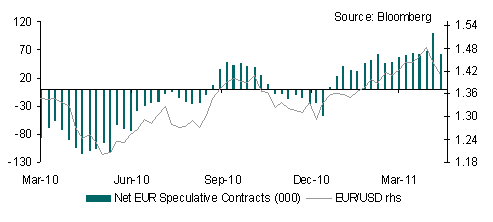
Robust Q1 GDP growth readings in both Germany and France helped to spur gains in the EUR but this proved short-lived. Sentiment for the currency has soured and as reflected in the CFTC IMM data long positions are being scaled back. Nonetheless, there is still plenty of scope for more EUR selling given ongoing worries about the eurozone periphery, which are finally taking their toll on the EUR. A break below EUR/USD 1.4021 would open the door for a test of 1.3980.

The eurogroup and ecofin meetings will be of interest to markets this week but any additional support for Greece is unlikely to be announced at this time. However, likely approval of Portugal’s bailout may alleviate some pressure on the EUR but any positive impetus will be limited. Even on the data front, markets will not be impressed with the German ZEW index of investor confidence likely to register a further decline in May.

Japanese officials have been shying away from further FX intervention by blaming the drop in USD/JPY over recent weeks on general USD weakness despite the move towards 80. However, this view is not really backed up by correlation analysis which shows that there is only a very low sensitivity of USD/JPY to general USD moves over recent months. One explanation for the strength of the JPY is strong flows of portfolio capital into Japan, with both bond and equity markets registering net inflows over the past four straight weeks.

This is not the only explanation, however. One of the main JPY drivers has been a narrowing in yield differentials. This is unlikely to persist with yield differentials set to widen sharply over coming months resulting in a sharply higher USD/JPY. As usual data releases are unlikely to have a big impact on the JPY this week but if anything, a further decline in consumer confidence, and a negative reading for Q1 GDP, will maintain the pressure for a weaker JPY and more aggressive Bank of Japan (BoJ) action although the BoJ is unlikely to shift policy this week.